Article

Why Do Cats Destroy Toys (And What It Actually Means)

Your cat just eviscerated a $15 toy in seven minutes. The thing is completely destroyed: seams…

Published April 4, 2026

Your cat just eviscerated a $15 toy in seven minutes. The thing is completely destroyed: seams ripped open, stuffing everywhere, the squeaker separated from its housing. Your cat looks satisfied and a little proud of herself.

\n

You feel frustrated and maybe confused. Is your cat broken? Too aggressive? Is she bored, angry, or just demonstrating an expensive hobby?

\n

The real answer is simpler and, honestly, a bit wonderful: your cat just hunted something, and hunting is one of her most fundamental drives.

\n

Destroying toys isn’t a behavioral problem. It’s evidence of a successful predatory sequence. Understanding what’s actually happening when your cat destroys a toy changes how you think about the behavior. And how you respond to it.

\n

Destroying Toys Is Normal. It’s Hunting Behavior

\n

Cats are hunters. Not metaphorically. Their entire neurology, skeleton, and muscle system evolved to find prey, stalk it, catch it, and kill it. This predatory sequence has five phases: stalk, chase, pounce, grab, and kill.

\n

When your cat destroys a toy, she’s executing the full sequence.

\n

The stalking happens silently, usually with you not paying much attention. Your cat crouches, eyes locked on the toy, back legs wound tight. This is the calculation phase. She’s reading movement, assessing distance, timing the approach.

\n

Then comes the chase. Your cat launches forward, pounces on the toy, and pins it with her front paws. If the toy is something like a kick toy or a stuffed mouse, she immediately moves to the grab phase. Her mouth engages and her teeth lock. This is where seams separate and fabric tears.

\n

Then the kill sequence: bunny kicks. Your cat flips onto her side or back and rakes the toy with her back legs, the same way a wild cat would disembowel prey. This is the stage where stuffing flies. Most toys don’t survive this phase.

\n

Finally, the kill bite: your cat administers a definitive bite to “finish” the kill, then releases.

\n

This entire sequence (from stalk to kill) is not aggression. It’s predatory play. And it’s normal. It’s healthy. Your cat isn’t being mean to the toy; she’s being a cat.

\n

The reason we interpret it as “destruction” is because toys aren’t designed to survive it. Most cat toys are built to look appealing to owners at point-of-purchase. They’re not built to survive a determined hunter completing her predatory sequence.

\n

What Exactly Happens When Cats Kill A Toy

\n

The physics of destruction are worth understanding because they explain why some toys fail and others survive.

\n

The bunny kick is the first real stressor on a toy’s construction. Your cat uses her back legs to rake and tear, applying rotational force and sharp claw pressure. This works well on small prey in nature. On a toy, it works well on seams. Cheap seams separate immediately.

\n

The bite-and-shake phase applies torsional force. Your cat grabs the toy and shakes it violently side to side, the way a wild cat would shake a bird or small mammal to break its neck. A toy with reinforced seams might survive the bunny kick, but the shake phase often finishes the job.

\n

Then there’s the material itself. Most cat toys use thin polyester plush, cheap nylon, or soft plastic. These materials feel good to a human hand and look colorful on a shelf. They feel terrible to a cat trying to hunt. The plush tears easily. The plastic cracks. The stuffing, often made of loose polyester fiberfill, spills out. This stuffing is where danger lurks. Cats can accidentally ingest it, leading to potential intestinal blockage.

\n

Why crinkly, feathery, and squeaky toys get destroyed fastest: these toys signal prey to a cat. Crinkle sounds mimic small animal movement. Feathers trigger predatory instinct directly. Squeakers? That’s the sound of a small animal in distress. Your cat doesn’t just want to hunt the toy; these cues tell her the toy is definitely prey. She hunts harder and more effectively.

\n

The material quality makes the difference between a toy that survives one session and a toy that survives months of regular play.

\n

Why Cheap Toys Fail In The First Session

\n

This is worth understanding because it’s not a mystery. Cheap toys fail because they’re engineered to fail.

\n

Consumer toy design prioritizes what matters to the buyer (the owner) over what matters to the user (the cat). A toy needs to look appealing on a shelf, feel soft in your hand, and cost $5-15. Those constraints lead to thin materials, minimal stitching, and glued-on attachments.

\n

When a cat hunts a toy designed that way, here’s what happens in sequence:

\n

Seam failure: Cheap seams use minimal thread and are glued instead of stitched. The bunny kick or first shake tears them apart. This is the end for most toys.

\n

Fill material hazard: Loose polyester fiberfill spills out. Cats can eat this. It doesn’t digest and can cause blockage.

\n

Wire and feather attachment failure: Feathers and wires are usually glued on, not sewn. They separate immediately and become choking hazards or foreign objects in your cat’s mouth.

\n

Electronic failure: Toys with motors and batteries fail because the seams protecting the electronics give way. Battery acid or electronic components become a toxicity risk.

\n

Plastic component failure: Hard plastic eyes, bells, and other glued-on parts separate and become choking hazards.

\n

A cat doesn’t need much to destroy these toys. She needs one successful bunny kick, and the seams open. One shake, and the fill spills. One bite to an attachment point, and something dangerous gets loose.

\n

This is why many cat owners see destroyed toys as evidence that their cat is destructive or aggressive. The toy failed so fast and so completely that it seems like the cat was unusually violent. In reality, the toy was never built for what cats actually do.

\n

Free Checklist

Free checklist: 30 ways to enrich your indoor cat's life.

Practical, printable, no fluff. Get the complete Indoor Cat Enrichment Checklist delivered to your inbox.

How To Pick Toys That Actually Survive

\n

The solution isn’t to avoid toys that get destroyed. It’s to buy toys that are engineered to survive destruction.

\n

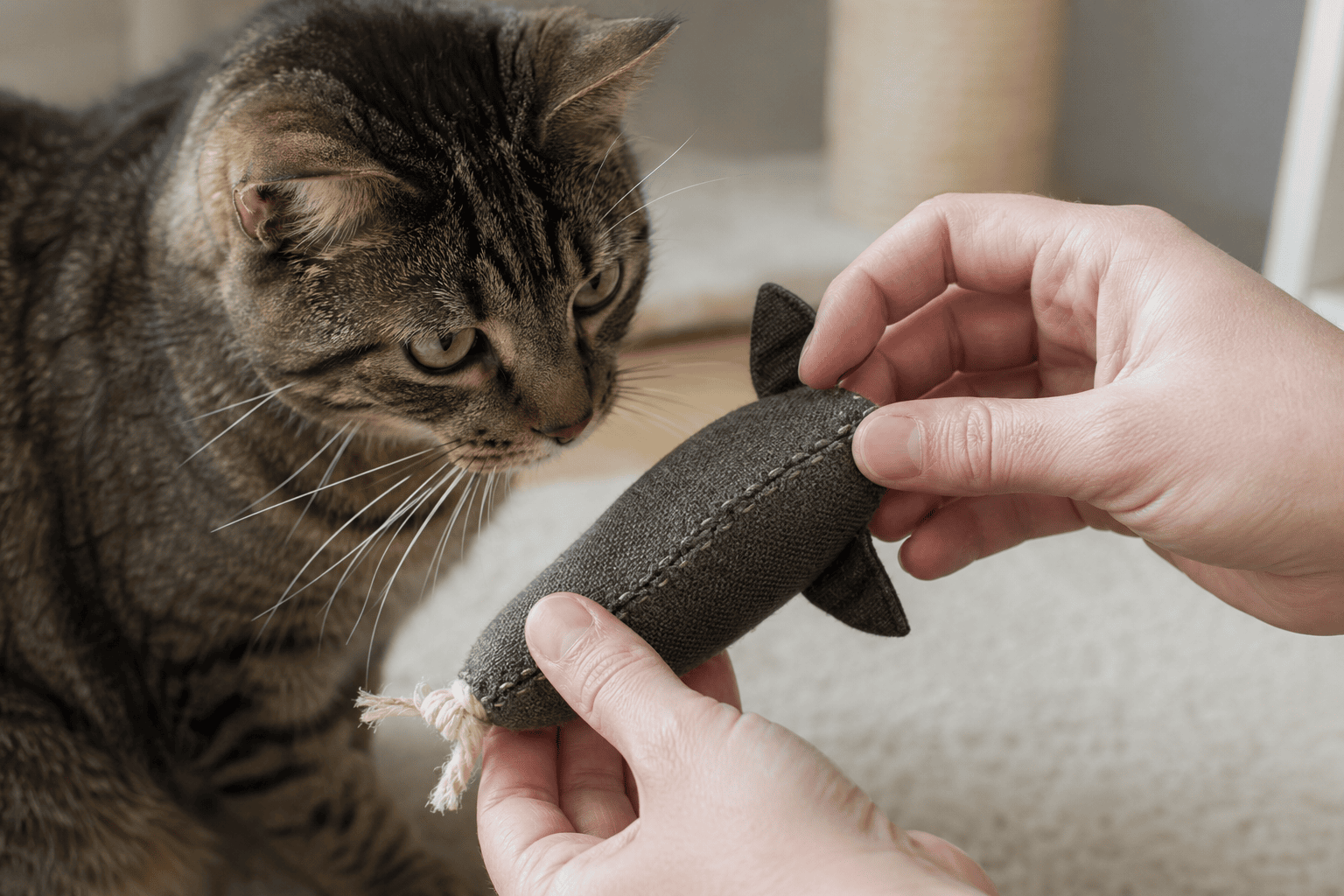
Reinforced seams or no-seam construction: Look for toys that are stitched, not glued, with multiple passes of thread. The best toys have no external seams at all. They’re injection-molded or seamlessly constructed.

\n

Dense fill or no fill: Solid rubber or TPR (thermoplastic rubber) toys survive bunny kicks and bites better than plush toys. If you want a plush toy, look for ones with minimal, tightly-secured fill or dense material that won’t shed.

\n

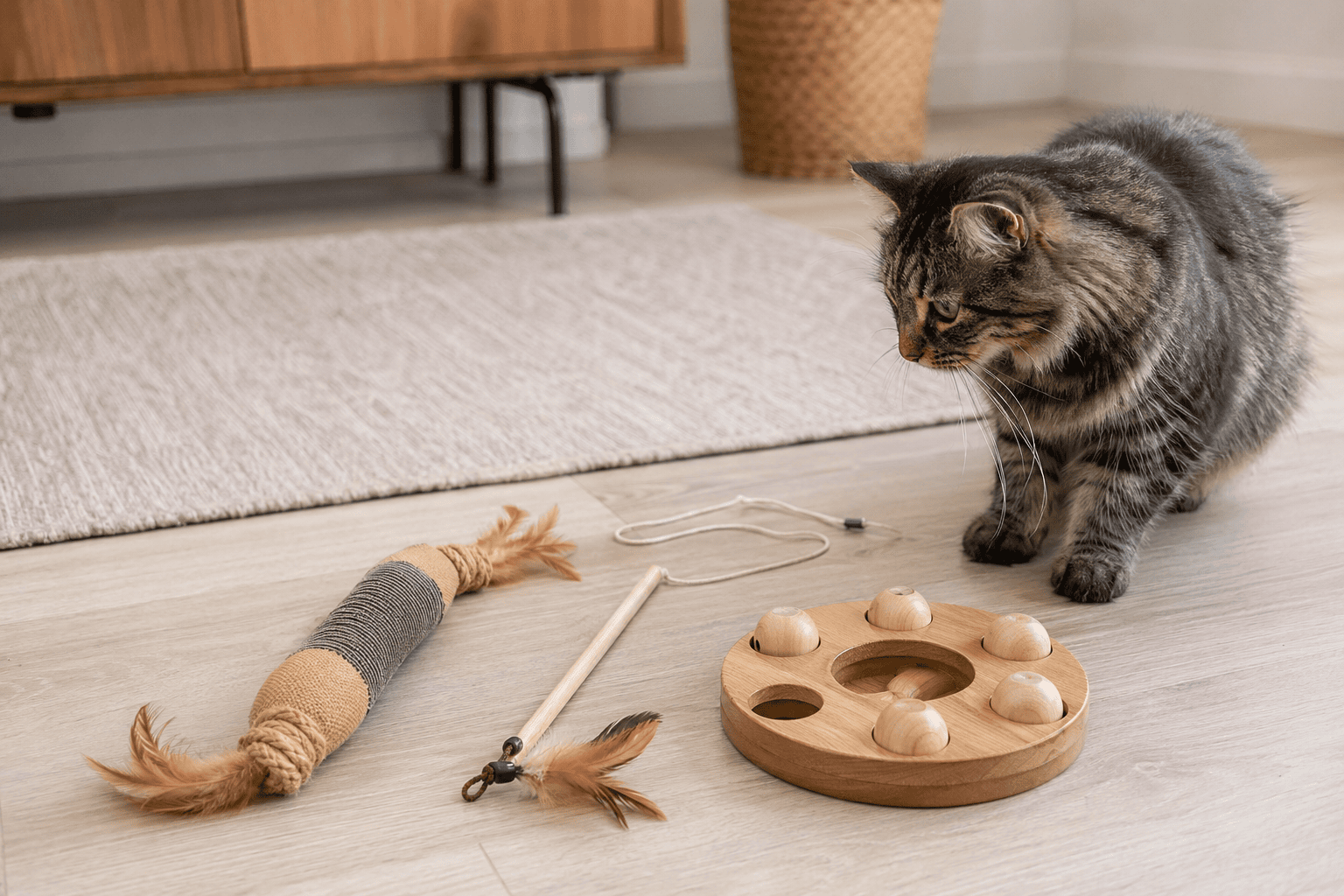
Durable attachment methods: Any attachments (feathers, strings, bells) should be sewn or mechanically attached, not glued. Better yet, toys where attachments are integral to the structure, not add-ons.

\n

Appropriate size and weight: A heavy kick toy resists the flinging force of bunny kicks. A toy that’s too light gets thrown across the room, which frustrates cats and makes them less likely to re-engage.

\n

Material choices: Braided rope, canvas, thick nylon, natural rubber, and heavy TPR all hold up. Cheap polyester, thin plush, and flimsy plastic don’t.

\n

When you’re shopping, look at the toy and ask: “If my cat does the full predatory sequence on this, what fails first?” If the answer is “the seams” or “the fill,” keep looking.

\n

Does Destroying Toys Mean Your Cat Is Bored Or Aggressive?

\n

This is the question that usually brings cat owners to search this article in the first place.

\n

Short answer: no. Destruction isn’t a sign of aggression. Cats don’t destroy toys out of anger or frustration.

\n

But boredom can amplify destructive play.

\n

An enriched cat plays with toys, completes the predatory sequence, and then moves on. She might return to the same toy later or move to a different enrichment activity. The toy gets destroyed slowly, across many play sessions, spread over time.

\n

A bored cat fixates on toys. She hunts the same toy repeatedly in a single session, attacking it harder and more aggressively. She gets frustrated that the toy doesn’t “fight back” (doesn’t provide dynamic feedback). She destroys it more completely and more quickly.

\n

So the distinction: any cat will destroy toys eventually. A properly enriched cat will do this slowly and over many sessions. A under-enriched cat will destroy them fast and completely.

\n

Signs your cat needs more enrichment: excessive destruction in single sessions, destruction of inappropriate objects (furniture, cables, your hands), repetitive, frantic play sessions, or destruction directed at a single toy obsessively.

\n

Signs your cat is just being a normal predator: varied play across different toys, calm destruction over days or weeks, play sessions that vary in intensity and duration, and the ability to be redirected to other activities.

\n

True aggression (biting hard, growling, attacking unprompted) is rare in cats and usually indicates a behavioral issue worth addressing with a veterinary behaviorist. Destruction is normal predatory behavior. Unprompted aggression is a different issue.

\n

FAQ: What Every Destructive-Toy Owner Should Know

\n

Is it dangerous if my cat eats bits of destroyed toys?

\n

Depends on what gets eaten. Small amounts of fabric or filling usually pass through without issue. But swallowed strings, wires, batteries, or large pieces of fill can cause blockage. If your cat regularly swallows toy pieces, switch to toys that are truly durable and don’t shed. Watch for vomiting, appetite loss, or lethargy. These are signs of blockage and warrant a vet visit.

\n

Should I let my cat destroy toys?

\n

Yes, but smartly. Destruction is a healthy outlet for predatory instinct. Let your cat destroy toys that are built to survive it. Supervise play if you’re unsure about a new toy. And rotate toys so she’s not fixated on destroying a single toy repeatedly.

\n

How do I redirect cats that destroy furniture instead of toys?

\n

Furniture destruction usually means she’s lacking an appropriate outlet. Provide high-quality scratch posts and bunny-kick toys, and more interactive play sessions. The goal is to make toys more rewarding than furniture. Also, make furniture less rewarding by using deterrent sprays or furniture covers temporarily. And identify what type of destruction she’s seeking (scratching, bunny-kicking, etc.) and match the toy to that need.

\n

Free Enrichment PDF

Want the full enrichment checklist?

30 things you can do this week to make your indoor cat's life better. Free PDF, straight to your inbox.

The Real Message In Destruction

\n

Your cat is doing exactly what cats do. Cats hunt. They destroy what they hunt. This is how their predatory system works.

\n

Most toys are terrible at being hunted. They’re built for you, not for her.

\n

When you switch to toys built for actual predatory play (toys with reinforced seams, dense materials, and durable construction) something shifts. Your cat still “destroys” them, but it happens slowly. She returns to them. She’s satisfied. And you’re not feeling frustrated or broke.

\n

That’s the payoff. Understanding what’s really happening makes the behavior satisfying to watch. Your cat is doing what she was born to do, safely, on toys built to handle it.

\n

Building toys for cats that actually hunt. We’re creating durability-first cat toys designed for this reality. If you’re tired of destroying wasted money, join our waitlist for toys engineered to survive determined hunters.

Author

Source: Why Do Cats Destroy Toys (And What It Actually Means)