Think letting your kitten eat whatever they want will make them healthier? Not really. It sounds sweet, but that free-for-all can lead to under- or over-feeding pretty fast.
Rule of thumb: aim for 100-300 g per day (grams, g, a small unit of weight, about 1 paperclip per gram). That’s roughly 1 to 4 of those 71 g cans (71 g, single-can size; about 2.5 oz). Newborn kittens need three to four tiny meals a day; by six months most do fine on two meals.
Your kitten’s whiskers will twitch at a full bowl, happy, satisfied, and ready to pounce. Ever watch them bury their face in the food? Cute, right.
Practical steps: weigh portions on a kitchen scale, track kcal (kcal, kilocalories, the Calories listed on pet food), check body condition once a week (feel the ribs, look for a waist), and tweak amounts with your vet’s advice. Think of kcal like fuel for playtime, too little and they’re tired, too much and they pack on the pounds.
Worth every paw-print.
How Much Wet Food Should a Kitten Eat
Quick start: if you want a simple rule, feed about 100-300 g per day (grams), which is roughly 1-4 of the 71 g (2.5 oz, ounces) sample cans. Split that into 3-4 small meals a day for very young kittens, and move toward two meals a day by about six months when growth slows and appetites settle. This is a starting point, not gospel, so watch your kitten and tweak as you go.
Pick the row in the chart that best matches your kitten's age and weight. Then choose a daily kcal target (kcal means kilocalories, the Calories listed on pet food) toward the low or high end based on how active your kitten is and how they look – lean or chubby. The wet grams/day and cans/day columns assume about 90 kcal per 71 g can. If your brand lists a different kcal or can size, follow the conversion how-to and use a kitchen scale (digital food scale) to measure portions precisely. Start with the suggested daily grams, divide into the meal count shown for that age group, weigh each serving, and check your kitten's weight and body condition weekly. Talk with your veterinarian to personalize portions for health, activity level, and breed. See the Adjusting section for tips if your kitten needs to gain or lose a little.
| Age (weeks/mo) | Approx weight (lbs/kg) | Daily kcal target (range) | Wet grams/day (based on 90 kcal per 71 g) | Approx cans/day (2.5 oz/71 g cans) |
|---|---|---|---|---|
| 4 weeks | 1 lb / 0.45 kg | 150-200 kcal | 118-158 g | 1.7-2.2 cans |
| 6 weeks | 1.5 lb / 0.7 kg | 180-260 kcal | 142-205 g | 2.0-2.9 cans |
| 8 weeks | 2 lb / 0.9 kg | 220-320 kcal | 174-252 g | 2.4-3.6 cans |
| 3 months | 3 lb / 1.4 kg | 260-380 kcal | 205-300 g | 2.9-4.2 cans |
| 4 months | 4 lb / 1.8 kg | 300-420 kcal | 237-331 g | 3.3-4.7 cans |
| 6 months | 6 lb / 2.7 kg | 320-420 kcal | 252-331 g | 3.6-4.7 cans |
| 12 months | 8 lb / 3.6 kg | 240-320 kcal | 189-252 g | 2.7-3.6 cans |
| See conversion how-to for brand-specific math and kitchen-scale method. | ||||
How to convert wet food calories and cans into kitten portions
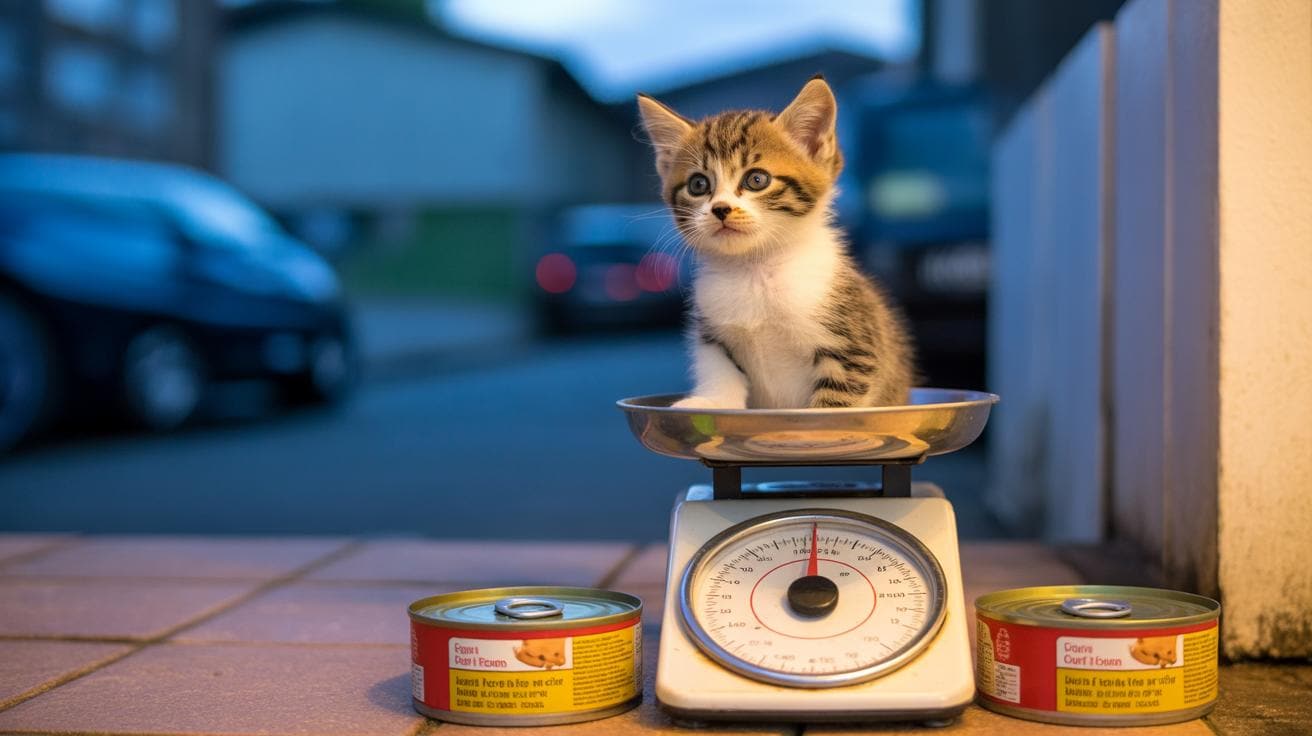
Small label differences in kcal and can sizes can change your kitten's meal plan a lot, so do this math once and you can feed precise, comfy portions every day. kcal (kilocalories, the energy in food) and grams (g, a metric weight unit) are the two things you need to compare. Think of it like translating food labels into what your kitten actually eats.
- Find the kcal per serving on the label and the serving weight in grams.
- Calculate kcal per gram: kcal ÷ grams = kcal/g (example: 90 kcal ÷ 71 g = 1.27 kcal/g).
- Pick a target kcal/day from a portions table that fits your kitten’s age and activity level.
- Divide the target kcal by kcal/g to get grams per day (example: 200 kcal ÷ 1.27 kcal/g ≈ 158 g/day).
- Convert grams per day into cans or pouches using the product’s serving weight (158 g ÷ 71 g ≈ 2.2 cans).
- Weigh and record actual portions for 3 to 7 days with a digital food scale (digital food scale – a small kitchen scale that shows grams). Tare the scale with the empty bowl, add the serving, note the grams, and put measured portions in labeled containers in the fridge.
| Label kcal per serving | Serving weight (g) | kcal per g | Grams needed for 200 kcal/day | Cans/servings for 200 kcal/day |
|---|---|---|---|---|
| 90 kcal | 71 g | 1.27 kcal/g | 158 g | 2.2 cans |
| 120 kcal | 85 g | 1.41 kcal/g | 142 g | 1.7 cans |
| 150 kcal | 100 g | 1.50 kcal/g | 133 g | 1.3 cans |
| 100 kcal | 75 g | 1.33 kcal/g | 150 g | 2.0 cans |
| 70 kcal | 50 g | 1.40 kcal/g | 143 g | 2.9 pouches |
Handle multipack wet pouches the same way: check each pouch’s kcal and grams, then portion into daily jars or reusable trays and label with the date. For cans, move leftovers into airtight containers and use within the fridge window the label recommends. Weigh servings at each meal the first week so you notice inconsistencies and learn what a proper portion feels like.
If you mix wet and dry food, add up the kcal from each so the whole day hits the target (see Mixing section for ratio guidance). When choosing kitten formulas, pick higher calorie and higher protein options for growing kittens, here's a good reference: wet cat food high in protein.
If anything feels off, sudden weight change, different stool, or a drop in appetite, call your veterinarian so portions can be adjusted for health, breed, or activity. Ever seen your kitten pounce on a bowl like it’s prey? That’s a good sign the portion was just right.
How often should a kitten eat wet food: meal frequency and sample schedules
Kittens do best with regular, small meals so their energy and growth stay steady. Young kittens usually eat three to four times a day until about four months old, then slowly move toward two meals a day by around six months. Timed meals help you spot appetite changes, stop one kitten from gobbling everything, and make it easier to track calories and weight.
If you’re caring for an orphaned or bottle-fed kitten, skip the schedules below and see the Weaning section for round-the-clock guidance and formula volumes (kitten milk replacer, the special kitten formula).
Sample schedule: 4–12 weeks
For kittens raised by their mother, try three to four small meals: morning (7–9 am), midday (11 am–1 pm), late afternoon (3–5 pm), and evening (7–9 pm). Keep portions small and steady so your kitten gets energy between naps and play. Picture tiny whiskers twitching as the bowl hits the floor, adorable and practical.
Portion each meal as part of the daily total. Example: if the daily wet-food amount is 200 g (about 7 oz), give roughly 50 g (1.8 oz) at each of four meals, or about 67 g (2.4 oz) at each of three meals. Weigh the servings a few times so you get a feel for a proper portion.
Sample schedule: 3–6 months
Start shifting from three meals to two across several weeks: keep a morning meal and an evening meal, and add a small midday snack during growth spurts if needed. Try breakfast around 7–9 am and dinner around 6–8 pm. Watch your kitten’s body condition and weight during this change. If they seem ravenous or lose weight, add a small mid-afternoon portion and reweigh after a week to tweak the amounts.
Worth every paw-print.
Mixing wet and dry for kittens: ratios, hydration and calorie tracking
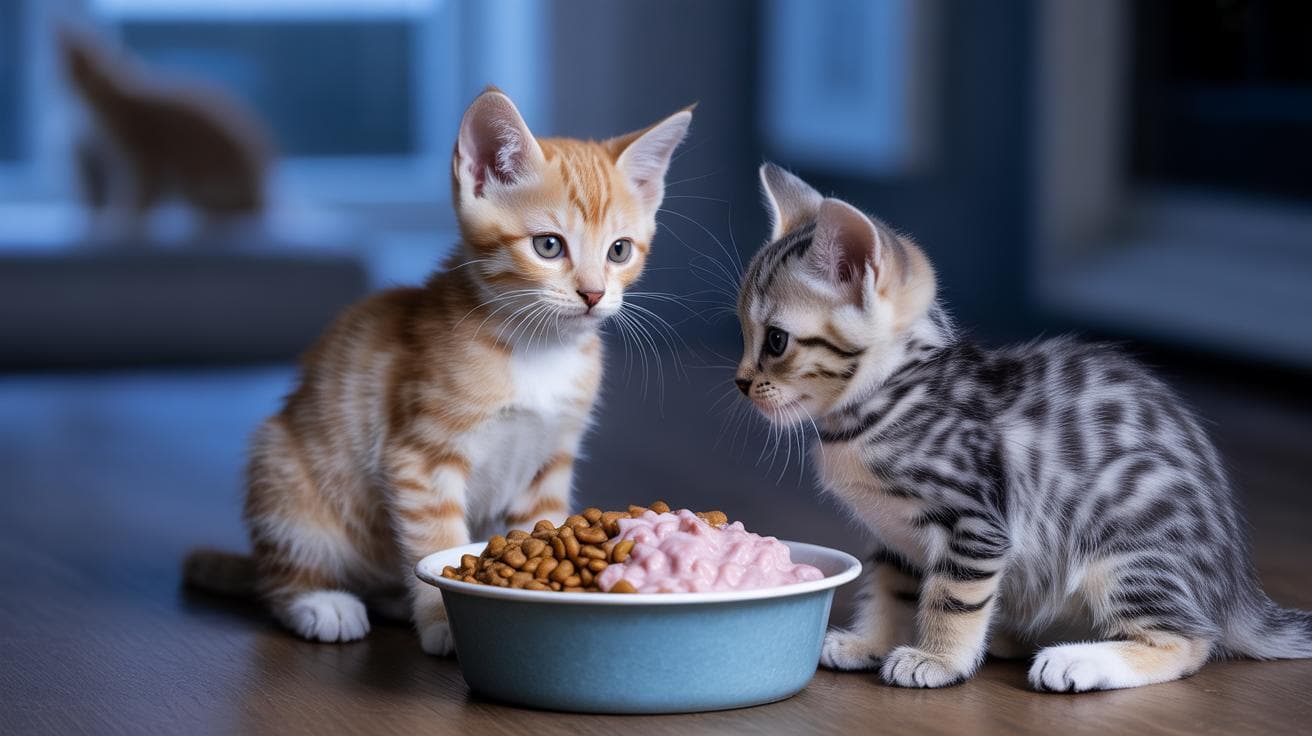
Wet food holds about 75% moisture, while dry kibble has roughly 6 to 10% moisture. Wet meals give kittens extra water, which helps hydration, softens stools, supports kidney health, and can tempt picky eaters. Picture a glossy pate that smells like a tuna parade, tempting, right? That aroma often gets timid tummies eating.
A simple starting plan is to aim for a 2/3 wet to 1/3 dry split by calorie contribution. In plain terms, that means two thirds of the day’s calories come from wet food and one third from kibble. Measure wet and dry separately on a kitchen scale, check each product’s kcal (food calories) per serving on the label, then add the kcal totals so the day matches your kitten’s calorie target.
If you want to convert calories into how much to feed, you’ll do kcal to grams math (kcal, food calories; grams, metric weight). We walk through the kcal → grams → cans steps in the Conversion section. See How to convert wet food calories for step-by-step math.
Practical tips that actually help: weigh servings into labeled containers so you don’t guess mid-day. Use timed meals so one kitten doesn’t gobble up all the kibble between wet feedings. Give each kitten its own bowl or use a microchip feeder (feeds only the cat with the matching chip) if competition is an issue.
Always keep fresh water nearby, even with lots of wet food. And before you mix brands, compare calorie density across wet foods so you don’t accidentally overfeed. For a quick product-choice reference, check wet cat food brands.
Worth every paw-print.