
Think that round bald patch on your cat is just a grooming quirk? Uh, it might be ringworm, dermatophytosis (a contagious skin fungus that lives on hair and nails), and it spreads easily between pets and people.
You may spot a neat circle of missing fur, a pink or red scaly edge, flaky skin, or even brittle claws. Sometimes cats look perfectly fine but still shed spores (tiny fungal cells that spread the infection), so a glossy coat isn’t always proof everything’s safe.
Vets usually treat it with topical meds (creams or medicated shampoos applied to the skin) and sometimes oral antifungal pills. I’ll walk you through the common options vets use and what each one does, so you’ll know what to expect.
You’ll also get simple home steps to protect your family and other pets: isolate the affected cat, wash bedding and soft toys in hot water, vacuum often, and use a vet-approved disinfectant on hard surfaces. Wear gloves when you handle infected areas and wash your hands well , ringworm can pass to people, so don’t skip that.
Read on for the signs, the usual vet treatments, and easy, practical steps to treat your cat and keep your home safe.
ringworm in cats: symptoms and treatment
Ringworm (dermatophytosis) in cats is a contagious fungal infection of the skin, hair, and nails, most often caused by Microsporum canis (a fungus that lives on hair and skin). It spreads easily from cat to cat and can pass to people through direct contact or shared items like bedding, brushes, or towels. Kids and people with weaker immune systems are at higher risk. Ever watched a kitty groom a bald patch? That might be your first clue.
Treatment at a glance: small, local spots often respond to topical antifungals (creams, ointments, or medicated shampoos). Bigger or stubborn infections usually need systemic antifungals (oral medicine your vet prescribes). Courses are commonly 4 to 6 weeks or longer, and vets often keep treatment going until a negative fungal culture (a lab test that grows any remaining fungus) confirms the infection is gone.
Common signs to watch for
- Circular or patchy hair loss , sometimes with the full circle visible.
- Scaly, crusty patches with red edges.
- Broken, stubby, or brittle hair.
- Dandruff or flaky skin.
- Lesions often show up on the head, ears, and face.
- Changes at the nail bed , brittle, deformed, or crusty claws.
- Note: some cats carry and shed fungal spores without looking sick (asymptomatic carriers), so a clean-looking cat can still spread it.
Urgent action checklist (do these now)
- Isolate the affected cat in one room to limit spread. Keep the door closed and minimize who goes in.
- Use PPE – wear disposable gloves and long sleeves when handling the cat, bedding, or grooming tools (PPE means personal protective equipment).
- Call your veterinarian promptly and, if you can, take photos of the lesions to show them.
- Limit contact from children and immunocompromised household members until your vet says it’s safe.
- Start focused laundry and surface cleaning now , wash bedding, towels, and soft toys on hot, and clean hard surfaces (see Environmental cleaning below).
- Follow your vet’s treatment plan and schedule follow-up testing as recommended, including fungal cultures to confirm cure.
See the sections below for Diagnosis, Environmental cleaning, Multi-cat management, and Monitoring.
Ringworm in cats: common signs and what ringworm looks like on a cat
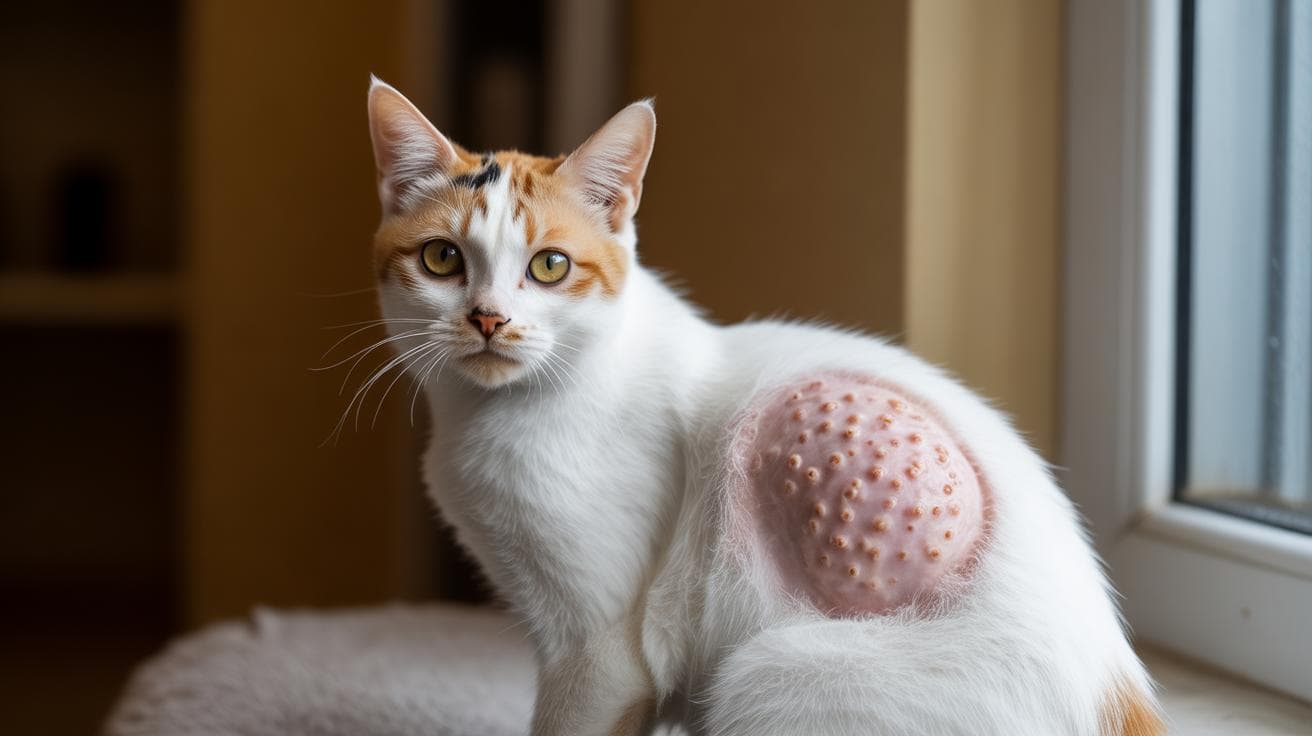
Ringworm usually shows up on your cat’s skin and coat. Spotting it early helps your vet treat it faster. Kittens and cats who are immunocompromised (weakened immune system) often get larger, harder-to-treat patches. And a lot of infected cats barely scratch, so not itching does not mean no infection.
Look for subtle changes first , hair that feels different or skin that looks off before your cat seems uncomfortable. The classic sign is a round, spreading spot with a clearer middle and a raised, red, scaly edge that slowly gets bigger.
- Outwardly spreading ring lesions: clear center with a raised, red, scaly rim that grows outward.
- Patchy hair loss around the head, face, and ears, or odd bald spots with visible scaling.
- Areas where the fur looks a different shade where hair is thinning.
- Broken, stubby, or brittle hairs, especially on longhaired cats.
- Thick crusts or dandruff-like flakes over the area.
- Small raised nodules or granulomas (small lumps of inflamed tissue) in more severe cases.
- Lesions that look bright red on the head, ears, or face.
- Many infected cats show little or no itching; a tidy-looking cat can still spread spores.
Photographing lesions for your vet
Take 3 to 6 clear photos from different angles: one close-up with a small ruler or coin for scale, one showing the whole affected patch, and one wider shot that shows where the lesion sits on the body. Date each image and try to use the same lighting and background so you can compare over time. Repeat photos every 7 to 10 days to track change and share them with your veterinarian.
Example shot , Close-up with ruler: lesion about 2 cm across.
Ringworm in cats: diagnosis , Wood’s lamp, microscopic exam, and fungal culture

Start with a vet visit and a quick history. Tell the vet where the spots are, how long they’ve been there, and whether other pets or people have similar rashes. No single test finds every case, so vets usually combine fast screens with slower lab tests to get a clear answer.
Wood’s lamp exam
A Wood’s lamp is an ultraviolet light (a handheld black light) that can make some Microsporum canis infections glow pale green. It’s fast and cheap. But only some strains glow, and other things can fluoresce too, so a glow helps, but no glow does not rule out ringworm.
Microscopic examination (KOH)
A KOH prep (potassium hydroxide slide test that dissolves skin debris) means the vet plucks a few hairs and checks them under a microscope for fungal spores or arthroconidia (fungal reproductive bits). Results are quick , often same-day , and can show active shedding. Still, very low-level carriers can be missed.
Fungal culture
A fungal culture on dermatophyte test medium (a nutrient gel that lets fungus grow) is the clinic standard for diagnosis and for confirming cure. Cultures can take up to 14 days to grow. Vets commonly want two negative cultures spaced 2 to 4 weeks apart before stopping treatment, because cultures catch low-level infections that quick tests might miss.
PCR and biopsy
PCR (a DNA test that looks for fungal genetic material) and skin biopsy (a tiny piece of skin sent to the lab) are options when cases are confusing or don’t follow the usual pattern. They’re used if other tests disagree or if the vet needs more detail.
What to bring to the clinic
- 3 to 6 dated photos of the lesions and a note on when they first showed up.
- A list of recent medications, supplements, and any topical products you’ve used.
- Notes about recent contact with other animals or people, and any new pets or fosters (see do cat scratches scar for how to tell scars or trauma from infection).
Worth every paw-print.
Ringworm in cats: topical and oral treatment options, durations, and medication notes

Treatment usually goes down two paths: surface care for a few spots, or medicine that works through the whole body for bigger problems. Surface treatments lower spores on the coat and help small lesions. Systemic, or oral, drugs (medicine given by mouth that reaches the whole body) are for widespread, stubborn, or carrier cats (cats that carry the fungus without looking sick). Your vet will pick based on how many spots there are, where they are, your cat’s age and health, and whether other pets or people are at risk.
Topical treatments and dips
Creams like miconazole (topical antifungal cream) or clotrimazole (topical antifungal cream) are great for one or two small patches. Medicated shampoos with antifungals help wash spores away from the coat , follow your vet’s schedule so you don’t dry out the skin. When you put creams on, go about 1–2 cm past the visible edge of the lesion so you catch tiny spread you can’t see.
For bigger problems vets use whole-body dips like lime sulfur dip (sulfur-based topical that kills spores; it can stain fur and smells strong) or enilconazole dip (veterinary antifungal dip). Dips lower environmental spores well, but they can stain, smell, and bother sensitive skin. Clip matted fur first. Wear gloves and long sleeves. Ask your vet to show you how to mix, apply, and rinse safely , it’s worth watching once.
Oral antifungal therapy
When lesions are all over, your cat has long hair, or the cat is a carrier, vets often use oral drugs: itraconazole (oral antifungal pill), terbinafine (oral antifungal pill), or fluconazole (oral antifungal pill). Doses and schedules change by drug and by cat , some vets use daily dosing, some use pulse dosing (short treatment bursts). Griseofulvin (old-school antifungal) has more risks in cats , possible bone marrow and liver problems , so it’s rarely first choice.
Oral meds can affect the liver, so your vet will want baseline bloodwork and periodic liver enzyme checks (blood tests that show how the liver is doing). Watch your cat for less appetite, vomiting, or being extra sleepy , call your vet if you see those signs.
| Medication | Route | Typical use | Key precautions |
|---|---|---|---|
| Itraconazole (oral antifungal) | Oral | Widespread or persistent infections; pulse or continuous dosing | Monitor liver enzymes (blood tests); use vet-prescribed dose |
| Terbinafine (oral antifungal) | Oral | Alternative systemic option for many cases | Watch for stomach upset; periodic bloodwork |
| Fluconazole (oral antifungal) | Oral | Used in selected cases or when others don’t work | Follow vet dosing; watch for side effects |
| Miconazole / Clotrimazole (topical antifungals) | Topical | Small, localized lesions; creams and shampoos | Apply 1–2 cm beyond lesion edge; wear gloves |
| Lime sulfur dip (sulfur-based topical) | Topical dip | Whole-body treatment for heavy contamination | Stains fur and has strong odor; use PPE and vet guidance |
Most owners see visible improvement in 2–4 weeks, and many cats are close to recovered by 5–6 weeks. Don’t stop early , even if the spots look gone. Keep treatment until your vet confirms cure with negative fungal cultures (lab tests that check for fungus), usually two negatives a few weeks apart.
Worth every paw-print.


