Field Note

Toys for Cats That Chew: Safer Picks for Determined Biters

How to choose toys for cats that chew hard, with safer materials, inspection rules, cord-chewing risks, and enrichment routines.

The best toys for cats that chew are large enough not to swallow, simple enough not to shed parts, and interesting enough to redirect the chewing away from cords, plastic, fabric, and hands. For most determined biters, start with oversized fabric kickers, molded rubber or silicone pet toys, sturdy puzzle feeders, and wand toys used only during supervised play. Avoid toys with feathers, string, bells, glued eyes, thin elastic, sequins, loose rope strands, or tiny removable pieces.

Chewing is not automatically a problem. Cats use their mouths to investigate, play, catch prey-like objects, relieve boredom, and sometimes seek comfort. The problem starts when the toy fails faster than you can inspect it, or when your cat moves from chewing toys to eating fabric, plastic, electrical cords, plants, hair ties, or string.

This guide is for owners whose cats chew through ordinary toys, gnaw plastic springs, bite wand strings, shred plush mice, or keep trying to mouth unsafe household items. The goal is not to find an impossible indestructible toy. The goal is to choose better failure points, supervise the first sessions, rotate toys before they become boring, and retire damaged pieces before they become swallowed debris.

What current search results miss

Most ranking pages for cat chew toys are shopping pages or short product lists. They can help you discover categories, but many skip the decision that actually matters: how does this toy fail when your cat keeps chewing the same spot? A toy that looks durable in a product photo can become risky if it has a glued seam, a small squeaker, a thin rubber nub, or a rope end that frays into strands.

A stronger Titan Claws approach starts with the cat’s behavior, not the product shelf. Watch one play session and decide whether your cat is a grab-and-kick chewer, a quiet seam picker, a plastic gnawer, a cord hunter, a fabric sucker, or a hand biter. Each type needs a different toy setup and a different supervision rule.

If your cat is mostly destroying prey-style toys during normal play, read this with Titan Claws’ guide to why cats destroy toys. If the chewing is intense enough that you are worried about swallowed pieces, Titan Claws’ article on cat bite toys has a closer look at bite-focused toy choices.

Match the toy to the way your cat chews

Before buying another toy, sort the behavior. This keeps you from handing a seam-ripper a tiny plush mouse or leaving a cord-chewer alone with a battery toy.

Chewing style Better toy direction Avoid
Grabs, bites, and rabbit-kicks Large kicker toy, tough fabric tube, refillable catnip kicker Small plush toys, thin tails, dangling ribbons
Chews plastic springs or bags Molded rubber or silicone pet toy, puzzle feeder, safe crinkle mat used under supervision Brittle plastic, tiny springs, packaging, shopping bags
Picks at seams Simple shapes, reinforced stitching, fewer panels, no glued trim Stuffed faces, tags, bells, embroidered loops, weak seams
Chews wand strings Wand play only while supervised, then closed storage Leaving string, elastic, feathers, or wire attachments out
Bites hands or ankles Long wand, kicker redirect, scheduled hunt-catch-eat routine Hand wrestling, short toys that keep fingers near teeth

The right toy often looks boring: one piece, no decorative bits, no exposed string, and no tiny openings. That is a good thing. The fewer parts there are, the fewer parts your cat can loosen and swallow.

Safer materials for cats that chew

Material choice is a tradeoff. Softer materials are usually gentler in the mouth but can tear. Harder materials may last longer but can crack, splinter, or damage teeth if they are too rigid. The best choice depends on how your cat bites and how closely you can supervise.

  • Reinforced fabric: Good for cats that wrestle and kick. Look for tight weave, hidden seams, doubled stress points, and no loose trim.
  • Molded rubber or silicone: Useful for cats that mouth objects. Choose pet-safe pieces too large to swallow and retire them if chunks, flaps, or deep tooth grooves appear.
  • Cardboard and paper bags: Cheap enrichment for supervised play. Remove bag handles and toss cardboard once it gets wet, shredded, or stringy.
  • Puzzle feeders: Better for cats that need work and food-seeking outlets. They redirect the mouth and paws without relying on feathers or dangling parts.
  • Wand toys: Excellent for chase and bite release, but they belong in a drawer or closet after play.

For a deeper material breakdown, use Titan Claws’ guide to durable cat toy materials. Treat any claim like indestructible as marketing shorthand, not a safety guarantee. Cats with focused chewing can eventually damage almost anything.
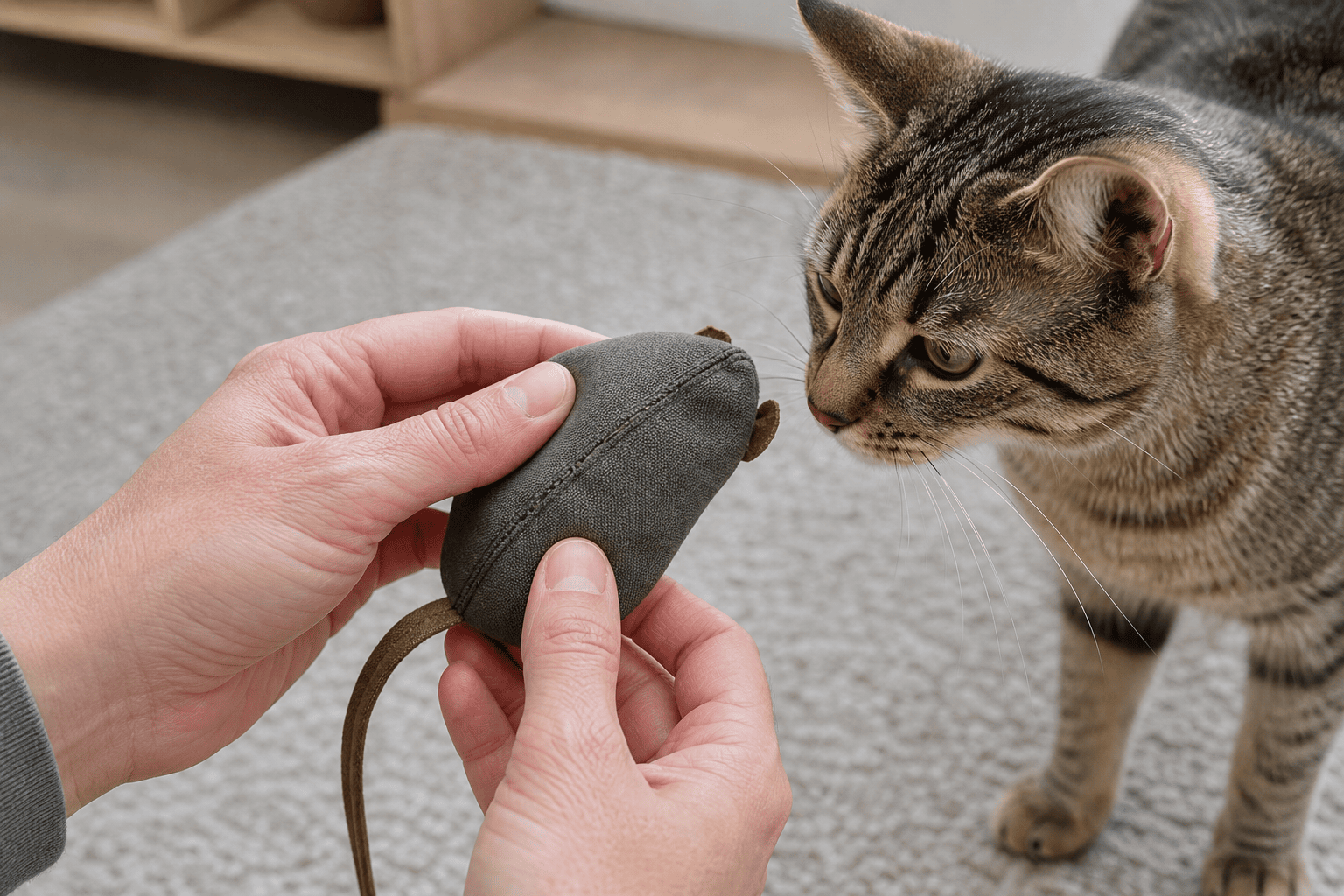
Close view of a cat toy being inspected for loose seams

Free Checklist

Free checklist: 30 ways to enrich your indoor cat's life.

Practical, printable, no fluff. Get the complete Indoor Cat Enrichment Checklist delivered to your inbox.

Safety rules that matter more than toughness

Cornell’s Feline Health Center notes that toys support stalking, pouncing, problem solving, and exercise, but it also warns owners to avoid small pieces and linear strand-like parts such as feathers and string that can separate from a toy and be ingested. That is the central safety rule for chewing cats: do not only ask whether the toy is fun; ask what your cat can detach from it.

Use these rules before a toy earns a place in the rotation:

  • Run the first session as a test. Sit nearby for ten minutes and watch where your cat bites, pulls, and worries the toy.
  • Size up. Choose toys that cannot fit fully in the mouth, especially if your cat carries toys away.
  • Cut off weak extras. Remove tags, loops, loose threads, and packaging ties before play.
  • Retire before failure. Exposed stuffing, cracked plastic, loose seams, deep punctures, dangling threads, and missing chunks all mean the toy is done.
  • Separate supervised toys from solo toys. String, feather, elastic, and battery toys should not be left out for a chewer.

The University of Wisconsin School of Veterinary Medicine gives similar practical advice for aggressive chewers: many traditional toys include feathers, strings, or sparkly parts that can be ingested, so sturdy construction and removal of loose pieces matter. That advice is more useful than a brand promise. A toy is only safer while it remains intact.

If your cat chews cords, solve the room first

A chew toy can help redirect cord chewing, but it should not be your only safety plan. Electrical cords are a different risk category from plush toys. PetMD’s veterinary guidance warns that cats can swallow insulation or wire pieces, burn their mouths on exposed wires, or suffer electrical shock from chewing live cords.

For a cord-chewing cat, set the room up before you test toys:

  1. Unplug and remove unnecessary cords from the cat’s favorite chewing zone.
  2. Route necessary cords behind furniture or through heavy cord covers.
  3. Block access to charging stations, holiday lights, and thin appliance cords.
  4. Offer a chew-safe toy in the same area only while you are watching.
  5. Add a play session before the time of day your cat usually seeks cords.
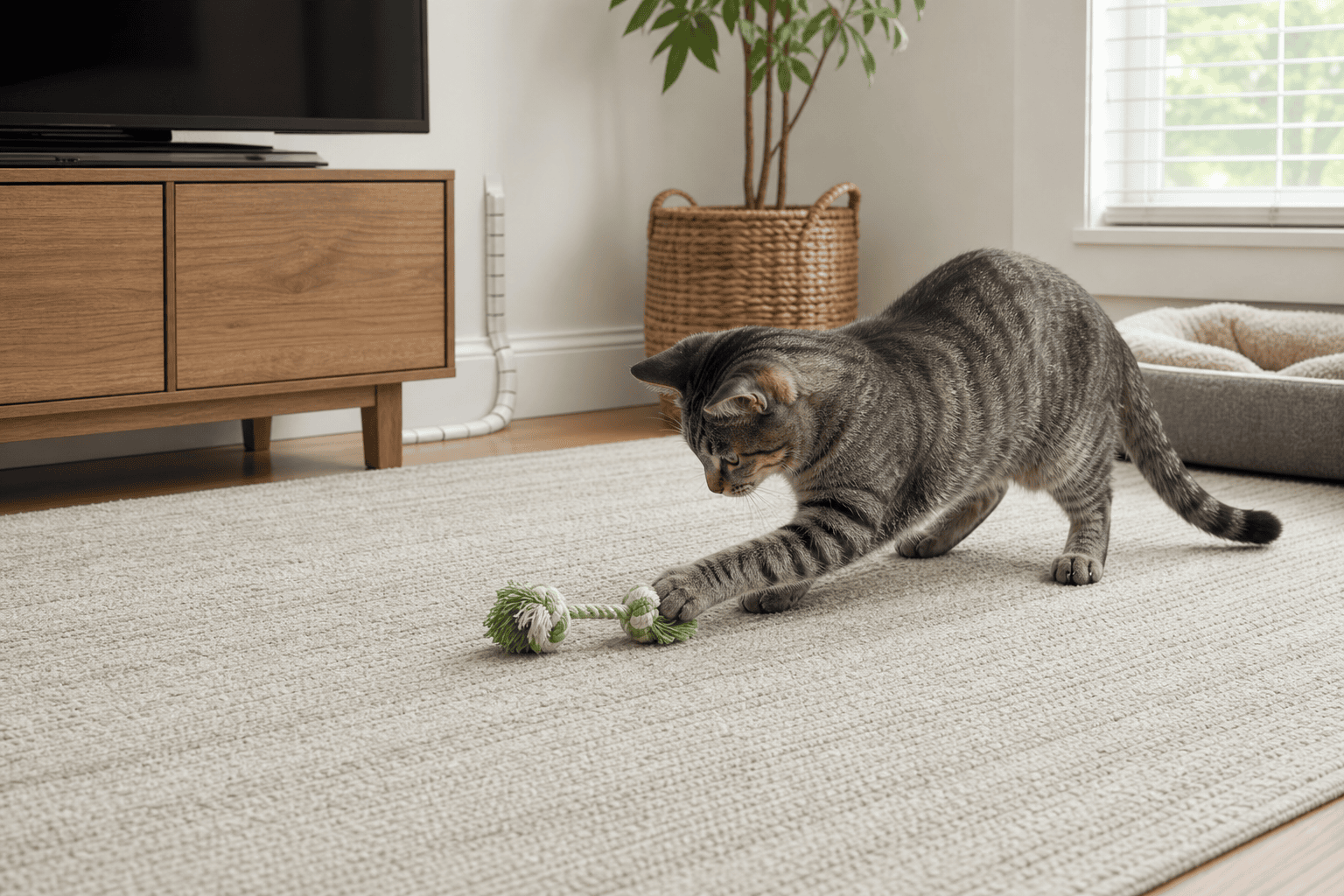
Cat playing with a chew-safe toy away from protected electrical cords

If the chewing is sudden, frantic, or paired with drooling, mouth pain, appetite changes, vomiting, hiding, or lethargy, stop treating it as a toy problem and call your veterinarian. Excessive chewing can be related to dental pain, skin irritation, stress, pica, or other medical and behavior issues.

Build a routine around chewing outlets

Chewing toys work better when they are part of a predictable enrichment routine. The AAFP and ISFM feline environmental needs guidelines describe play and predatory behavior as a core environmental need for cats. In plain terms: many indoor cats need to stalk, chase, catch, bite, and eat in a way that feels complete.

Try this simple routine once or twice daily:

  1. Warm up with chase. Move a wand toy away from your cat, around furniture, and across the floor like prey.
  2. Let the cat catch it. Constant teasing without a catch can create frustration and harder biting.
  3. Switch to a kicker. Offer a large chew-resistant kicker for the bite-and-rabbit-kick phase.
  4. End with food work. Use a small meal, treat scatter, or puzzle feeder to complete the hunt-catch-eat pattern.
  5. Put risky toys away. Leave out only the toys that passed supervised testing.

If your cat needs more movement than chewing, Titan Claws’ guide to interactive cat toys can help you build a better active-play setup. For many cats, chewing decreases when daily play becomes more predictable and satisfying.

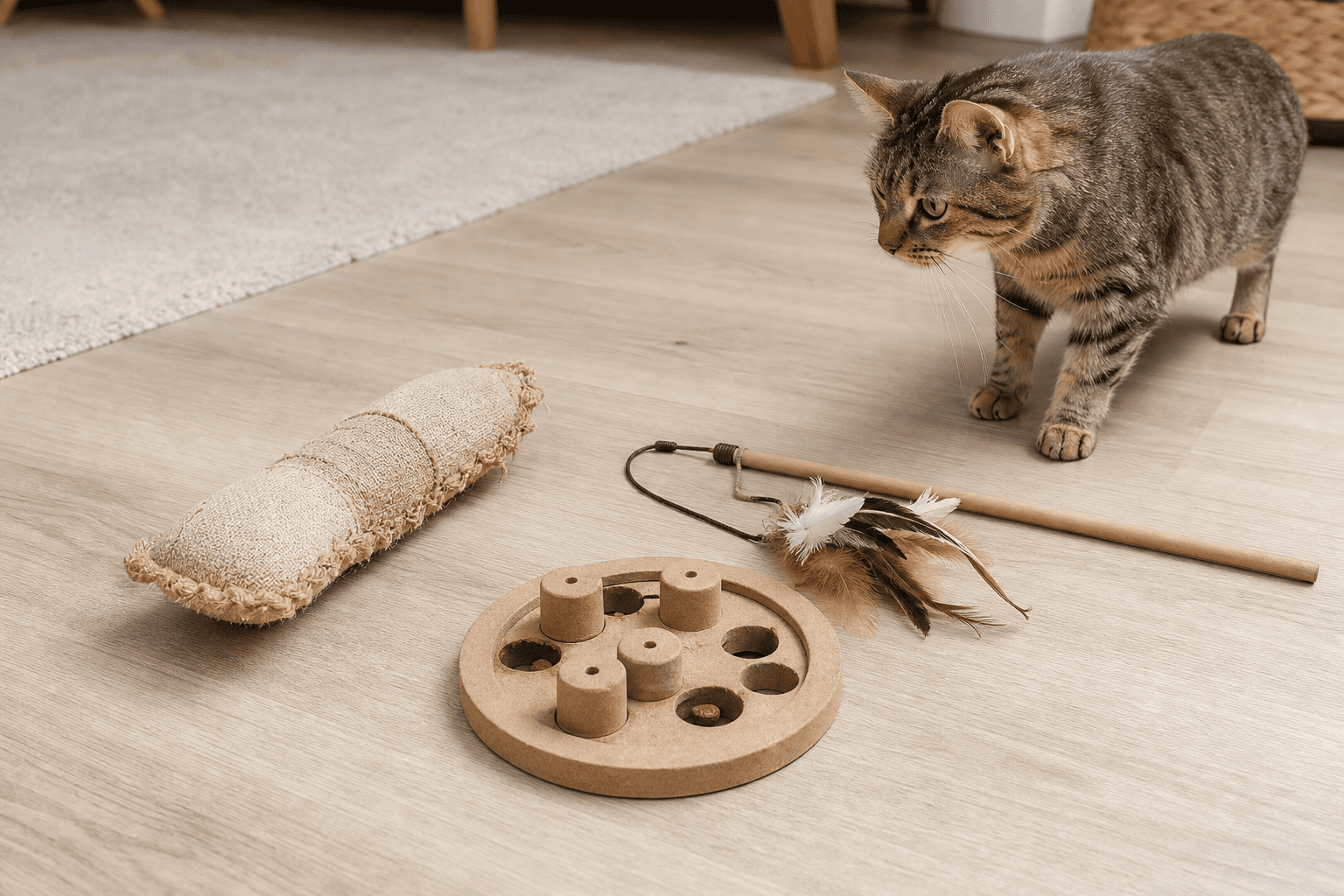
Several different cat toys arranged for toy rotation

Free Enrichment PDF

Want the full enrichment checklist?

30 things you can do this week to make your indoor cat's life better. Free PDF, straight to your inbox.

When chewing may be more than play

Cornell’s destructive behavior handout explains that fabric chewing and sucking is relatively rare in cats, may be comfort-seeking or investigative, and can be harmful when swallowed fabric causes gastrointestinal obstruction. It also notes that kittens may chew while exploring and that some cats continue the behavior for life.

Call your veterinarian if your cat swallows toy pieces, eats string or fabric, vomits after chewing, has appetite loss, drools, paws at the mouth, hides, becomes lethargic, or suddenly starts chewing as an adult. Also call if your cat fixates on one risky material such as wool, plastic bags, rubber, cords, plants, or hair ties.

For ingestion-specific warning signs, keep Titan Claws’ foreign body ingestion guide handy. String and fabric are especially serious because they can move from toy damage to emergency care quickly.

Quick checklist before buying toys for cats that chew

  • Is the toy too large to swallow, even after damage?
  • Does it avoid string, feathers, bells, glued eyes, sequins, and tiny parts?
  • Can you inspect every seam, edge, and attachment point?
  • Does the material fit your cat’s bite style rather than just the product label?
  • Will it be supervised-only, solo-tested, or put away after every session?
  • Can it be washed or wiped clean after slobbery play?
  • Do you have a replacement rule before stuffing, chunks, threads, or sharp edges appear?

For cats that chew, the best toy is not the hardest object on the shelf. It is the toy that gives your cat a satisfying outlet while failing slowly, visibly, and safely enough for you to remove it in time. Choose simple construction, supervise the first sessions, rotate toys before boredom sets in, and take medical warning signs seriously.

Source: Toys for Cats That Chew: Safer Picks for Determined Biters