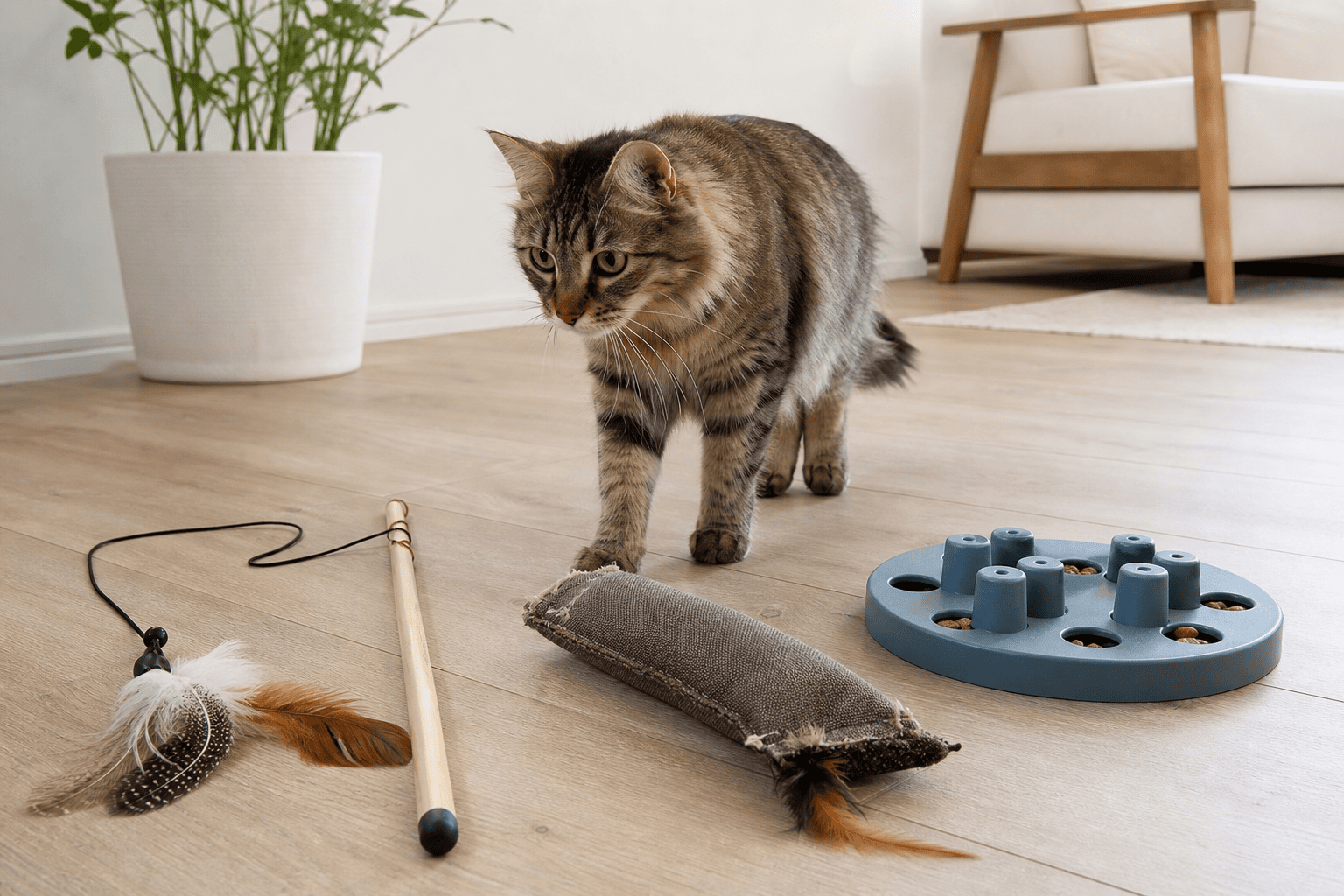
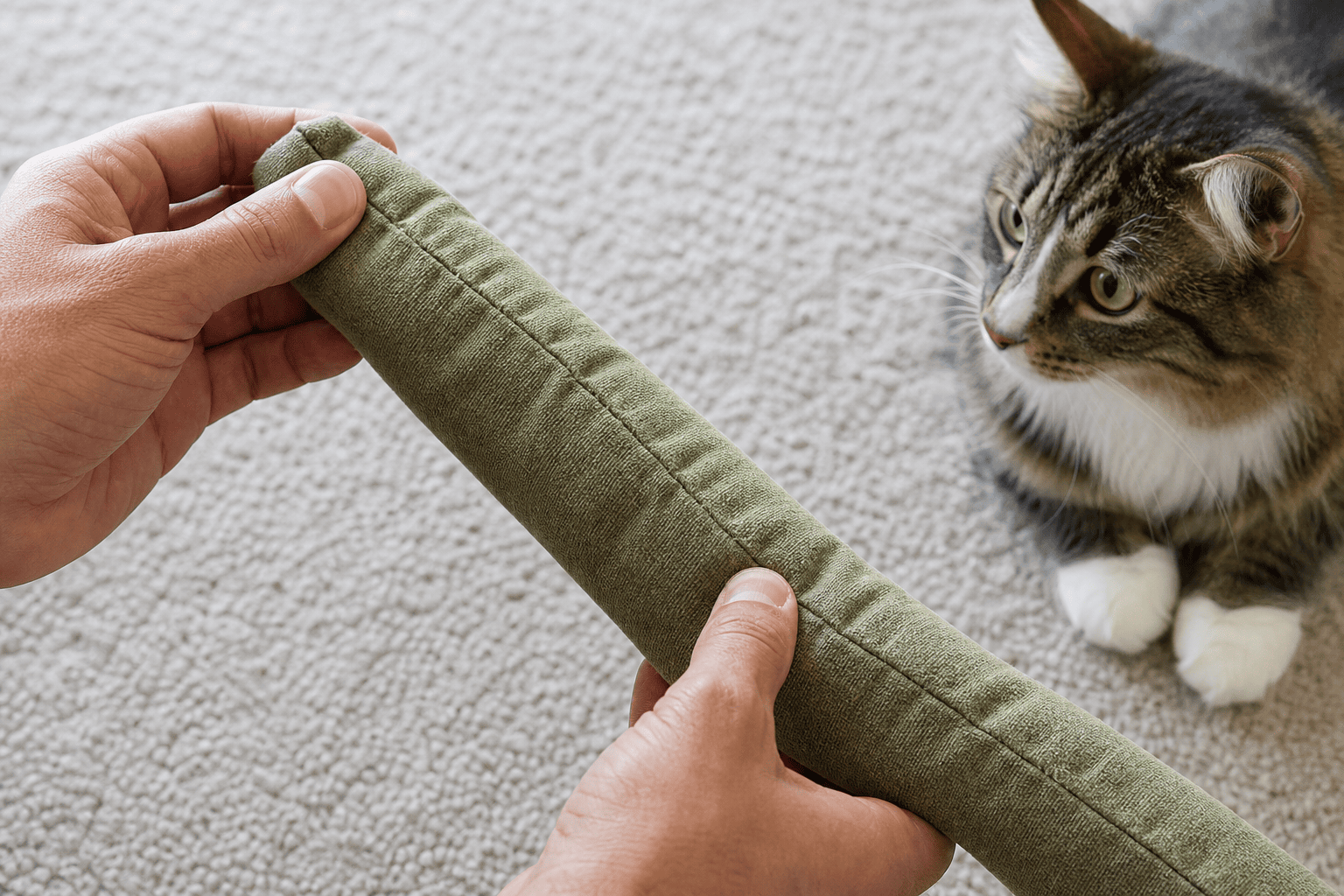
A cat kicker toy is a long, grab-able toy designed for the moment when a cat wraps the front paws around prey, bites, and kicks with the back legs. For rough players, the best kicker is long enough to keep teeth and claws away from your hands, sturdy enough to survive repeated wrestling sessions, and simple enough that there are no feathers, strings, bells, glued eyes, or tiny parts to pull loose.
Kicker toys are especially useful for cats that bunny kick arms, attack ankles, clamp onto pillows, shred small plush mice, or get overstimulated during petting. They give that full-body wrestling behavior a better target. They are not magic behavior fixes, and they are not indestructible. A good kicker toy works because it matches a cat’s natural play pattern while giving you an object you can inspect, rotate, wash, and retire before it becomes unsafe.
This guide explains what to look for in a cat kicker toy, how big it should be, which features help or hurt durability, and how to use one without teaching your cat that hands are toys.
Why cats bunny kick in the first place
Bunny kicking is normal feline behavior. During intense play, a cat may grab with the front paws, bite, roll to the side, and rake with the back legs. PetMD’s veterinary-reviewed guide describes bunny kicking as part play, part hunting practice, and sometimes a response to overstimulation or defense. That context matters: the same movement can mean happy play with a toy, too much petting, or a cat asking for space.
The ASPCA also notes that play aggression includes stalking, chasing, pouncing, swatting, grasping, fighting, and biting. Kicker toys are helpful because they redirect those prey-play movements away from skin. They let the cat use the bite-and-kick sequence without your hand becoming the prey object.
If your cat already destroys small toys, read this alongside Titan Claws’ guide to why cats destroy toys. The behavior is often normal hunting play, but the toy has to be chosen for the way your cat actually attacks it.
What current search results get right and miss
Most ranking results for cat kicker toy are product grids. They show that common kickers are long plush tubes, catnip-filled sticks, crinkle kickers, or novelty shapes. That is useful for shopping, but it leaves the owner with harder questions: what size is safer, which decorations are risky, whether crinkle and catnip are good for every cat, and how to tell when a kicker is too damaged to keep.
Commercial pages often emphasize excitement: catnip, crinkle, feathers, and wild kicking. The missing Titan Claws angle is failure behavior. For a determined cat, ask how the toy will fail after repeated bites in the same spot. A kicker with a tough body but a feather tail can still become unsafe if the tail is the part your cat removes first. A soft toy with weak seams may be fun for ten minutes and then turn into stuffing, threads, or swallowed fabric.
A better article should help you choose the right toy before you buy, test it during the first session, and build a routine that lowers rough play directed at hands and ankles.
How big should a cat kicker toy be?
Use a two-point fit test: the front paws should close around the kicker while the back feet contact a substantial part of it at the same time. If the hind feet miss, it is too short; if the front legs cannot wrap around it, it is too wide or rigid. Long-haired, broad-chested, and mobility-limited cats may need extra clearance without needing a heavier toy.
For most adult cats, choose a kicker long enough for the cat to hug with the front paws while the back paws land on the toy instead of your wrist. Many useful kickers are roughly forearm-shaped: long, narrow, and firm enough not to collapse immediately. Tiny plush toys can be fun for batting, but they do not solve the full-body bunny-kick problem because the cat cannot anchor them with the front paws and rake safely with the hind legs.
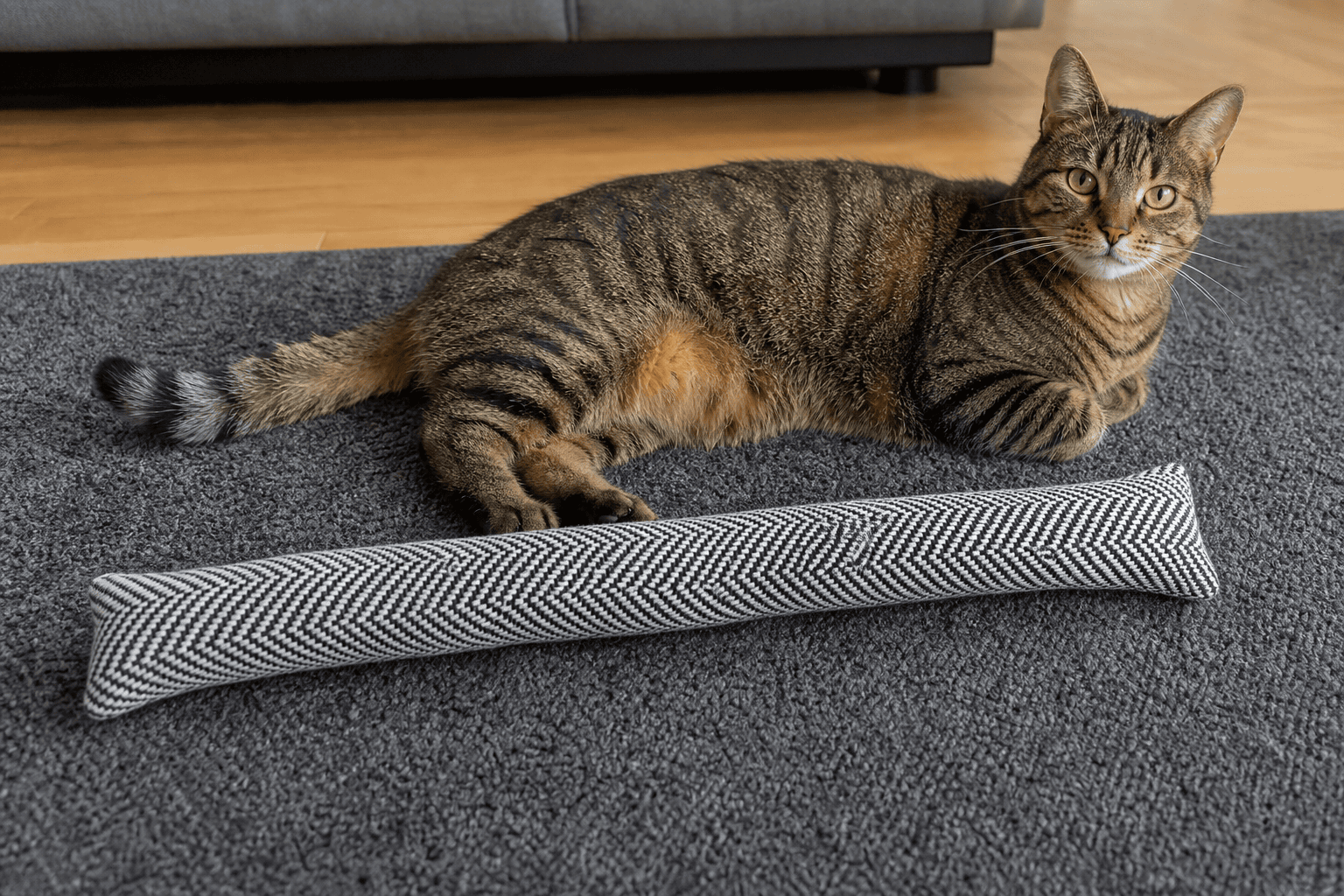
Use this sizing rule:
- For kittens: start with a lightweight kicker that is longer than the kitten’s torso but soft enough to carry. Supervise because kittens also chew and explore.
- For average adult cats: pick a toy long enough to span from chest to hind feet when the cat lies on its side.
- For large cats or powerful kickers: size up to a longer, denser kicker with fewer seams and no dangling parts.
- For cats that carry toys away: avoid small pieces that can fit fully in the mouth, especially if the cat hides with toys under furniture.
The toy does not need to be heavy. In fact, a toy that is too heavy may be ignored. The goal is enough length and resistance for a satisfying grip, not a hard object your cat has to fight.