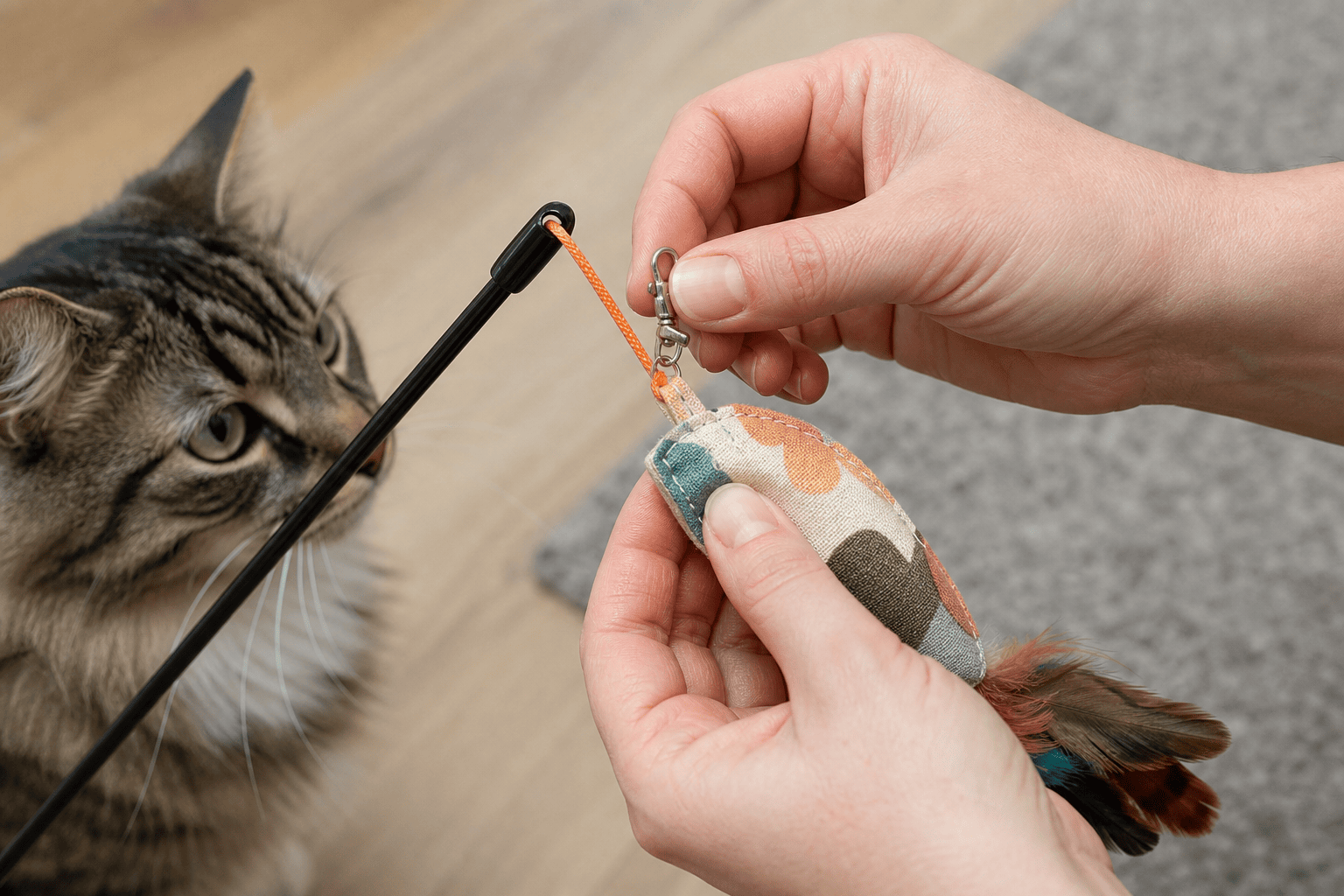
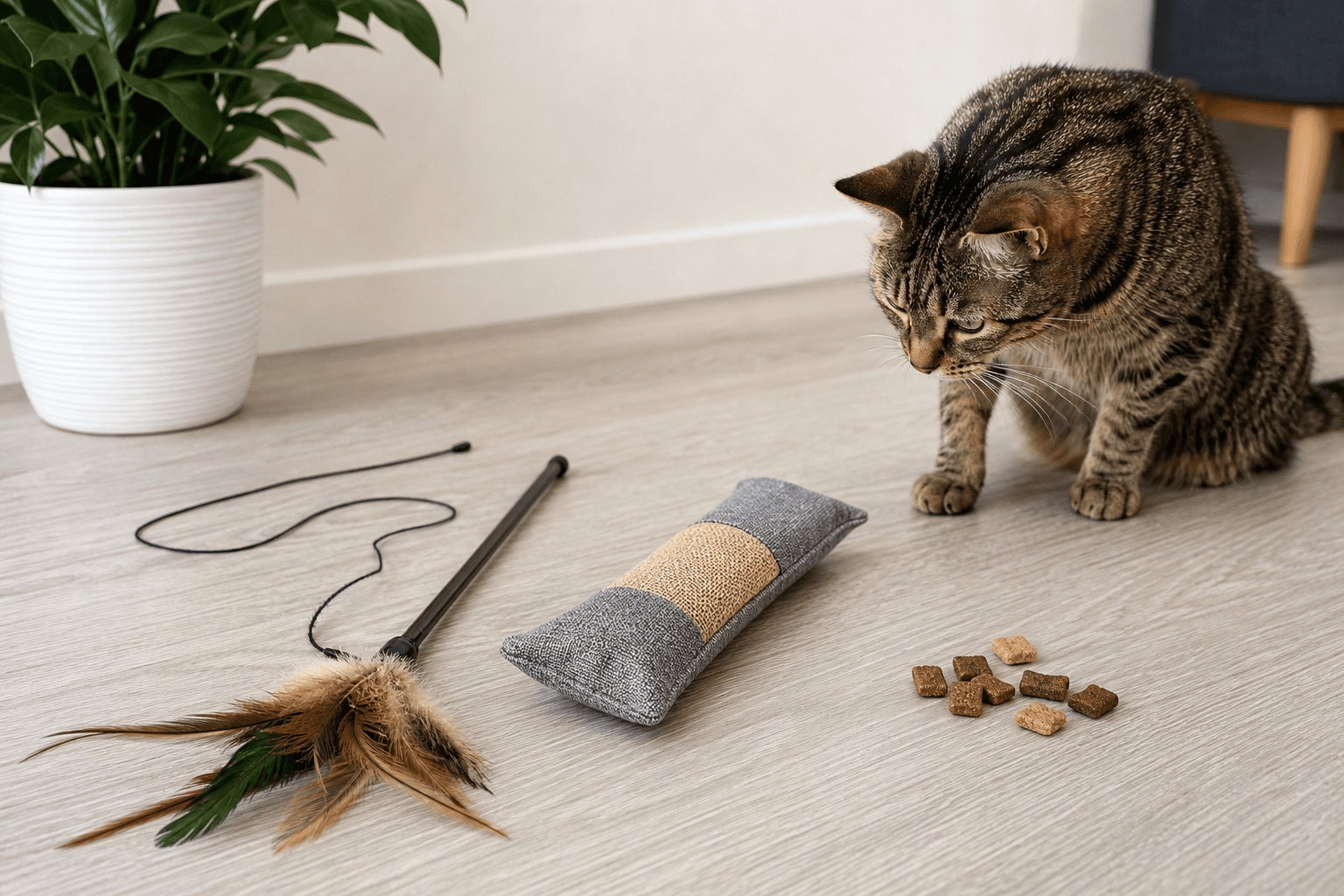
A wand cat toy is one of the best tools for interactive play because it lets your cat stalk, chase, pounce, catch, and bite a prey-like target while your hands stay away from teeth and claws. The safest choice is a sturdy wand with a secure attachment, a lure your cat can grab without swallowing pieces, and a strict rule that it goes away after supervised play.
Most people searching for a wand cat toy see shopping pages first: feather teasers, retractable poles, wire dancers, suction-cup gadgets, and refillable lures. Those pages are useful for browsing, but they often skip the two decisions that matter most: how the toy will fail under rough play, and how you will use it so your cat finishes the hunt instead of getting more frustrated.
This guide is for owners whose cats pounce hard, bite lures, chew strings, leap after feathers, or lose interest unless the toy moves like real prey. The goal is not to find an impossible indestructible wand. The goal is to choose a wand that fits your cat’s play style, use it in short satisfying sessions, inspect it often, and store it where your cat cannot chew the string or lure alone.
What a wand cat toy is best for
A wand cat toy is best for supervised chase play. The rod gives you distance, the string or wire gives the lure lifelike motion, and the lure gives your cat something safe to target instead of your hands. A good wand can help an indoor cat burn energy, practice natural hunting movements, and redirect rough play toward an appropriate object.
The AAFP and ISFM feline environmental needs guidelines describe play and predatory behavior as a core environmental need for cats. Their play guidance specifically includes moving a rod or wand so the attached toy mimics flying or ground prey, then letting the cat catch it. That catch matters. Constant teasing without a capture can make some cats more frantic, not more satisfied.
Use a wand when your cat needs movement, focus, and a clear outlet. Use a different toy when your cat needs solo chewing, quiet batting, food work, or a kicker to wrestle. If your cat destroys toys quickly, pair this guide with Titan Claws’ broader article on cat toys that last.
What current ranking pages get right and miss
The current results for “wand cat toy” are dominated by retailers and product roundups. They usually get one thing right: wand toys are excellent for activating hunting behavior. They also show the main options: feathers, felt strips, wire dancers, retractable handles, refill lures, crinkle attachments, and plush prey shapes.
What they often miss is the owner’s risk assessment. A feather wand may be thrilling for a gentle chaser and risky for a cat that bites feathers off. A long elastic string may create beautiful motion and still be a bad fit for a cat that chews cords. A tiny lure may be fine during active play and unsafe if your cat carries it away. Titan Claws’ angle is simple: buy for the way your cat actually attacks the toy, not for the prettiest product photo.
| Cat’s play style | Better wand direction | Watch out for |
|---|---|---|
| High jumper | Long rod, open floor space, lightweight lure | Slippery floors, hard landings, furniture edges |
| Ground stalker | Lure that drags, hides, and darts around corners | Forcing aerial play when the cat wants cover |
| Hard biter | Replaceable fabric lure, visible stitching, no tiny parts | Feathers, bells, glued eyes, weak clasps |
| String chewer | Short supervised sessions, immediate closed storage | Leaving elastic, ribbon, or string accessible |
| Shy watcher | Slow movements behind pillows or boxes | Swinging the lure toward the cat’s face |
How to choose a safer wand cat toy
Start with construction. The wand should feel controlled in your hand, not flimsy or whippy. The connection between rod, line, clasp, and lure should be easy to inspect. If the toy has feathers, bells, beads, plastic eyes, ribbons, tassels, or glued-on trim, assume those parts can come off and supervise accordingly.
Cornell’s Feline Health Center says toys can encourage exercise and natural behaviors, but it also advises owners to avoid toys with small pieces or linear strand-like parts such as feathers and string that may detach and be ingested. That does not mean every wand toy is bad. It means wand toys with dangly parts should be treated as active-play tools, not as objects left on the floor all day.
- Choose a rod long enough to protect your hands. A longer wand keeps fingers away from teeth and helps prevent accidental scratches during pounces.
- Prefer replaceable lures. Cats have prey preferences, and replaceable lures let you retire damaged pieces without throwing away the whole wand.
- Inspect the attachment point. The clasp, knot, swivel, or wire connection should not have sharp edges or loose gaps.
- Match the lure to the mouth. For hard biters, choose a larger fabric lure over tiny feathers or delicate parts.
- Avoid mystery materials for chewers. If your cat bites through plastic, rubber, feathers, or string, do not rely on the label. Watch the first session closely.