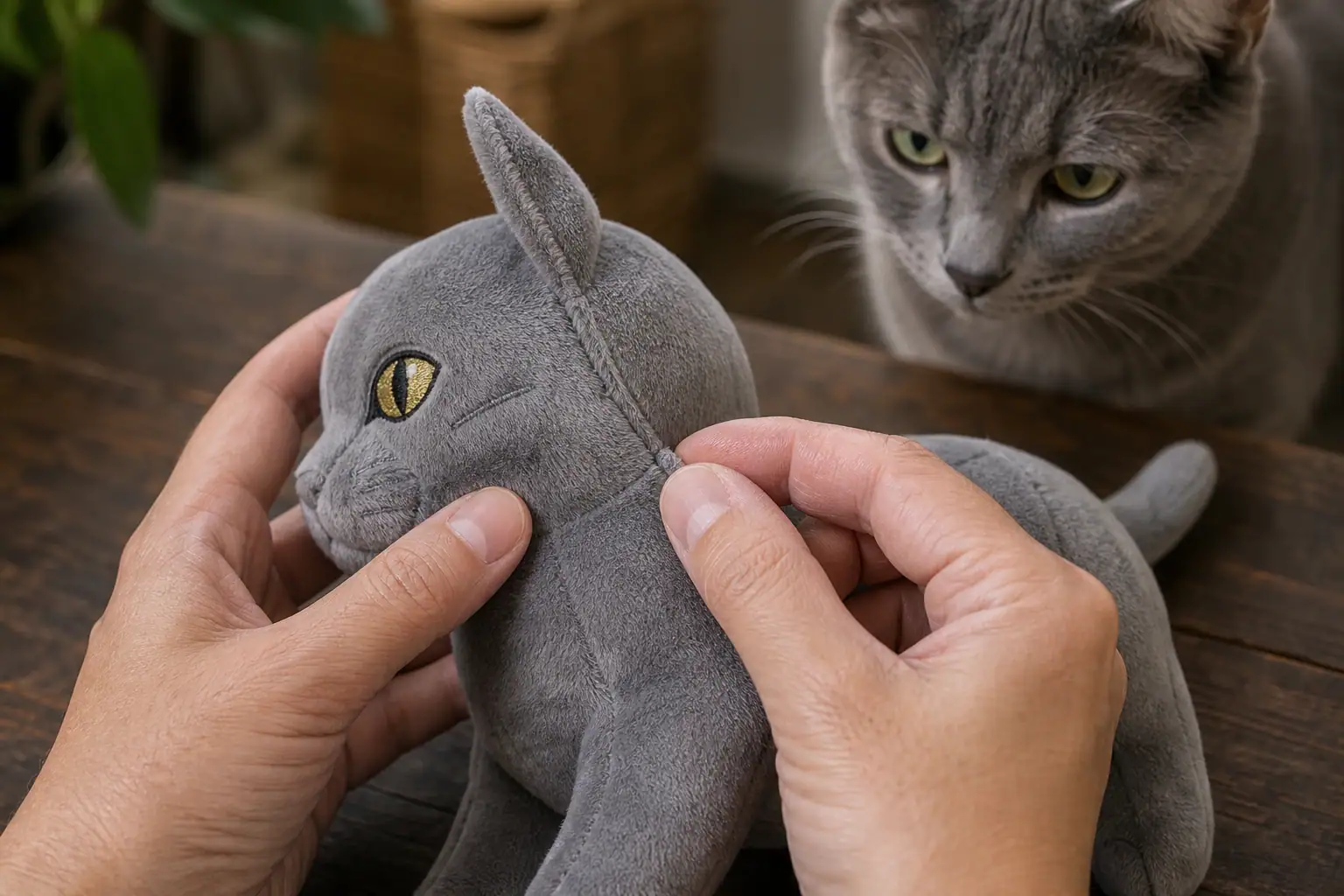
A good grey cat plush toy should match the person and purpose first. For a child or cuddle companion, prioritize a soft washable body, simple securely attached features, and the correct age guidance. For a collector or memorial keepsake, color, markings, posture, eye color, and facial shape matter more. If the plush is meant for a real cat, buy a pet-designed toy instead of assuming a human stuffed animal can withstand teeth and claws.
Start by choosing one of three directions: realistic, soft and floppy, or rounded and stylized. Then compare the shade of grey, size, fabric feel, filling, facial details, seams, care instructions, and return policy. This guide gives you a fast way to narrow the options—and a separate safety test for homes shared with children and real cats.
Grey cat plush toy choices at a glance
The word plush covers everything from palm-sized keychains to large decorative pillows. Search results also mix the British spelling “grey” with the American “gray,” so use both spellings if the selection seems thin.
| Plush style | Best for | Look for | Common tradeoff |
|---|---|---|---|
| Realistic sitting cat | Display, gifting, or matching a real pet | Natural proportions, breed-like face, layered markings, stable posture | May be firmer and less comfortable to hug |
| Floppy cuddle plush | Hugging, travel, and bedtime for an age-appropriate child | Soft body, even filling, washable construction, embroidered details | Shape is less lifelike and may flatten with use |
| Rounded or cartoon cat | Casual gifts, décor, and plush pillows | Simple silhouette, pleasant fabric, resilient fill, clean stitching | May not resemble a particular cat |
| Mini plush or keychain | Bags, desks, and small collectibles | Secure loop, compact stitching, no loose accessories | Small parts make it unsuitable for young children and many pets |
| Pet-designed plush or kicker | A real cat’s supervised grabbing and rabbit-kicking | Simple shape, reinforced seams, pet-appropriate fill, no glued face | Designed for play rather than realistic display |
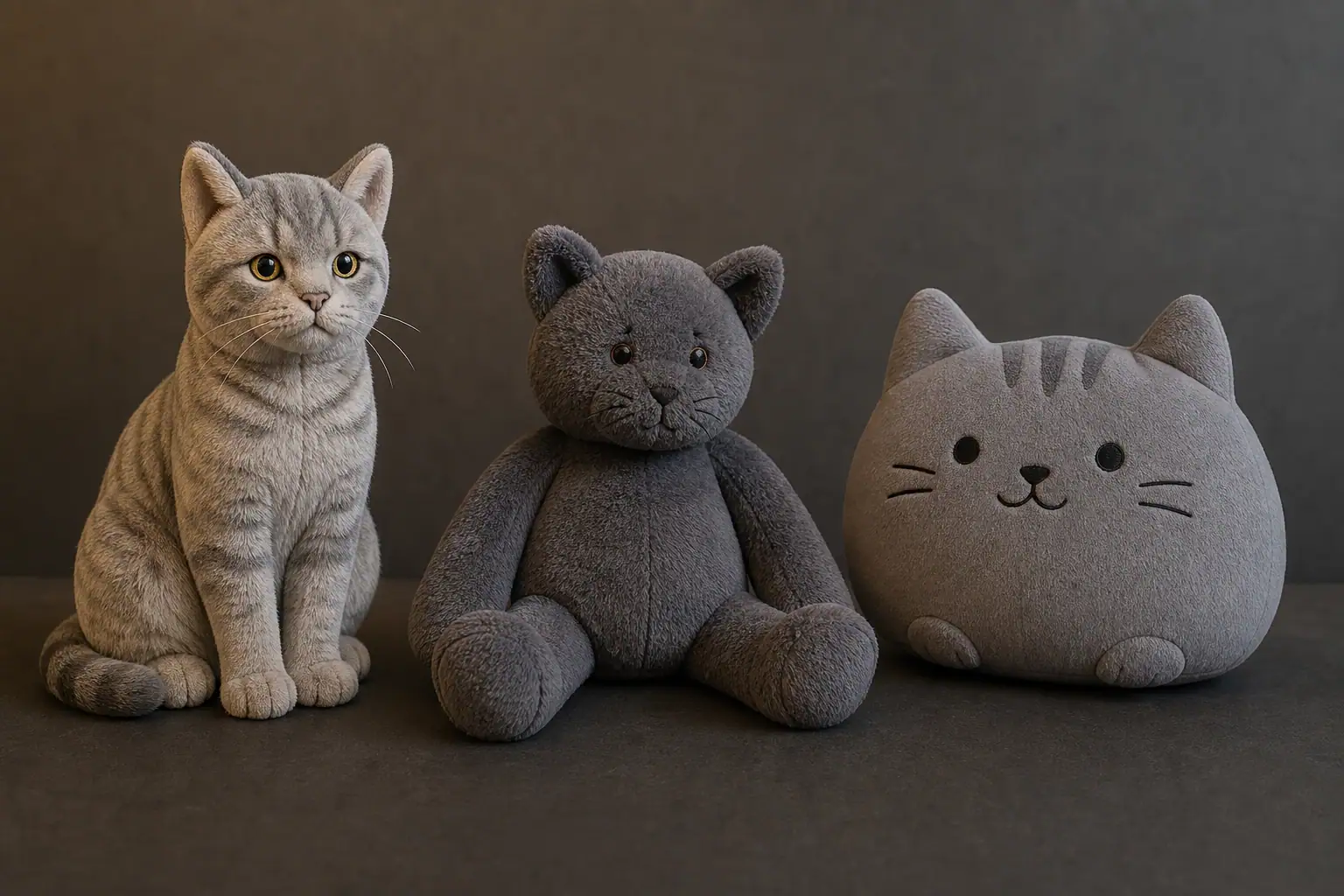
Do not shop across all five categories at once. A highly realistic grey cat stuffed animal can be a lovely shelf piece but an awkward cuddle toy. A large floppy plush may feel perfect in the arms but fail to capture the exact expression of a beloved cat.
Get the shade, markings, and face right
“Grey” is not one color. Product photos may show cool blue-grey, warm taupe-grey, dark charcoal, pale silver, or a mixed tabby coat. Screen brightness and warm photography can also shift the apparent color. If matching a real cat matters, compare customer photos taken in ordinary daylight and read the written color description instead of trusting one polished image.
Choose a coat pattern
- Solid blue-grey: an even cool coat with little visible pattern. This is often used for plushes inspired by Russian Blue–type cats.
- Grey tabby: darker stripes, forehead lines, ringed tail, and sometimes a pale muzzle or belly.
- Grey and white: a grey back and head with white paws, chest, blaze, or muzzle.
- Silver tabby: a pale base with high-contrast dark markings.
- Long-haired smoke grey: a fluffy silhouette with light and dark fibers blended through the coat.
If you are trying to resemble a specific pet, outline the three details you notice first. It might be a white chin, green eyes, and a bent tail—not the nominal breed. Search with those traits, such as dark grey cat stuffed animal with green eyes or long-haired grey and white cat plush. A stock plush rarely matches every marking, so prioritize the face and color blocks before small stripes.
Realistic versus expressive faces
Realistic designs use a longer muzzle, smaller head-to-body ratio, shaped paws, and a natural sitting or lying pose. Stylized designs enlarge the head and eyes, shorten the limbs, and simplify the coat. Neither is inherently better. A realistic plush usually works better as a keepsake; a softer expressive face often feels friendlier as a general gift.
Match the size and feel to the recipient
Check dimensions rather than labels such as small, medium, or jumbo. Sellers may measure from the front paw to the end of the tail, which can make a narrow lying plush sound much larger than it feels. Look for seated height or body length, width, and weight. If only one measurement is listed, ask how it was taken.
- Under 8 inches: easy to display or carry, but more likely to include small-scale details and too little body for hugging.
- 8–14 inches: a versatile gift size that fits a shelf, lap, or travel bag.
- 15–24 inches: better for cuddling or use as a decorative cushion; check weight and washability.
- Over 24 inches: visually impressive, but harder to store, clean, and dry completely.
Fabric descriptions are useful only when they are specific. Short-pile plush tends to show markings clearly and collects less debris than shaggy faux fur. Minky-style fabric feels velvety and suits simplified shapes. Long faux fur can make a cat look lifelike but mats more easily and may hide seams or hard inner structure. A product described only as “premium plush” gives you little to evaluate.
For a child, follow the manufacturer’s age label and inspect the actual construction. The U.S. Consumer Product Safety Commission advises choosing toys that match a child’s abilities and keeping small parts away from children younger than three. The American Academy of Pediatrics recommends well-made stuffed toys with secure seams and parts, no loose ribbons or strings, and no accessible pellet-like filling. Keep stuffed toys and other soft objects out of an infant’s sleep space.