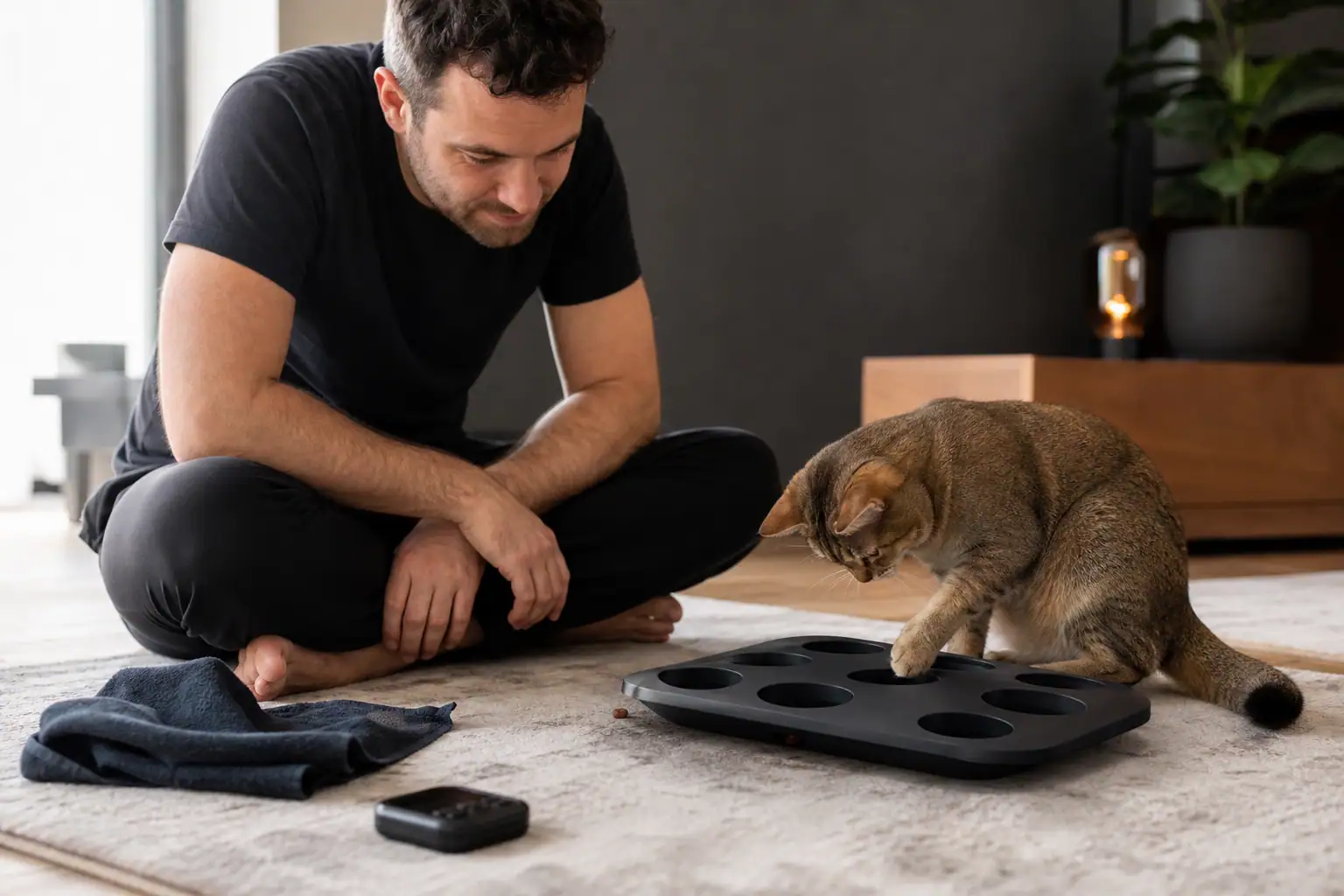
3D printed cat toys can be suitable for supervised play when the design is large, simple, smooth, and strong—but no filament is automatically cat-safe. The finished object matters as much as the material. Layer separation, sharp support scars, small articulated links, trapped debris, coatings, and a cat’s chewing style can turn an appealing print into a swallowing or injury hazard.
For a cat that mainly bats objects, a carefully made rolling toy, track, or broad puzzle may be reasonable. For a cat that clamps down, gnaws plastic, or destroys ordinary toys, skip rigid printed mouth toys. Use the printer for a stable base, holder, mold, or storage accessory instead, and give the cat a larger purpose-built capture toy for biting and bunny-kicking.
This guide gives makers and buyers a practical way to judge 3D printed cat toys without pretending that PLA, PETG, or TPU is universally safe. It covers design, filament documentation, print quality, cleaning, supervised testing, and the exact damage that means a toy is finished.
The short answer: match the print to the cat
Start with behavior, not the STL file. A toy that survives gentle paw taps from one cat may fail in seconds when another cat pins it, bites an edge, and rabbit-kicks it across tile. “My cat has used it for months” is useful experience, but it is not a safety test for every print, printer, filament batch, or cat.
| Your cat’s likely use | 3D printed option | Practical verdict |
|---|---|---|
| Bats and chases without mouthing | Oversized one-piece roller or captive-ball track | Potentially reasonable for supervised trials if it cannot enter the mouth or break apart |
| Paws food from a puzzle | Broad, stable puzzle with large rounded openings | Possible with documented material, a clean print process, short contact, and careful washing |
| Grabs, bites, and bunny-kicks | Rigid printed fish, mouse, or articulated figure | Poor fit; hard edges and layer failure can become hazards |
| Chews plastic or eats non-food items | Any direct-contact printed toy | Avoid; choose a different material and discuss repeated non-food eating with a veterinarian |
| Needs a wand or kicker | Printed handle, wall mount, or storage hook kept away from the mouth | Use printing for the human-side hardware, not the cat’s bite target |
If you need a non-printed alternative for a forceful player, start with our guide to durable cat toys. It explains why size, construction, and failure mode matter more than a toughness label.
What model galleries get right—and what they miss
Current search results are full of clever rolling shapes, treat eggs, springs, articulated fish, and motorized projects. That is excellent for inspiration. Printables’ cat-toy contest even tells entrants to avoid choking hazards and sharp parts. The gap is that a downloadable model is usually a geometry file, not a validated pet product.
The same STL can produce very different objects. Nozzle size, wall count, layer height, print orientation, temperature, moisture in the filament, under-extrusion, supports, colorants, and post-processing all change the result. A five-star model rating may reflect printability or appearance rather than resistance to canine teeth and repeated impact.
Articulated “print-in-place” toys deserve extra caution. Their appeal comes from many small joints and gaps—the same features that create thin links, pinch areas, break-off pieces, and surfaces that are difficult to inspect or clean. A decorative 3D printed cat, flexi dragon, keychain, or fidget is not a cat toy just because a cat notices it.
Never hand these to a cat
- Failed prints, purge lines, brims, rafts, support fragments, calibration shapes, or loose filament
- Miniatures, keychains, articulated figures, narrow springs, thin lattice shapes, or anything that can fit deeply into the mouth
- Objects with magnets, bearings, bells, batteries, metal hardware, glued decorations, or accessible fasteners
- Prints with sharp corners, stringing, rough support scars, cracks, gaps, or pieces rattling inside
- Uncured, tacky, strongly odorous, or incompletely post-processed resin prints
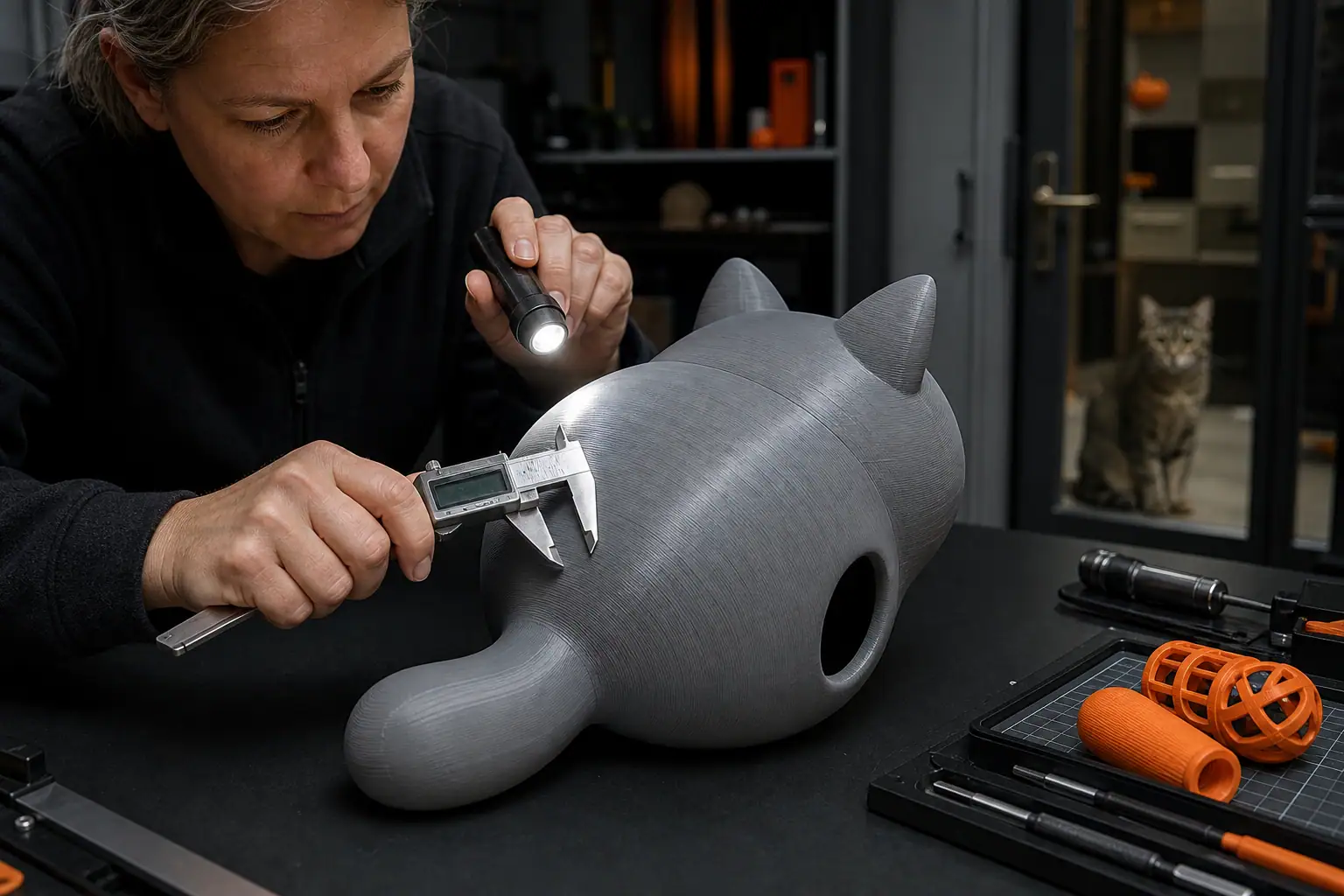
Use a finished-print checklist, not a filament shortcut
A label such as PLA or PETG names a polymer family; it does not disclose every pigment, modifier, processing aid, recycled component, or contamination path. Ask the filament manufacturer for the current technical data sheet and safety data sheet for the exact product and color. If a seller cannot identify the filament, printer process, and finishing method, treat that uncertainty as a reason to pass.
Claims such as “natural,” “biodegradable,” “food safe,” and “non-toxic” do not mean bite-proof, swallow-safe, or tested for feline use. Even documentation for food contact addresses a different use case. It does not evaluate claws, tooth pressure, impact on a hard floor, small-parts release, or what happens after weeks of wear.
| Material | Why makers consider it | Cat-toy concerns | Titan Claws take |
|---|---|---|---|
| PLA | Easy to print; crisp shapes; widely available | Usually rigid; thin sections or poor layer bonds can crack; formulations and pigments vary | Consider only for large, simple supervised batting or puzzle designs—not a chew target |
| PETG | Often tougher and less brittle than basic PLA | Can string, deform, split at weak layers, and still release pieces; additives vary | Better impact behavior does not make it automatically pet-safe |
| TPU or flexible filament | Flexible and resilient | A determined cat may slice, stretch, or swallow flexible pieces; hardness and additives vary widely | Do not assume “rubbery” means chew-safe; verify the exact grade and supervise |
| ABS, ASA, nylon, or specialty blends | Useful engineering properties | More process variables and less reason to experiment in a mouth-contact toy without specific documentation | Use for non-contact hardware when appropriate, not as a casual pet-toy upgrade |
| Wood-, metal-, carbon-, glow-, or sparkle-filled filament | Distinctive appearance or stiffness | Extra particles, roughness, abrasives, and opaque formulations add uncertainty | Avoid for direct cat contact |
| Photopolymer resin | Fine detail and smoother-looking surfaces | Uncured resin and incomplete post-processing are hazards; thin detailed parts may be brittle | Not our choice for a cat toy |
Prusa’s food-contact printing guidance highlights layer grooves, unknown pigments and additives, nozzle wear, and incomplete resin curing as reasons material choice alone is not enough. Food contact is not the same as cat play, but those manufacturing questions are directly relevant when saliva or treats touch a print.