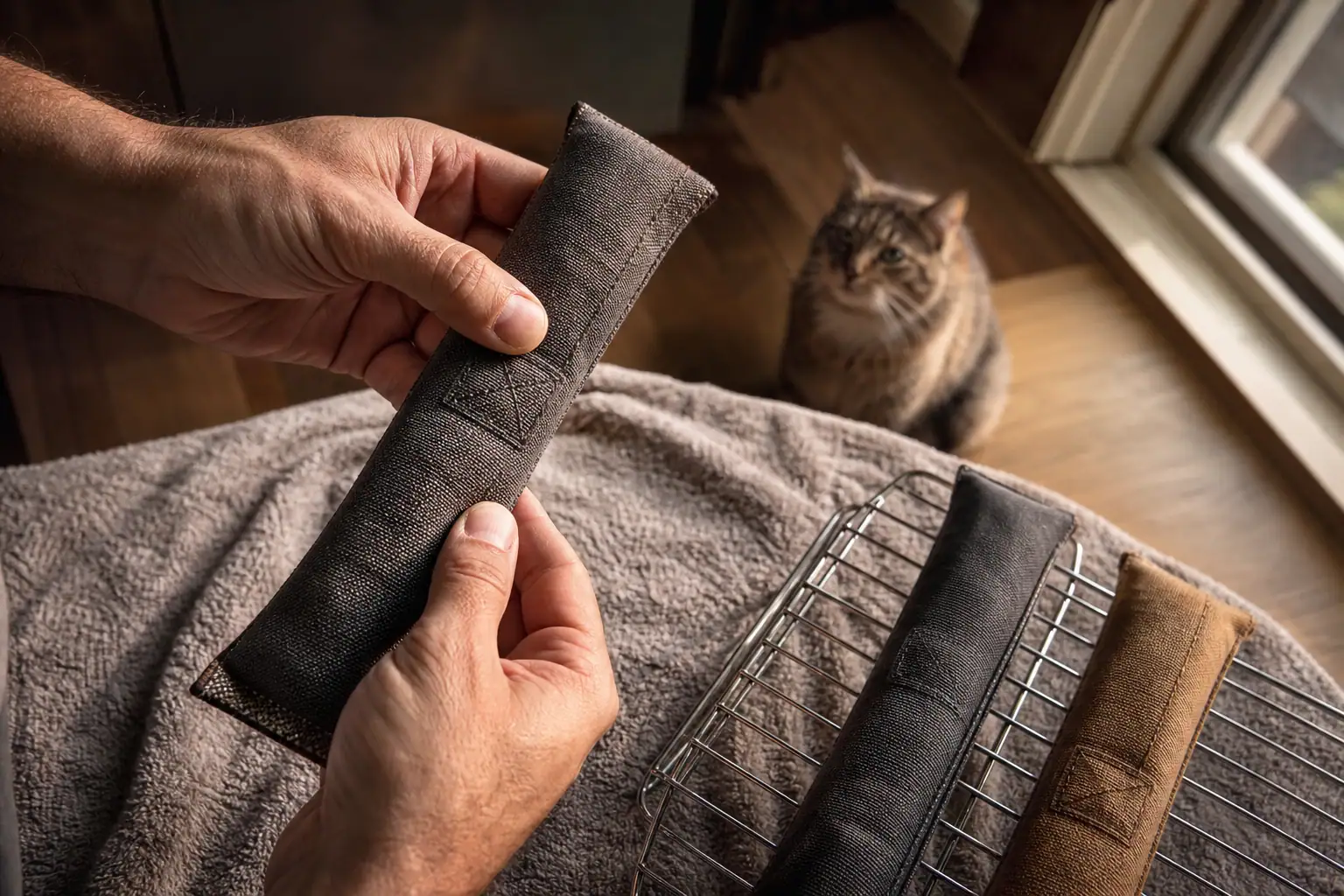
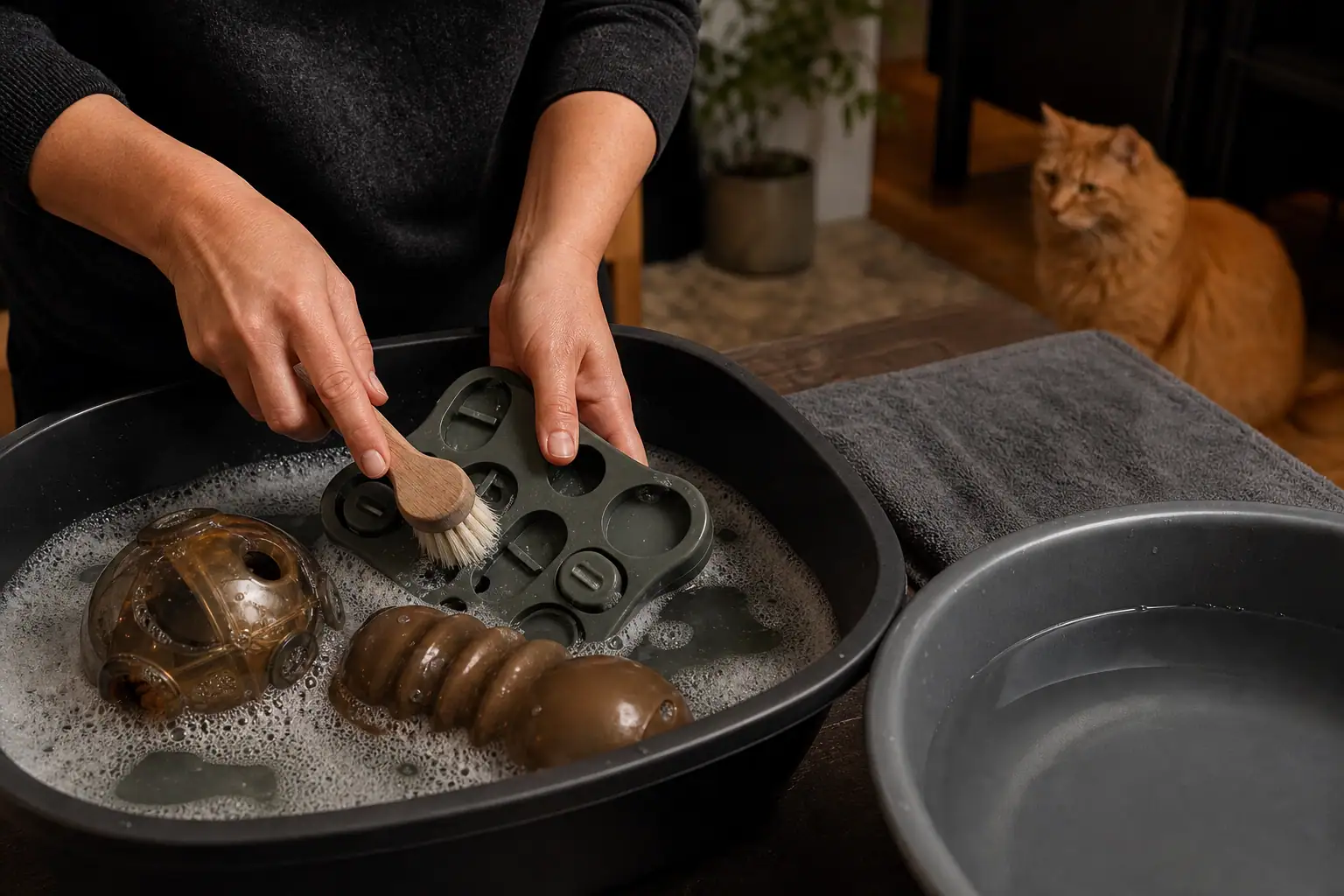
To clean cat toys safely, start with the care label and the material—not a one-method-fits-all cleaning hack. Remove hair and crumbs, inspect for damage, wash hard or washable toys with soap or detergent and warm water, rinse thoroughly, and let every part dry completely before play. Keep motors, battery compartments, glued feather attachments, and non-washable catnip filling out of the sink.
Cleaning can extend the useful life of a sound toy, but it cannot make a failing toy safe. If a rough-playing cat has opened a seam, loosened a bell, split plastic, exposed foam, or driven moisture deep into filling that will not dry, retire the toy instead of washing it back into the rotation.
Choose the Cleaning Method by Toy Type
The manufacturer’s instructions take priority because two toys that look alike may use different glue, filling, electronics, or heat-sensitive plastic. When no instructions remain, use the least aggressive method that can remove the dirt and still let you rinse and dry the toy fully.
| Toy type | Practical cleaning method | Do not | Retire when |
|---|---|---|---|
| Machine-washable fabric kicker or plush | Close fasteners, place in a mesh bag, use the labeled cycle and detergent amount, rinse well, then dry as directed | Assume hot water or a hot dryer is safe without checking the label | Seams open, filling escapes, hardware loosens, or the center stays damp |
| Non-refillable catnip toy | Follow its label; spot-clean only if that is the permitted method | Soak a toy that cannot be dried through the center | It is visibly dirty, moldy, musty, leaking filling, or cannot be cleaned as directed |
| Hard plastic, rubber, or silicone toy | Hand-wash with warm soapy water, scrub grooves, rinse, and dry; use a dishwasher only when labeled dishwasher-safe | Expose unknown plastic or rubber to high heat | It cracks, turns sticky, develops sharp gouges, or sheds pieces |
| Food puzzle | Disassemble as directed, remove food, clean every channel, rinse, and dry before reassembly | Leave wet food, oil, detergent, or moisture in hidden cavities | Food cannot be removed, parts deform, or a cat can pry pieces loose |
| Electronic or motorized toy | Switch off, unplug, remove batteries if the manual says to, and wipe only as directed | Immerse the motor, charging port, speaker, or battery compartment | There is corrosion, heat, odor, swelling, exposed wire, or a cracked housing |
| Wand lure, feather, fur, or glued attachment | Follow the attachment’s instructions; gently wipe or replace delicate parts when appropriate | Soak, machine-wash, or heat-dry a weak glued assembly by guesswork | String frays, quills split, clips bend, or small pieces loosen |
The CDC’s current pet-supply guidance uses the same basic distinction: hard items can be cleaned with soapy water, while soft washable items can go through a washer and dryer. It also says to follow product cleaning instructions and discard non-refillable catnip toys when they become dirty.
Inspect Before Washing: Clean, Repair, or Retire?
Give every toy a dry inspection before water hides the evidence. Pull gently at seams and attachments, flex hard shells, check every piece against the product photo or manual, and smell the toy. Set aside anything with a missing part until you know where that part went.
- Clean it when the toy is structurally sound and the care method can reach the dirty area without damaging the toy.
- Repair it only when the design supports repair and the result will not add loose thread, sharp knots, exposed glue, or an altered part your cat can swallow. When in doubt, replace it.
- Retire it when it has an open seam, exposed stuffing, splintered feather shaft, cracked plastic, damaged battery door, deep tooth cuts, persistent odor, visible mold, or a section that cannot be rinsed or dried.
For cats that bite and bunny-kick hard, washing is a stress test. Wet fabric may reveal a seam that was already separating, while flexing a clean rubber toy may expose a crack hidden by grime. The Titan Claws guide to durable cat toys explains the failure points worth checking before a toy returns to rough play.
How to Wash Fabric, Plush, and Catnip Toys
First remove loose fur with clean hands, a lint roller, or a vacuum attachment used carefully. Detach any refillable catnip pouch, bell, battery unit, or removable electronic mechanism only when the instructions say it is designed to come out.
Machine-washable fabric toys
- Read the tag for water temperature, cycle, detergent, and drying limits.
- Place small toys in a closed mesh laundry bag so they do not disappear or strike the drum.
- Use the detergent amount appropriate for the load. A dye-free, fragrance-free detergent may be a better choice for a cat with sensitive skin, according to the CDC.
- Run the labeled cycle. Skip fabric softener unless the manufacturer explicitly permits it.
- Dry exactly as directed. Air-dry when required; use a dryer only at the allowed setting.
- Squeeze the center, smell the toy, and inspect seams and decorations again before returning it.
Catnip toys and non-washable plush
A refillable catnip toy is easier to maintain: remove the herb pouch, clean the empty cover as labeled, dry the cover fully, then refill it. For a sealed toy, do not assume that soaking is harmless. Water can carry soil into the filling and create a damp center you cannot inspect.
Spot-clean only when the label allows it, using the specified cleaner and as little moisture as necessary. If a sealed catnip toy is dirty through the fabric, smells musty, shows mold, or remains damp, discard it. You can restore interest in a clean refillable toy with fresh catnip after it is dry, but added catnip cannot refresh a contaminated toy.