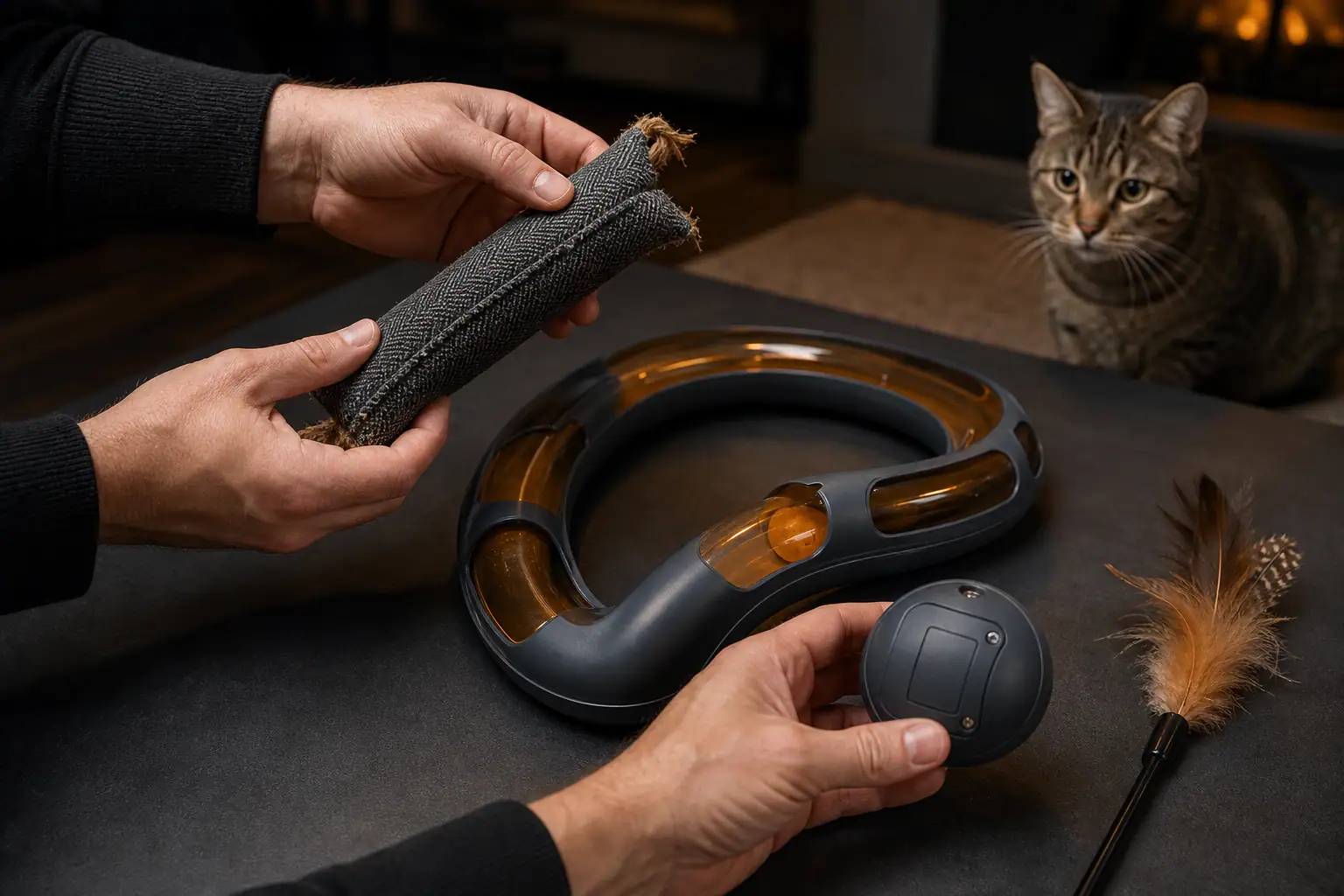
The best interactive cat toys for bored cats are not necessarily electronic. Start with one owner-guided chase toy, one safe object the cat can catch and bite, and one self-directed puzzle or track toy. Match each choice to what your cat actually enjoys—stalking, sprinting, batting, solving, chewing, or bunny-kicking—then rotate a small set instead of leaving every toy out all day.
A useful interactive toy makes the cat do something and produces an outcome: the lure hides, the ball rolls, food appears, or the prey can finally be grabbed. A gadget that flashes while your cat watches from the doorway is not more enriching just because it has a motor. The seven-day reset below helps you identify the play your cat wants, rebuild novelty, and decide which toys are safe enough for supervised or solo use.
Choose the Toy by the Job Your Cat Wants
Many shopping lists treat all boredom as one problem. It is more useful to watch the first move your cat makes. Does the cat crouch and wait, race after motion, fish under doors, wrestle with both back feet, chew the catch, or work patiently for food? Use that behavior to choose a toy category.
| What your cat does | Try first | Why it may work | Access rule |
|---|---|---|---|
| Watches, crouches, then ambushes | Wand lure moved behind a box or through a tunnel | Creates hiding, waiting, and a timed pounce | Supervise; store all corded toys afterward |
| Sprints after anything that rolls | Large rolling ball or enclosed track | Turns batting into movement without requiring high jumps | Test size, shell, and room hazards before solo use |
| Hooks paws into gaps | Box puzzle or sturdy puzzle board | Rewards searching and controlled paw work | Remove if the cat eats cardboard, foam, or small parts |
| Grabs, bites, and bunny-kicks | Long, firmly stuffed kicker with simple construction | Gives teeth and back feet an appropriate capture target | Inspect seams after hard play; retire exposed filling |
| Is strongly food-motivated | Easy puzzle feeder or food-dispensing ball | Adds searching and manipulation to part of a meal | Count food toward the daily ration and clean after use |
| Loses interest when motion repeats | Human-guided lure or tested irregular-motion toy | Changes speed, direction, hiding place, and pause length | Supervise powered toys until their failure points are known |
Watching is part of hunting behavior. A cat that studies a lure for thirty seconds before pouncing is not necessarily bored by it. Look for focused ears, forward whiskers, a low crouch, stillness, and a tail-tip twitch. Change the game when the cat walks away repeatedly, grooms instead, startles, or shows no interest across several low-pressure attempts.
Build a Three-Part Boredom Kit
You do not need a floor full of gadgets. A balanced starter kit covers three different jobs and keeps the highest-risk piece under your control.
- Chase: use a wand, teaser, tossed toy, or another owner-guided target. Move it away from the cat, let it disappear behind cover, pause, and allow frequent catches. For detailed lure and storage checks, see the Titan Claws guide to using a cat toy on a stick.
- Capture: offer a sturdy kicker or larger prey toy the cat can hold, bite, and rake. This matters for rough players that otherwise grind their teeth into a delicate feather attachment or motorized shell.
- Solve: use an easy food puzzle, enclosed track, treat hunt, or stable cardboard puzzle. Start with an obvious reward. A puzzle that is too difficult is not enrichment; it is an object the cat may ignore or attack.
This mix works because each item has a clear role. The wand creates lifelike movement, the capture toy allows a physical win, and the puzzle creates a quieter independent task. Add a scratcher, perch, hiding place, and window view to improve the environment rather than expecting toys to carry the entire load.
The Feline Veterinary Medical Association and International Cat Care environmental-needs guide recommends opportunities for predatory play, intermittent capture, food puzzles, toy rotation, and individual play in multi-cat homes. Those principles are more durable than any one product recommendation.

Run This Seven-Day Play Reset
Use the reset when your cat has a full toy basket but acts unimpressed. Store most toys first, leaving only proven-safe basics available. Keep a one-line note after each session: approached, watched, chased, caught, bit, solved, or walked away. You are looking for a pattern, not a perfect performance.
- Day 1—observe: offer a fabric lure moving slowly along the floor for five to ten minutes. Try hiding it behind a box. Note whether your cat prefers watching, chasing, or grabbing.
- Day 2—change the prey: switch texture and movement. If yesterday looked like a mouse, make today’s lure flutter briefly like an insect or bird, while keeping jumps appropriate for the cat’s age and mobility.
- Day 3—add a physical finish: after several catches, trade the chase lure for a larger kicker. Let the cat grip and kick; never wrestle with hands or feet.
- Day 4—make food work: place a small portion of the normal ration in an easy puzzle or several visible search locations. If your cat becomes frustrated, make the task simpler immediately.
- Day 5—redesign the room: add a box, paper bag with handles removed, tunnel, or furniture corner as cover. Familiar toys often become interesting when the hunting route changes.
- Day 6—test independent play: offer an enclosed track, large ball, or previously supervised puzzle in a cleared room. Watch the entire session and note chewing, dismantling, wedging, fear, and loss of interest.
- Day 7—repeat the winner: combine the two strongest responses into a short sequence: stalk, chase, catch, bite or kick, then finish with part of a meal or a small food search.
After the week, keep three to five active options that cover different behaviors and store the rest in a closed cat toy box. Swap one or two items when interest fades. Rotation restores contrast; it does not make a poor toy safe or guarantee that every cat will like it.