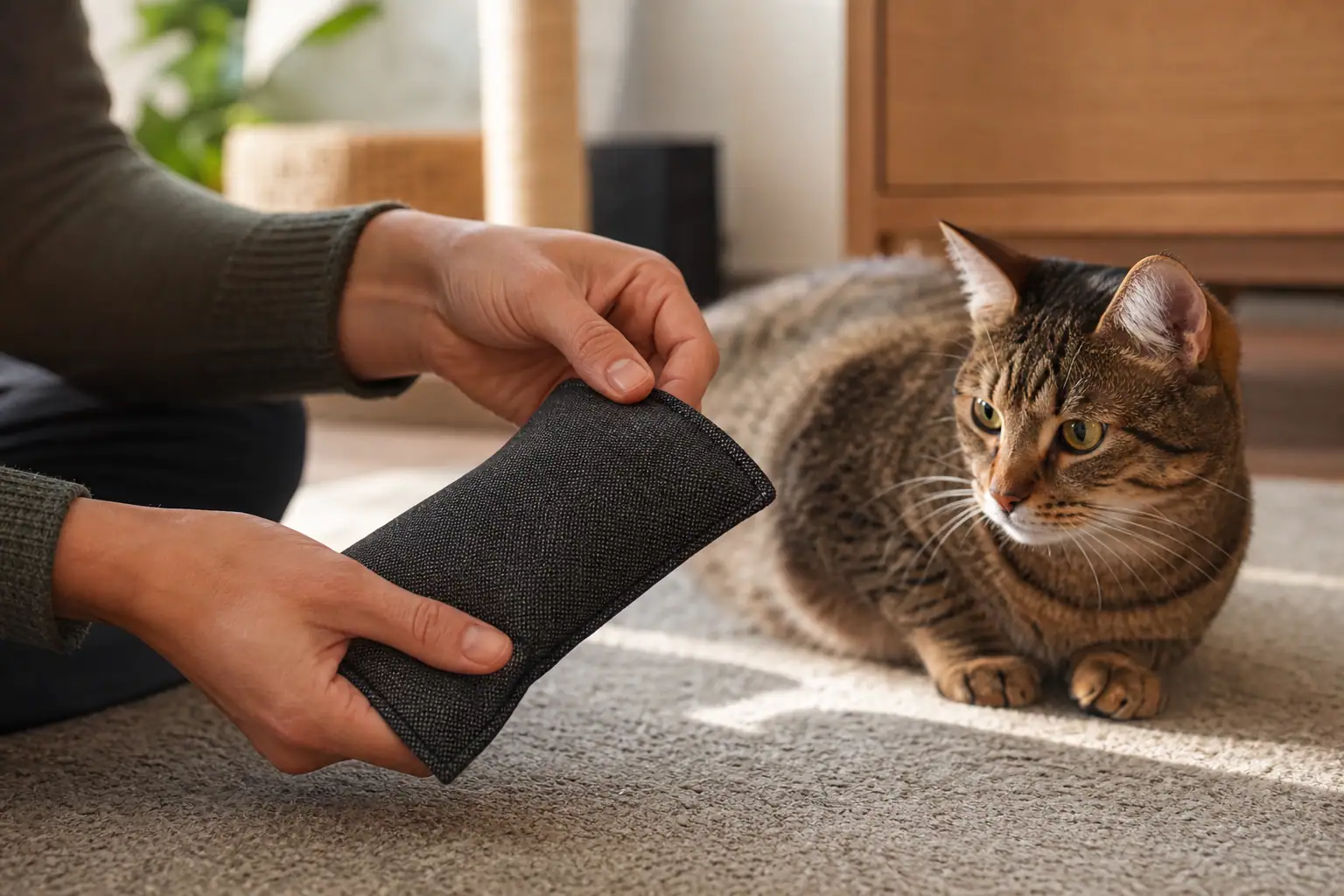
For most healthy adult cats, start with two or three interactive play sessions a day, about 10–15 minutes each. That is a practical starting point, not a rigid quota. A kitten may want many shorter bursts; a senior or cat with arthritis may prefer gentler five-minute games; a high-energy indoor cat may ask for another round.
Frequency matters more than forcing one long workout. Spread play across the day, let your cat stalk and catch the toy, and stop when their interest or comfortable movement fades. Judge the routine by your cat’s behavior and recovery—not only by the clock.
How Much Playtime Do Cats Need?
There is no scientifically proven daily number that fits every cat. A detailed review of domestic-cat play research concluded that important questions—including how much and what kind of play pet cats need—remain understudied. The AAFP/ISFM Feline Environmental Needs Guidelines recommend opportunities for play and predatory behavior, but they do not prescribe one universal minute target.
That is why competing answers such as 15, 30, 45, or 60 minutes should be treated as starting ideas, not pass–fail standards. A focused eight-minute hunt with several catches can be more satisfying than 30 minutes of waving a toy after the cat has checked out.
| Cat | Starting frequency | Typical session | How to adjust |
|---|---|---|---|
| Healthy adult | 2–3 times daily | 10–15 minutes | Add or shorten sessions according to engagement and recovery |
| Kitten | Several opportunities throughout the day | 5–10 minutes | Use frequent short bursts; stop before panting or loss of coordination |
| Senior cat | 2–3 gentle sessions daily | 3–10 minutes | Keep toys low, reduce jumping, and follow veterinary mobility advice |
| High-energy indoor cat | 3 or more varied sessions | 5–15 minutes | Add foraging, training, climbing, and solo enrichment rather than only longer chasing |
| Multi-cat home | Daily individual turns plus compatible group play | 5–15 minutes per cat | Prevent one cat from monopolizing the toy or blocking another cat |
The table describes owner-led, interactive play. A ball left on the floor, a puzzle feeder, climbing, scratching, and play with a compatible cat all add value, but they do not always replace the control and social contact of a game with you. Our broader cat enrichment plan can help you balance play with foraging, climbing, exploration, scratching, and rest.
Adjust the Schedule to Your Cat
Age is useful, but it is not the whole answer. Health, temperament, play history, indoor or outdoor access, time of day, toy preference, and the presence of other cats all change what a good schedule looks like.
Kittens: more chances, shorter games
Kittens often switch rapidly between sprinting, wrestling, eating, and sleeping. Offer several supervised play opportunities instead of trying to exhaust a kitten in one marathon. Use appropriately sized toys, keep strings and small parts out of solo reach, and never encourage attacks on hands or feet. A kitten who learns that skin is the target can carry that painful habit into adulthood.
Adult cats: build a repeatable rhythm
Many adults do well with a brief game before breakfast, another in the late afternoon or evening, and an optional wind-down session before bed. Cats are often naturally active around dawn and dusk, but your cat’s reliable alert periods matter more than forcing an exact time. If they consistently walk away at minute seven, make seven good minutes the plan.
Senior cats and cats with medical conditions: preserve choice
Older cats still benefit from play, even when running and jumping are uncomfortable. Slide a lure slowly across a rug, offer a kicker while the cat is lying down, or use an easy food puzzle. Keep the target close and low, add nonslip footing, and provide an easy exit. Ask your veterinarian for activity limits if your cat has arthritis, heart or breathing disease, neurologic problems, recent surgery, obesity, or another condition that affects exercise.
A sudden decrease in play is not automatically aging or boredom. Pain, dental disease, illness, impaired vision, and stress can all change activity. Arrange veterinary care when a normally playful cat abruptly stops, hides more, moves stiffly, misses jumps, loses appetite, breathes differently, or shows another new symptom.
High-energy and rough-playing cats: add variety, not just minutes
A cat who destroys ordinary toys may need several outlets: a wand for stalking and chasing, a larger sturdy kicker for catching and bunny-kicking, a food puzzle for problem-solving, and safe climbing or exploration. Match the object to the behavior instead of asking one toy to survive every job. The Titan Claws guide to durable cat toys explains how to match toys to biting, seam-ripping, string-chewing, and impact.
How to Run a Satisfying 10-Minute Play Session
Quality play resembles a small hunt. It changes speed, includes cover and pauses, and gives the cat real chances to catch. Constantly circling a lure above the cat’s head is exercise for the human wrist, but often a poor hunt.
- Invite; do not insist. Choose a time when your cat is awake and scanning the room. Move the toy at a distance and let the cat decide whether to engage.
- Make the toy act like prey. Move it away from the cat, around a box, or briefly behind furniture. Small ground-level movements are often more convincing than repeatedly pushing the lure toward the cat’s face.
- Use pauses. Give the cat time to watch, listen, crouch, and plan. Stalking is part of play; a still cat is not necessarily bored.
- Allow frequent catches. Let the cat pin and hold the lure. Do not yank every catch away immediately. If the cat bites or bunny-kicks hard, transfer the action to a sturdy capture toy rather than your hand.
- Lower the intensity. After several chase-and-catch cycles, make the movements smaller and slower. Finish with a final catch instead of making the toy vanish mid-pursuit.
- Close the routine. A small portion of the cat’s normal meal or an easy foraging task can follow play. Count any food toward the daily diet rather than adding unmeasured treats.
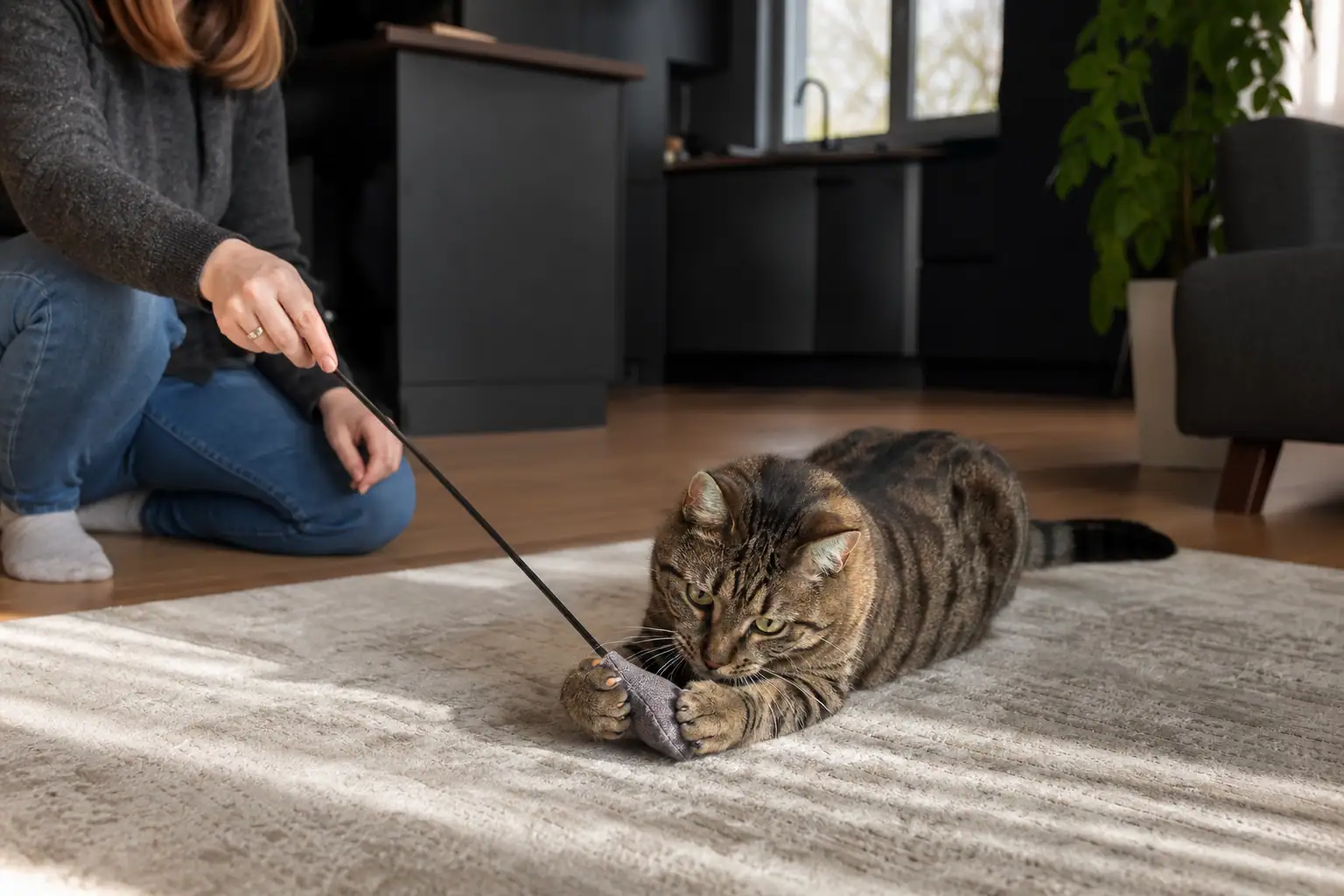
A wand keeps your hands away from teeth and creates better prey-like movement, but it is not a leave-out toy. See our cat wand safety guide for lure choices, technique, storage, and replacement points.