
Household vinegar is not usually a poisoning emergency for cats in tiny accidental amounts, but it is not something to feed, spray on, or use as medicine. A diluted vinegar-and-water cleaner is generally low risk when you keep your cat away from the wet solution, rinse the treated item when appropriate, and let it dry completely. Undiluted vinegar can irritate the mouth, stomach, skin, and eyes, and stronger cleaning or horticultural acid products can cause much more serious injury.
That makes the honest answer to “is vinegar safe for cats?” conditional. Safe use depends on the product, concentration, amount, route of exposure, and whether your cat can walk through or lick the residue. White vinegar and apple cider vinegar are not proven flea treatments, ear cleaners, skin remedies, or daily supplements for cats.
Vinegar and Cats: The Quick Safety Guide
Use this table to sort an ordinary household-cleaning question from an exposure that needs professional help. It cannot determine the risk for an individual cat, especially when the product or amount is unknown.
| Situation | Likely concern | What to do |
|---|---|---|
| Cat briefly smells vinegar from across a ventilated room | The sharp odor may be unpleasant or stressful, but a brief smell is not the same as drinking it | Give the cat an exit, ventilate, and never spray toward the cat |
| Cat returns after a diluted cleaning solution was rinsed and fully dried | Low exposure when the product was used correctly | Check that no puddles, damp cloths, or open containers remain |
| One lick from a damp surface | Possible drooling, mouth irritation, vomiting, or diarrhea | Remove access, note the product and amount, and call your veterinarian if signs develop or the exposure is more than a trace |
| Vinegar spilled on paws or coat | Skin irritation plus ingestion during grooming | Prevent grooming, rinse with lukewarm water, and contact a veterinarian or animal poison service for case-specific advice |
| Product splashed into an eye | Painful irritation or chemical injury | Start a gentle water rinse if you can do so safely and contact a veterinarian immediately |
| Cat drinks undiluted vinegar or contacts a concentrated acid product | Greater risk of digestive or corrosive injury | Call a veterinarian or animal poison service now; do not induce vomiting or try to neutralize it |
Do not assume every bottle called vinegar is ordinary food vinegar. Cleaning concentrates, horticultural products, and other acetic-acid solutions may be substantially stronger. Keep the original label, follow its directions, and treat an unknown concentration as a reason to call rather than guess.
How to Clean With Vinegar Around Cats
The ASPCA Animal Poison Control Center says vinegar can cause stomach upset and irritation, but a diluted solution is generally not an issue when it is rinsed and allowed to dry. Those last three conditions—dilution, rinsing, and drying—are the useful part of the advice.
- Read the exact bottle and surface instructions. Confirm the product concentration and whether vinegar is compatible with the floor, seal, grout, stone, appliance, or fabric. Do not pour a stronger product into an unmarked spray bottle.
- Move your cat and cat gear first. Put your cat in another comfortable room. Remove bowls, bedding, loose toys, and anything the cat mouths from the cleaning area.
- Use one product. Never improvise by adding bleach, disinfectant, ammonia, peroxide, essential oil, or another cleaner. The CDC warns never to mix household bleach or disinfectants with other cleaners; mixing bleach with an acid such as vinegar can release dangerous chlorine gas.
- Control wet contact. Wipe rather than creating a cloud of spray, close the bottle, and keep the cat away from buckets, soaked cloths, and damp floors.
- Rinse where appropriate. Food-contact surfaces, bowls, toys, and items a cat may lick deserve special care. Follow the item’s directions and remove both residue and strong odor.
- Ventilate and dry completely. Open a window or run ventilation, then inspect low corners and the floor before the cat returns.
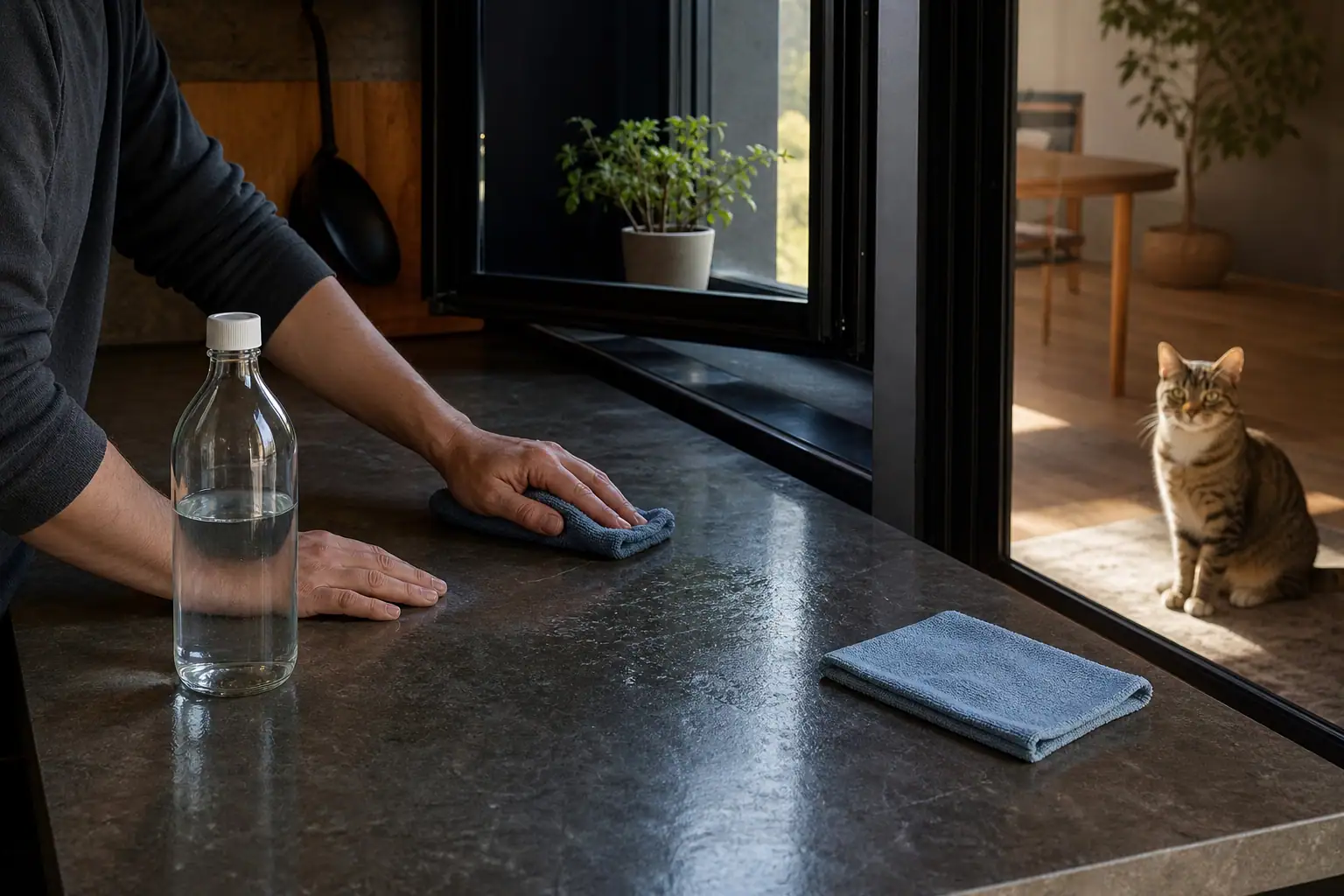
Vinegar is a cleaner for certain jobs, not a universal disinfectant. The Merck Veterinary Manual explains that acetic acid has antimicrobial action at some concentrations, but that does not tell you whether a homemade mixture will kill a particular pathogen on a particular surface. If you truly need disinfection after infectious illness, ask your veterinarian which labeled product, dilution, contact time, rinse, and re-entry routine to use.
For ordinary dirt, soap, water, and scrubbing are often enough. Our broader guide to pet-safe cleaners for cats explains how to compare products, clean floors, and handle enzyme cleaners without relying on a vague “natural” label.
Should You Use Vinegar to Clean Cat Toys?
You usually do not need vinegar to clean a cat toy. The better method depends on the toy’s material and manufacturer instructions. A washable hard toy may need warm water and mild fragrance-free detergent; a machine-washable fabric kicker may need a mesh bag and a full dry; an electronic toy may allow only surface wiping.
- Hard plastic, rubber, and silicone: clean grooves and food residue using the maker’s method, rinse thoroughly, and retire anything cracked, sticky, swollen, or sharply chewed.
- Fabric toys: use the permitted wash cycle, skip scent boosters and fabric softener, dry through the center, then pull gently at every seam.
- Catnip or silvervine toys: follow the label. A toy that stays wet inside, smells musty, leaks filling, or cannot be cleaned should be replaced.
- Wands, feathers, rope, and glued parts: surface cleaning cannot repair a frayed cord, bent wire, loose feather, or failing attachment.
- Electronic toys: power off and follow the manual. Do not let liquid enter a motor, battery compartment, speaker, switch, or charging port.
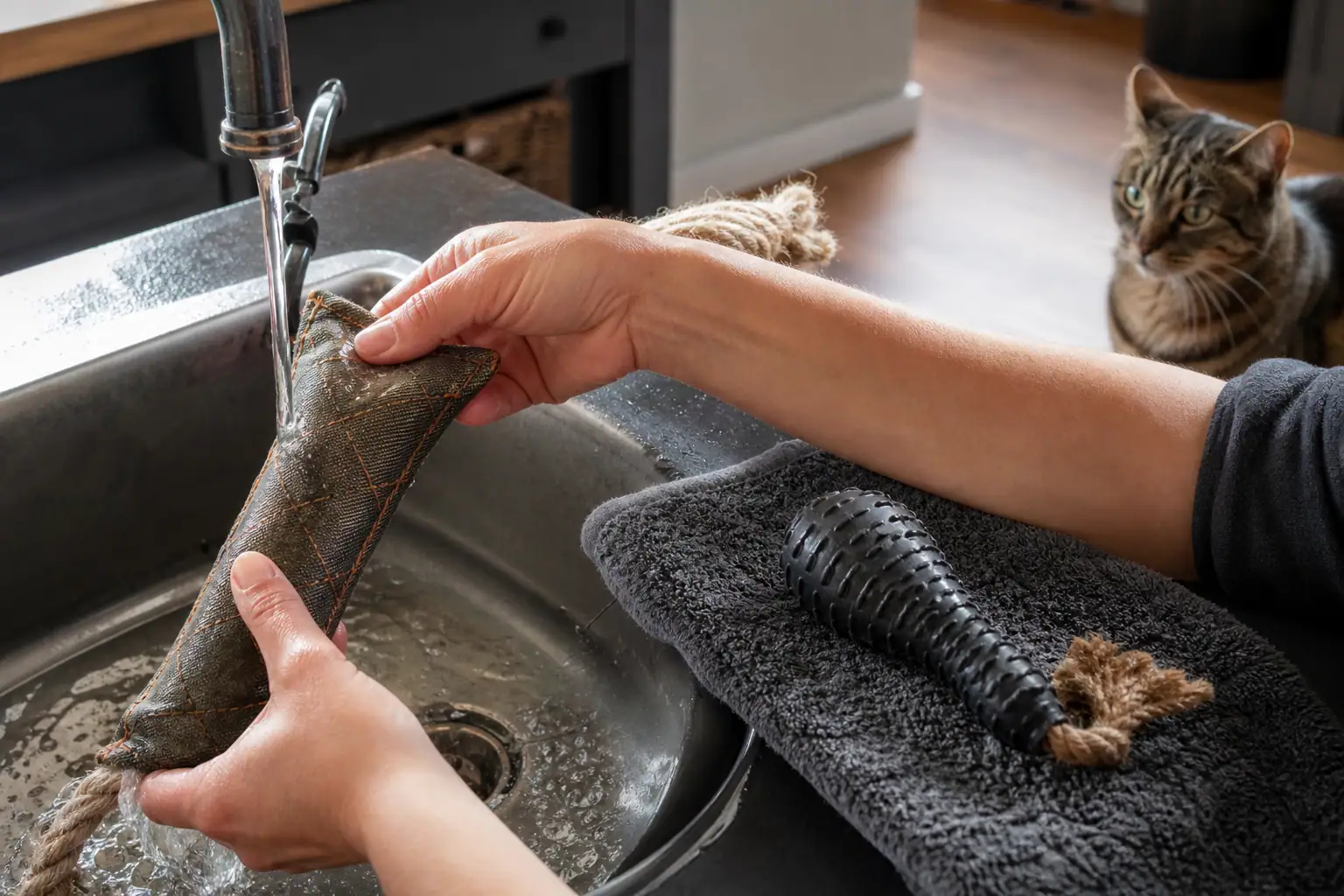
If a manufacturer permits diluted vinegar, keep the cat away during cleaning, rinse the toy, dry it fully, and smell it before returning it to play. A lingering sharp odor may make the toy aversive even when residue is small. Never soak a toy simply because an internet recipe recommends it.
For cats that bite, shake, and bunny-kick hard, cleaning time is inspection time. Press seams, check attachments, flex plastic, and account for every piece. Our durable cat toys guide shows the failure points rough players expose first. Cleaning cannot make an opened seam, exposed stuffing, sharp edge, or damaged battery door safe again.