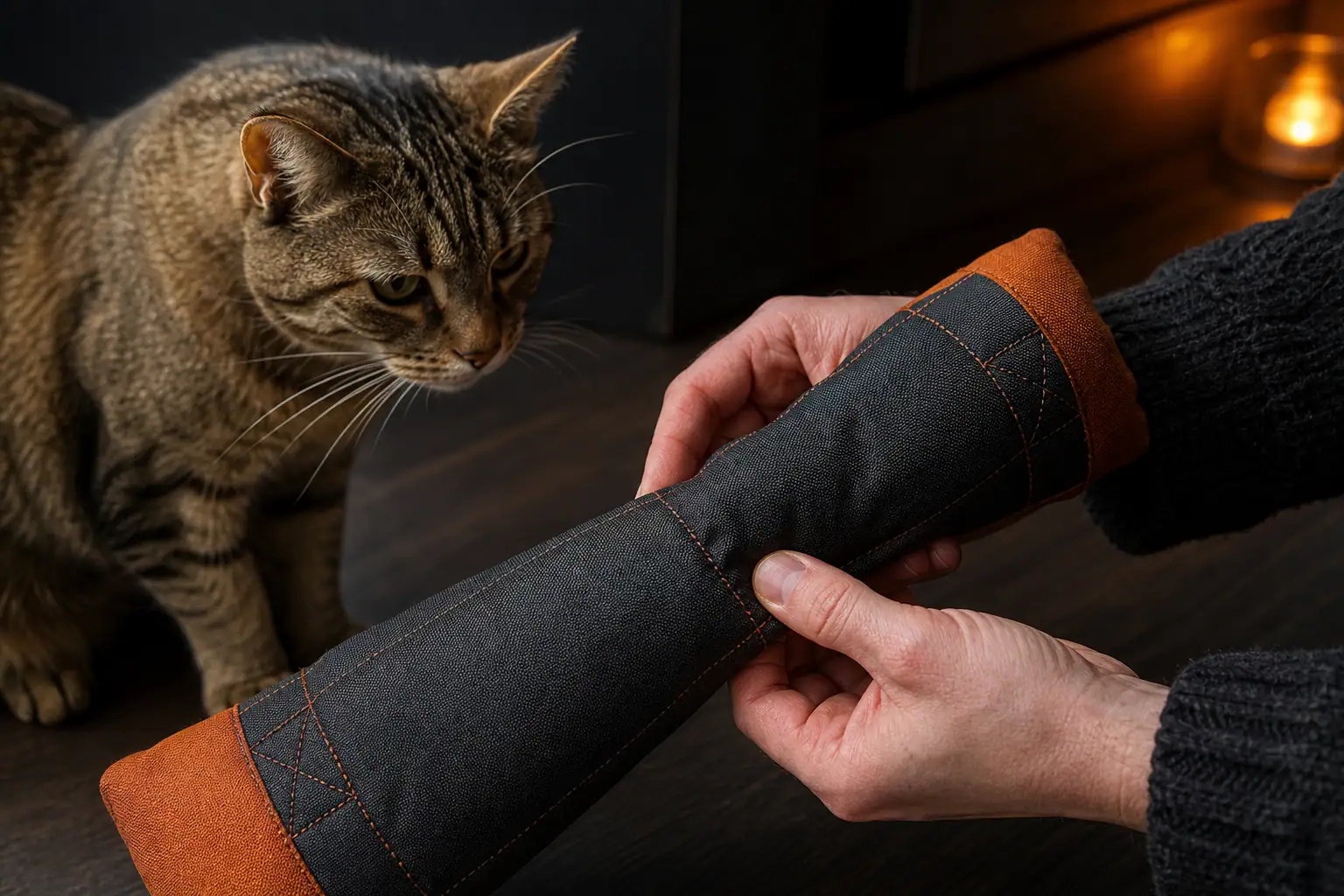
The best self-play cat toys are enclosed ball tracks, stable food puzzles, oversized batting toys, simple activity mats or tunnels, and sturdy kickers that match how your cat bites and paws. Motion-activated toys can also work, but only after you have watched several sessions and confirmed that your cat cannot expose a battery, motor, cord, or detachable lure.
The important distinction is easy to miss: self-play describes who moves the toy; it does not mean the toy is safe to leave with a cat unattended. A cat can play independently with a fabric mouse while you answer email in the same room, yet that same mouse may be a poor choice when you leave home if the cat tears off its tail or eats the stuffing.
A good setup uses a few toys with different jobs, not a floor covered in gadgets. Give your cat something to chase, something to catch, and something to solve. Keep string, ribbon, feathers, elastic, and fragile electronics for supervised sessions, especially if your cat destroys ordinary toys.
Quick picks: 9 self-play cat toy types
Choose from categories before comparing brands. Construction can vary widely within the same category, so inspect the exact product in your hands and test it with your cat.
| Toy type | Best for | Access rule |
|---|---|---|
| 1. Enclosed ball track | Swatting, circling, and repeated cause-and-effect play | Often suitable to leave out if the base is stable and the ball cannot come free |
| 2. Stationary food puzzle | Patient paw work and cats new to foraging | Start easy; use part of the normal food allowance and check for removable pieces |
| 3. Rolling food puzzle | Food-motivated cats that like to chase | Test the opening size, floor area, noise, and whether the toy can become trapped |
| 4. Oversized smooth ball | Batting and short hallway chases | Choose a size that cannot be swallowed and a material the cat cannot peel apart |
| 5. Wide tunnel or activity mat | Hiding, ambushing, scratching, and exploration | Remove exposed wire, elastic loops, torn mesh, dangling toys, and loose fasteners |
| 6. Simple fabric kicker | Grabbing, biting, carrying, and bunny-kicking | Conditional: inspect seams and remove it if the cat opens fabric or eats fibers |
| 7. Hunt box | Fishing toys or food from safe openings | Use only while present if the cat eats cardboard, foam, tape, or broken toy pieces |
| 8. Enclosed motion toy | Stalking and pouncing when you are busy nearby | Supervise first; require a screwed battery door and no accessible moving joint |
| 9. Automatic lure or spinner | Short, high-interest chase sessions | Supervised only when it includes feathers, string, elastic, wire, or detachable lures |
The joint AAFP/ISFM feline environmental-needs guidelines recommend opportunities to search, stalk, chase, pounce, catch, and manipulate toys. They also specifically advise putting away string-like or ingestible toys after play. That is why a balanced self-play kit includes both low-risk leave-out options and exciting toys that return to storage.
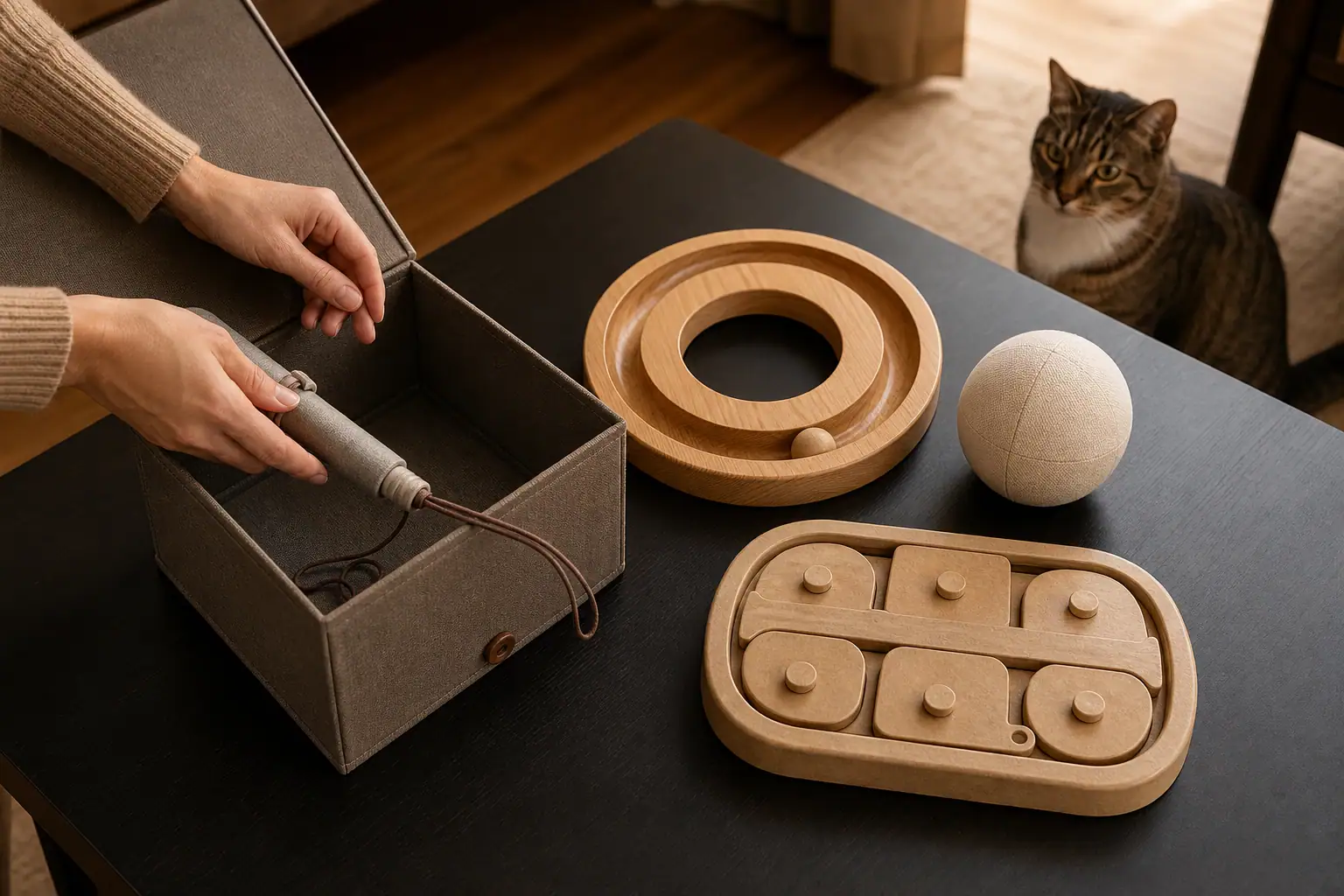
Match the toy to the first move your cat makes
The phrase “interactive cat toy” is too broad to predict what an individual cat will use. Watch the first move your cat makes when play begins, then choose a toy that lets that behavior produce a result.
- Crouches and waits: try a tunnel, hunt box, or enclosed motion toy that disappears and returns. Place it near cover rather than in the middle of an empty room.
- Swats repeatedly: try an enclosed track, large lightweight ball, or stationary puzzle with sliding pieces.
- Chases anything that rolls: try an oversized ball or rolling food puzzle on a clear floor. Block access under appliances before the first session.
- Grabs and bunny-kicks: use a kicker long enough for the front paws to hold while the back feet rake. A small mouse may be exciting, but it does not give a hard kicker enough target.
- Fishes under doors or furniture: try a stable puzzle board or a sturdy box with openings larger than a trapped paw but smaller than the cat’s head.
- Works for food: begin with a shallow stationary puzzle, then move to rolling or multi-step designs only after the cat succeeds easily.
A food puzzle is not merely a distraction. A review in the Journal of Feline Medicine and Surgery describes ways puzzles can support foraging and presents clinical cases in which they were used as part of broader health or behavior plans. The authors also emphasize matching the challenge to the cat and introducing puzzles gradually.
Food toys still need dietary judgment. Measure the portion before loading the puzzle, count treats within the daily plan, wash food-contact surfaces, and ask your veterinarian before changing how a cat with a prescription diet, diabetes, food guarding, dental pain, or mobility limitations is fed.
Use the six-point leave-out test
Before calling any toy an unattended option, watch your cat use it while you are present. Then check all six points below. A single failure moves the toy into supervised-only use.
- No linear parts: there is no accessible string, ribbon, yarn, elastic, feather shaft, wire, or long fabric tail. These can be chewed off, swallowed, or wrapped around a limb.
- No swallowable parts: balls, caps, bells, plugs, eyes, stuffing, foam, and broken fragments cannot enter the cat’s mouth or come free under pulling.
- No power access: a battery door closes with a screw, the housing has no cracks or bite openings, and charging cords are removed before play.
- No trapping route: the cat cannot wedge its head or paw into an opening, collapse the toy around itself, tip a heavy object, or chase it toward stairs, water, blind cords, or a tight gap.
- No edible failure material: the cat does not peel, shred, or consume the fabric, rubber, cardboard, carpet, glue, or coating.
- Easy to inspect: you can see the seams, shell, fasteners, openings, and attachments well enough to notice a change before the next session.
Cornell Feline Health Center’s toy-safety guidance cautions against small pieces, strand-like parts, feathers, string, and chewable electrical cords. It also points out that inexpensive options such as boxes and ping-pong-style balls can be enriching; price and technology do not determine whether a toy is useful.
Powered toys deserve an extra round of testing because motion invites harder capture attempts. Our guide to automatic cat toys for when you are away covers timer behavior, battery access, room setup, and alternatives for cats that dismantle electronics.