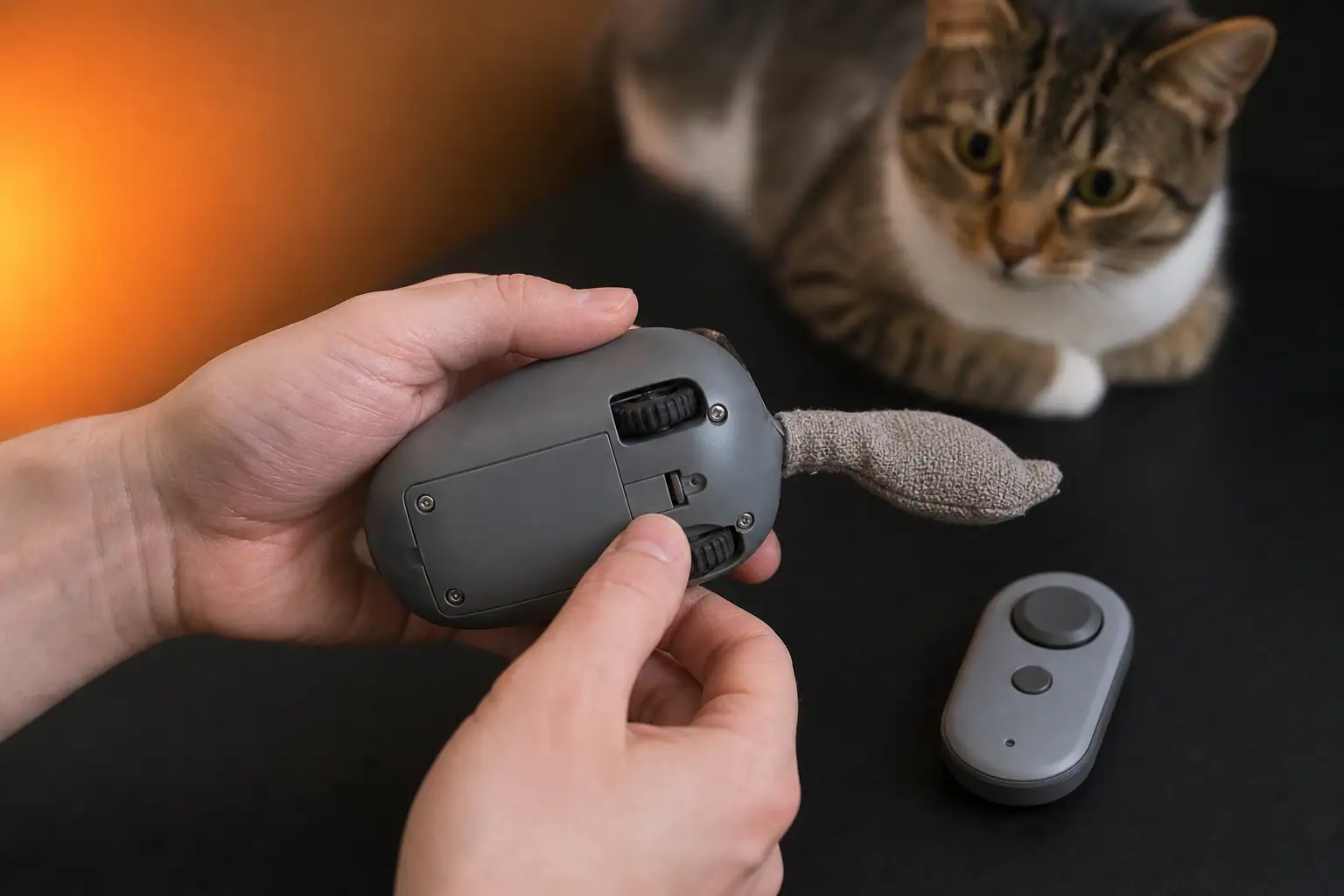
A remote control cat toy can be a good choice when your cat loves ground chases and you want a more responsive game than an automatic toy can provide. The best designs let you start, stop, turn, hide, and offer frequent catches while keeping batteries, wheels, and small attachments beyond a cat’s teeth and claws. Choose for your cat’s play style and your flooring—not for the longest feature list.
For a rough player, treat every motorized mouse, ball, or wheeled creature as supervised-only. Inspect it before and after play, put the charging cable and remote away, and end the session if your cat starts chewing the housing or prying at its seams. No remote control cat toy is indestructible.
This guide focuses on owner-controlled toys rather than generic automatic gadgets. You’ll learn which type fits your cat, what to check before buying, how to steer it like prey, and exactly when to stop using it.
Remote control cat toys at a glance
Remote control is useful because you—not a fixed program—can respond to your cat. You can slow down for a cautious stalker, pause when the cat loses sight of the target, and stop the motor as soon as the toy is caught. That makes the controller more than a novelty; used well, it turns a motorized object into interactive play.
| Type | Often suits | Main advantage | Main caution |
|---|---|---|---|
| Remote-control mouse | Ground stalkers on hard floors | Prey-like size and turns | Small tail, ears, wheel gaps, or button batteries |
| Large rolling or wheeled toy | Fast chasers and hard pouncers | Easier to see and harder to swallow | Plastic chewing, high speed, furniture collisions |
| Remote plus automatic mode | Cats that enjoy varied movement | Manual play and optional preset cycles | Automatic mode can hide poor control or unsafe behavior |
| App-controlled camera toy | Owners who want remote check-ins | Live view and distance control | Blind spots, latency, privacy, no physical supervisor |
| Remote laser | Some visually driven cats | Movement without a chewable moving unit | No physical catch and potential eye exposure |
For most cats, start with a physical rolling target you can stop instantly. A laser needs a stricter beam-safety and catch plan; see our guide to whether laser toys are bad for cats before choosing that route. If you are comparing all motorized formats, the broader electronic cat toys guide covers covered-motion toys, kickers, rotating lures, and automatic options too.
Seven checks before you buy
A product page may emphasize speed, range, or app features. Those details matter only after the toy passes the physical and practical checks below.
- Stop control: the toy should stop promptly when you release a button or press stop. A delayed response is a problem when a paw, tail, or toy is pinned.
- Battery security: prefer a rigid compartment that requires a tool to open. A sliding cover, flexible tab, or decorative flap is not enough for a cat that bites and kicks.
- Reachable parts: look closely at tails, ears, eyes, antennae, wheel hubs, axle gaps, and charging-port covers. Skip anything you could pull off with light finger pressure.
- Size and shell: choose a unit too large to swallow, with a smooth casing that does not flex or separate when pressed. Tiny realism is not a benefit if it creates tiny parts.
- Floor fit: small wheels may work only on hard floors; deep carpet can stall them. Check turning radius, traction, clearance, and whether the unit can climb a rug edge unexpectedly.
- Sound and speed: the lowest setting should be slow enough for stalking. A loud gearbox or instant full-speed launch can frighten a cautious cat.
- Cleaning and replacement: dirt and hair collect around axles. You should be able to clean the exterior and wheel area without wetting electronics, and replace a lure without exposing the drive system.
Read the manual before buying when one is available. Specifications can expose compromises that a product photo hides. For example, the manufacturer page for one popular remote-control mouse says it works only on hard surfaces, uses four button batteries, contains small parts, and requires supervised play. That does not make the product automatically right or wrong; it shows why the manual and warnings belong in the buying decision.
How to use a remote control cat toy like prey
The goal is not to see how fast you can drive. Cats commonly hunt through watching, stalking, chasing, pouncing, grabbing, and biting. A satisfying game includes pauses and successful catches; a toy that always escapes can become boring or frustrating.
A 10-minute first session
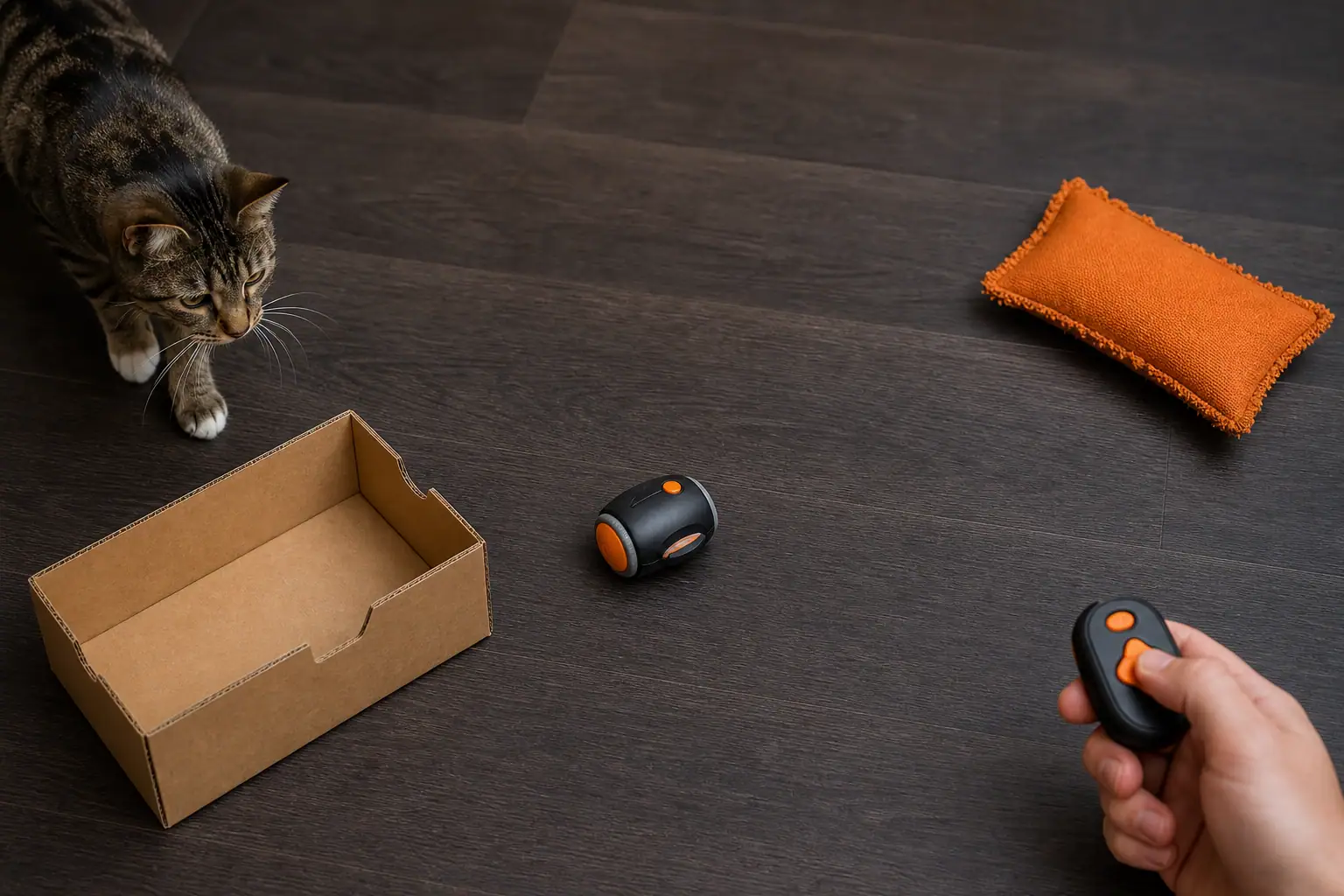
- Prepare the route (2 minutes): close off stairs and appliance gaps. Move drinks, breakables, cords, and unstable objects. Place a cardboard box, tunnel, or chair leg along the route as cover, and set a large fabric kicker near the finish.
- Introduce it switched off (1 minute): place the toy several feet away. Let your cat approach, sniff, retreat, or ignore it. Do not drive it directly at the cat.
- Start small (2 minutes): make one slow movement across the cat’s field of view, then stop. Move away from the cat rather than chasing the cat. Let the toy disappear partly behind cover.
- Build a hunt (3 minutes): alternate a few seconds of movement with longer pauses. Turn only when needed. Let the cat catch and pin the toy several times, switching the motor off during each catch.
- Offer the bite (1 minute): if the hard housing is not appropriate for biting, stop beside the kicker and shift the cat’s attention to that physical target.
- End and inspect (1 minute): finish after a catch, offer a small food reward if suitable, then check the toy for heat, cracks, loosened parts, hair around the axles, and a changed motor sound.
The timing should flex with the cat. A senior or hesitant cat may only watch two slow passes. A young, athletic cat may want several short rounds. Stop while your cat is still comfortable rather than running the battery down. The practical play-sequence advice from Preventive Vet likewise emphasizes behaving like prey, letting the cat catch it, and slowing the game to a clear finish.
Use the room as part of the game. A toy that vanishes behind a box and peeks out is often more interesting than one circling in an empty space. Our guide to cat toys that move explains how different motion patterns fit stalkers, sprinters, and wrestlers.