Field Note

Cat String Toys: Safer Play for Cats Who Love to Chase

Use cat string toys safely with supervision, better materials, smart storage, and a play routine that gives cats a real catch.

Cat string toys can be excellent for interactive play because they let you mimic prey: darting, hiding, pausing, and escaping just out of reach. They are also one of the cat toy categories that needs the clearest safety rules. A string toy should be used while you are actively controlling it, then inspected and stored away after the session.

The short answer is this: choose cat string toys with sturdy attachments, short supervised sessions, no loose or fraying strands, and a real catch toy at the end. Do not leave string, yarn, ribbon, elastic, or wand toys out for unsupervised play, especially if your cat chews, swallows non-food items, or destroys ordinary toys.

Why cats like string toys so much

String toys appeal to the hunting sequence cats are built to perform: watch, stalk, chase, pounce, grab, bite, and reset. The value is not the string itself. The value is movement you can control. A good wand or teaser can slip behind a box, rustle under tissue paper, pause near a doorway, or move away from the cat like a small animal trying not to be caught.

That is why many cats ignore a toy dragged toward their face but launch after the same toy when it disappears around a corner. Prey does not charge the predator. It hides, hesitates, runs, and makes mistakes. The RSPCA NSW guide to interactive string-toy play gives the same practical advice: create ambush cover, move the toy like prey, let the cat succeed, and keep sessions short enough that the cat winds down.

For Titan Claws readers, the important distinction is control. String is a good connector while you are directing the game. It is not a good chew target, capture toy, or overnight boredom toy.

The main safety risk: swallowed string

The hazard with cat string toys is not that every supervised wand is dangerous. The hazard is loose linear material getting chewed, swallowed, wrapped, or left where a cat can work on it alone. VCA Animal Hospitals explains linear foreign bodies in cats as long, thin objects such as string, yarn, and tinsel. If one end anchors in the mouth, stomach, or intestine, the intestines can bunch around it and serious injury can follow.

Cornell Feline Health Center gives a simple shopping rule in its safe toys and gifts guidance: avoid toys with small pieces or strand-like parts such as feathers and string that can detach and be ingested. The University of Wisconsin School of Veterinary Medicine makes the same point for aggressive chewers, warning that feathers, strings, sparkly parts, loose decorations, loops, and tags should be avoided or removed when a cat is likely to ingest them.

Those warnings do not mean you can never use a string wand. They mean the string should stay in your hand, stay in view, and go into closed storage when the game is over.

How to choose safer cat string toys

Most shopping results for cat string toys show wands, feather teasers, elastic cords, ribbons, suction-cup toys, door-hanging toys, and automatic string devices. They may all look similar on a product page, but they fail in different ways. For a rough player, look at the failure point before you look at the color or novelty.

  • Choose a sturdy handle. A longer wand keeps hands away from claws and lets you move the lure without dangling it in the cat’s face.
  • Prefer strong, visible cord over thin thread. Very thin string, fraying yarn, fishing line, and elastic strands are harder to inspect and easier to chew through.
  • Check the connector. Clips, knots, swivels, and glued points should not open, splinter, or shed small pieces under tugging.
  • Use replaceable attachments. A lure that can be removed and replaced is safer than one weak feather bundle you keep using after it starts to fail.
  • Avoid bells and tiny decorations for chewers. They add little to the game and create extra parts to swallow.
  • Skip unattended door or suction toys for cats that chew cord. A toy mounted to a doorway may still leave the string accessible when you are not watching.

If your cat is known for shredding plush, opening seams, or eating pieces, use the string toy only for chase. Then hand off to a larger toy built for biting and raking. Titan Claws has deeper material and rough-play guidance in durable cat toys, cat kicker toys, and cat toys for play aggression.

Set up the room before you start

The easiest way to make string-toy play better is to stop waving the toy in open air with no plan. Cats are ambush hunters. Give them places to stalk from and places for the toy to hide.

  1. Clear the floor of cords, hair ties, rubber bands, and fragile objects.
  2. Add simple cover: a box, tunnel, scratcher, chair leg, paper bag with handles removed, or folded towel.
  3. Keep the string length controlled so it cannot wrap around the cat’s neck, legs, or tail.
  4. Move the lure away from the cat, not toward the cat’s face.
  5. Pause often. Watching and stalking are part of the game.
  6. Let the cat catch the lure sometimes, then trade to a safer bite toy if the cat starts chewing the string.

Short sessions are usually better than one long frantic session. Two to fifteen minutes is plenty for many cats, depending on age, fitness, and interest. Stop before the cat is panting, frustrated, or grabbing at your hands.
Free Checklist

Free checklist: 30 ways to enrich your indoor cat's life.

Practical, printable, no fluff. Get the complete Indoor Cat Enrichment Checklist delivered to your inbox.

Use a safer play sequence

A strong string-toy routine has a beginning, middle, and finish. That matters for behavior as much as safety. A cat that only chases and never catches can become frustrated. A cat that catches the string and starts chewing needs a better target.

Try this sequence:

  1. Stalk: Drag the lure slowly behind furniture or a box. Let the cat watch.
  2. Chase: Add short bursts across the floor, then pause.
  3. Pounce: Let the cat catch the lure on the ground. Avoid high jumps on slippery floors.
  4. Trade: If the cat bites down hard, move to a larger kicker, plush, or chew-appropriate toy.
  5. Reward: End with a small meal, treat, or food puzzle if it fits the cat’s diet.
  6. Store: Inspect the string, clip off loose threads only if the toy remains structurally sound, and put it in a closed bin or drawer.
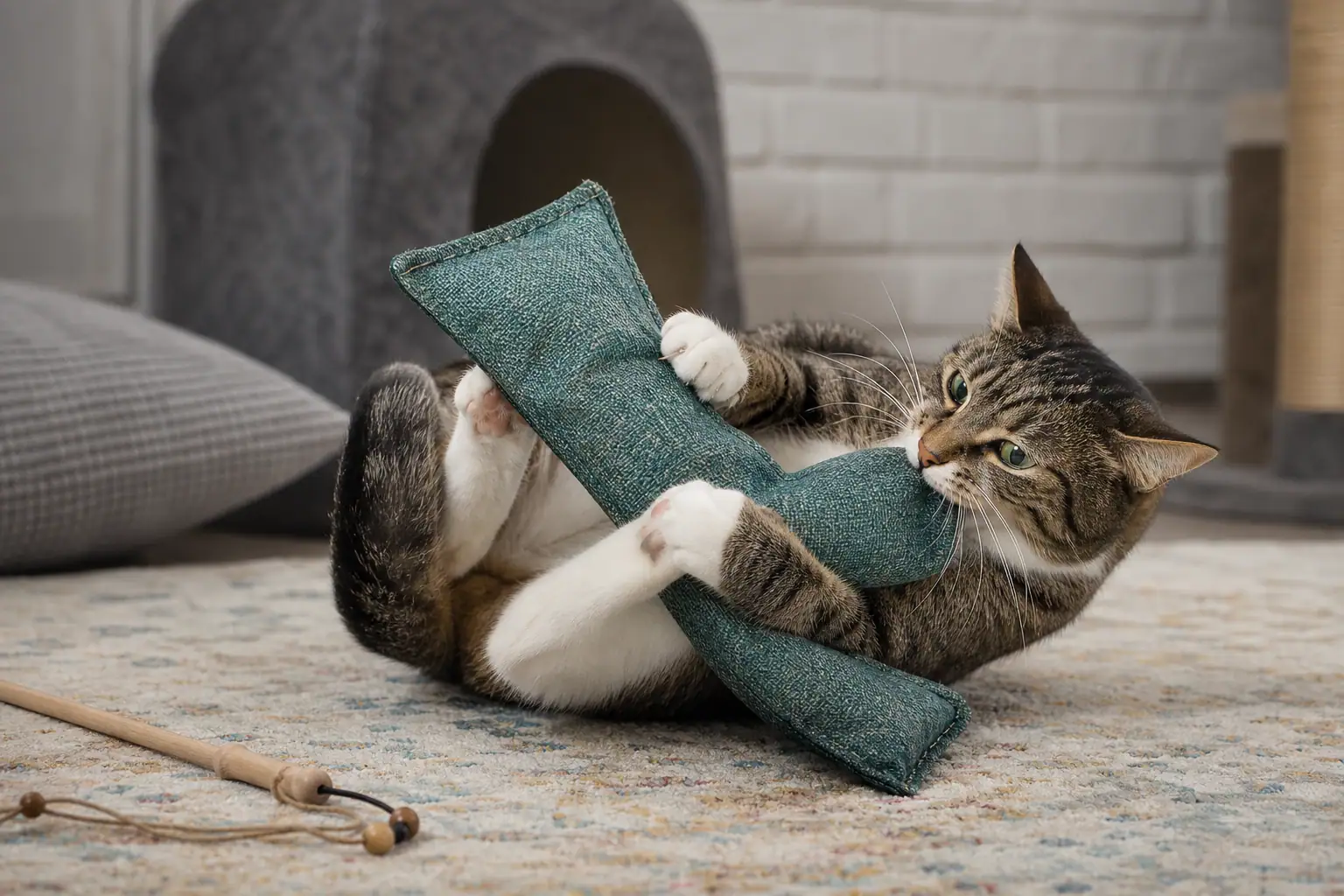
Cat biting a larger fabric kicker toy after chasing a wand toy
End chase play with something your cat can safely grab, bite, and kick.

This is especially useful for cats that attack ankles or hands. The string toy creates distance. The catch toy gives the cat something legal to bite. For cats that redirect onto people, see the Titan Claws guide to cat toys for play aggression.

What to avoid with string toys

Some string toy habits are risky even when the toy is marketed for cats. Treat these as red flags:

  • Leaving wand toys, ribbons, yarn, tinsel, sewing thread, dental floss, or elastic cords out after play.
  • Letting a cat chew the string as the reward at the end of the session.
  • Using one string toy with multiple cats at the same time, which can create conflict and tangles.
  • Draping string over a sleeping cat or wrapping it around paws, tail, neck, or body.
  • Using damaged feather clusters, loose knots, detached bells, cracked clips, or frayed elastic.
  • Using laser play as the whole routine with no physical catch at the end.
  • Buying an automatic string toy for unsupervised use when your cat already chews cords or eats fabric.

The VCA summary of AAFP and ISFM environmental needs guidance notes that cats need opportunities for play and predatory behavior, but also says toys with strings or ingestible parts should be put away after play. That is the balance: meet the hunting need, then remove the hazard.

What if your cat only wants string?

Some cats reject plush mice, balls, and electronic toys but go wild for a simple string. Usually, they are responding to the movement rather than needing string as the material. You can often keep the motion while reducing the risk.

  • Use a wand with a wider fabric ribbon or fleece strip instead of thin yarn.
  • Try a worm-style lure that is larger and easier to inspect.
  • Drag the lure under tissue paper or a towel so the cat chases movement, not the cord itself.
  • Use a tunnel or box so the toy disappears and reappears.
  • End on a kicker, larger plush, food puzzle, or treat search so the cat has a non-string finish.

If your cat compulsively eats string, fabric, plastic, hair ties, or other non-food materials, stop experimenting with string toys and ask your veterinarian for guidance. Toy choice can help, but repeated ingestion deserves a health and behavior conversation.

Free Enrichment PDF

Want the full enrichment checklist?

30 things you can do this week to make your indoor cat's life better. Free PDF, straight to your inbox.

Inspection and storage checklist

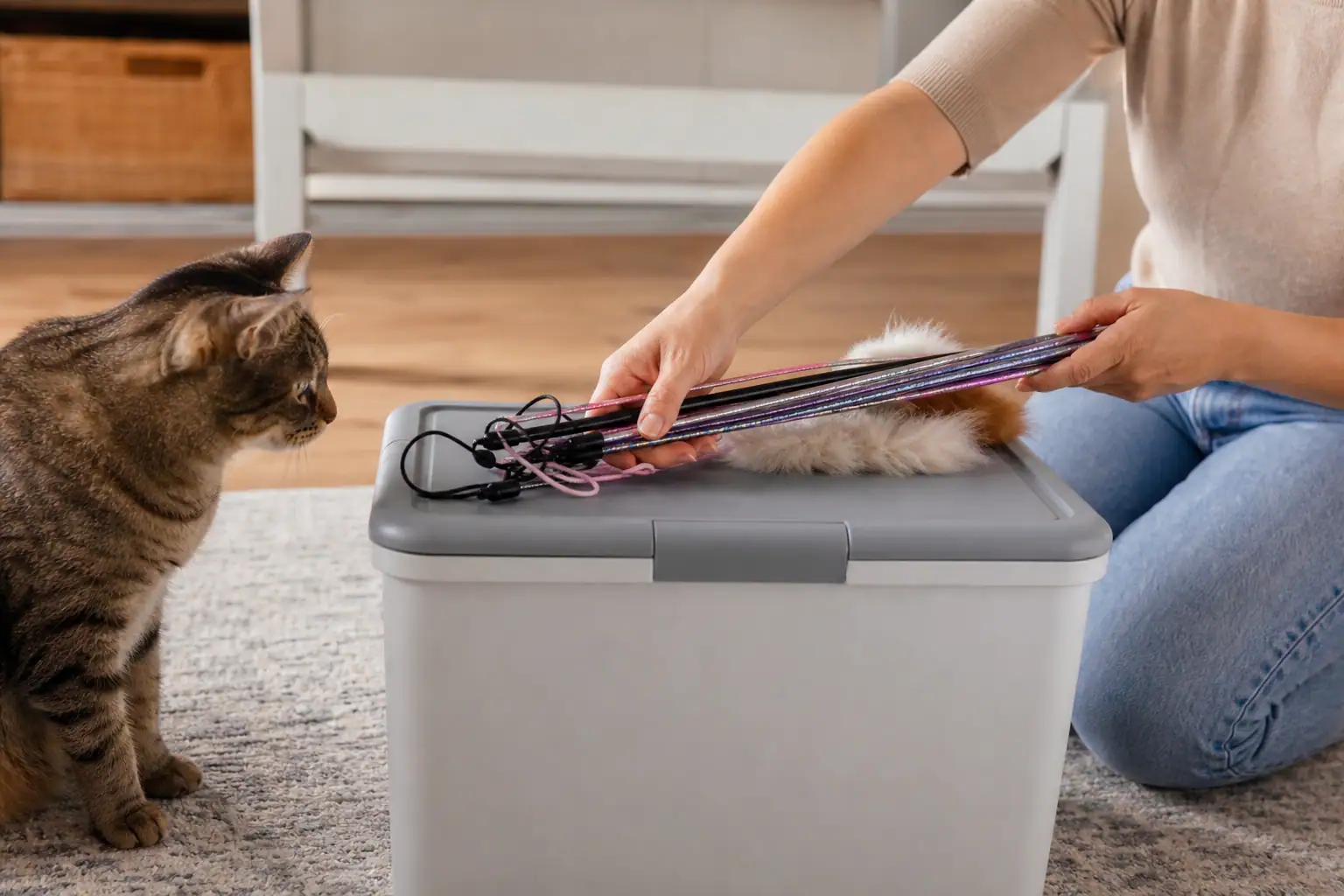
Owner placing string wand toys into a closed storage bin after cat play
The safest string toy habit is simple: inspect it, then put it away.

Run this check before and after each string-toy session:

  • Is the string intact, with no fraying, thinning, or bite marks?
  • Is the lure still firmly attached?
  • Are feathers, fabric strips, bells, knots, clips, and tags secure?
  • Is the wand smooth, with no splinters or cracked plastic?
  • Can your cat fit any detached piece fully in their mouth?
  • Did the cat try to chew or swallow the string during play?
  • Is there a closed drawer, cabinet, or bin ready for storage?
  • Do you have a safer catch toy ready for the end of the session?

Retire the toy if the answer makes you hesitate. A string toy does not need to be used until it completely breaks. For a cat that plays rough, retirement before failure is part of responsible enrichment.

When to call a veterinarian

Call your veterinarian promptly if you know or suspect your cat swallowed string, ribbon, elastic, yarn, dental floss, thread, a feather shaft, a bell, or any toy part. Also call if your cat vomits, stops eating, becomes lethargic, hides unusually, drools, paws at the mouth, seems painful, strains, or has a string visible from the mouth or rectum.

Do not pull on visible string from the mouth or rectum. Linear material can be anchored internally, and pulling can make injury worse. Keep the cat calm, remove other toys from reach, and get veterinary instructions.

The bottom line

Cat string toys are best treated as supervised hunting tools. They can give indoor cats excellent movement, focus, and owner-led enrichment, but they should not become chew toys or solo toys. Choose stronger designs, move the toy like prey, let your cat catch something safe, inspect the toy, and store it where your cat cannot reach it.

For rough players, the winning setup is not a supposedly unbreakable string. It is a controlled chase toy plus a tougher catch toy, clear storage habits, and a willingness to retire anything that starts to fail.

Source: Cat String Toys: Safer Play for Cats Who Love to Chase