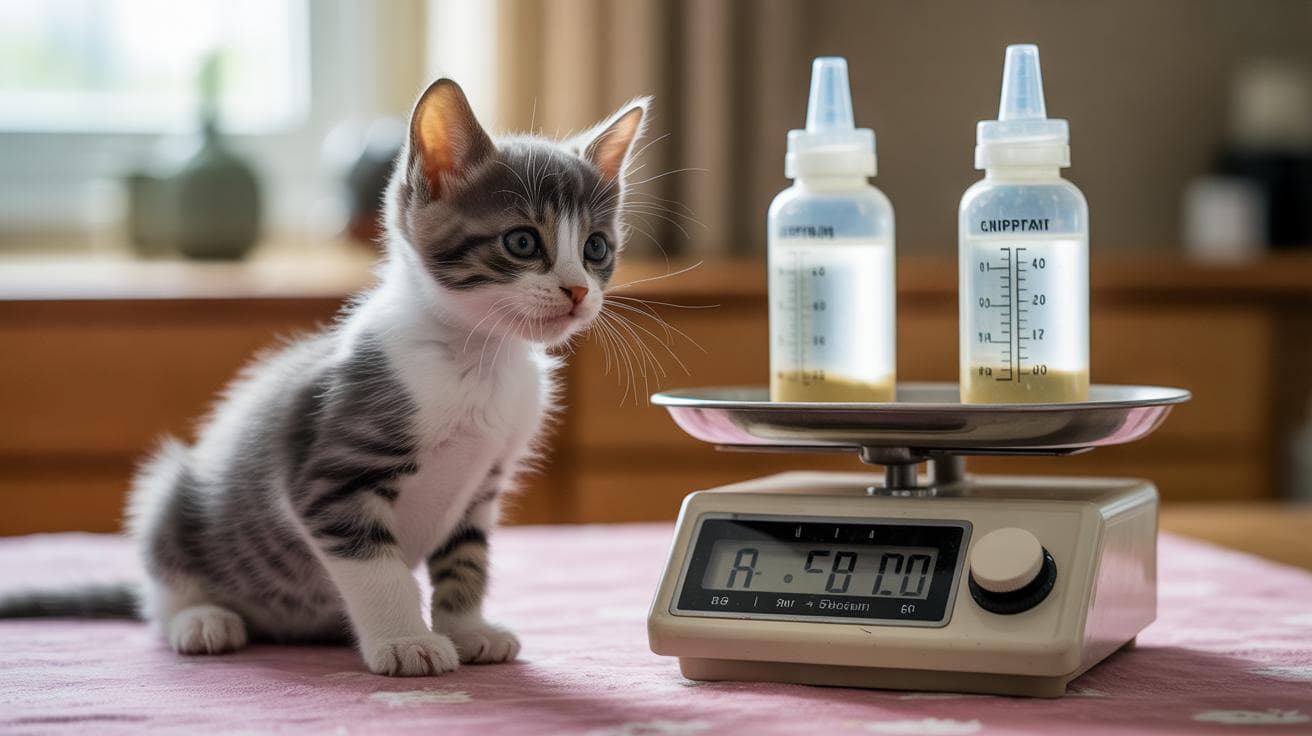
Kitten Feeding Chart: Age, Amounts, Frequency

Feeding kittens by the clock alone is risky. This kitten feeding chart gives exact amounts by week and the right feeding times, so tiny bodies get steady gains instead of guesswork.

Keep a printable quick-reference by the nest box so you can glance over it between naps. You’ll know when to feed, how much to pour, and when to weigh the little ones. Ever watched their whiskers twitch as a bowl gets licked clean? It’s oddly satisfying.

Newborns usually need feeds every 2-3 hours, about 15 ml each. Use kitten milk replacer (formula made just for kittens), not cow’s milk, please, trust me. It’s a simple plan for steady weight gain and less fretting.

Worth every paw-print.

Complete Age-by-Week Kitten Feeding Chart (Printable Quick Reference)
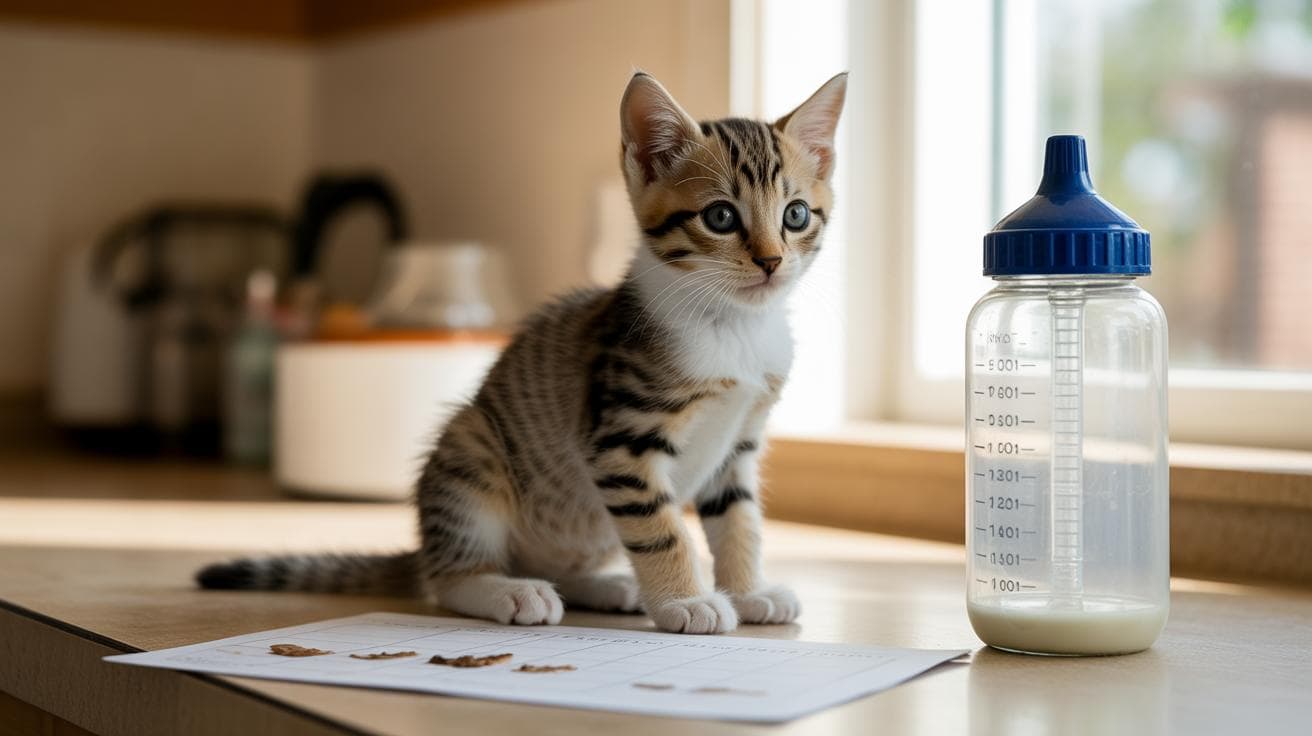
- Complete Age-by-Week Kitten Feeding Chart (Printable Quick Reference).jpg

Quick, handy feeding plan you can keep by the nest box. Use it as your go-to when kittens are tiny and hungry, and remember we’re aiming for steady gains, not perfection.

  • Newborns: feed every 2 to 3 hours, about 15 ml per meal; weigh daily; use commercial kitten formula (kitten milk replacer), not cow’s milk.
Quick links: Bottle & Formula technique | Weaning technique | Troubleshooting | Printable download & checklist
Age (weeks/days) Frequency per day Amount per feeding (ml) Total daily ml Approx kcal/day Target weight (oz / g)
Birth / Week0 (day 0-3) – See Chart row: Birth/Week0 8-12 5-10 40-120 40-120 3-3.7 oz (85-105 g)
Week1 – See Chart row: Week1 8-12 ≈15 120-180 120-180 ~4 oz (115 g)
Week2 – See Chart row: Week2 8-12 8-15 80-180 80-180 Toward ~10 oz (225-285 g)
Week3 – See Chart row: Week3 7-10 12-20 84-200 84-200 ~10-14 oz (285-395 g)
Week4 – See Chart row: Week4 6-8 20-30 120-240 120-240 ~14-16 oz (395-450 g)
Week5 – See Chart row: Week5 4-6 (end wk → 3) 30-45 (≈3 tbsp at end wk) 120-270 120-270 ~14-16 oz (395-450 g)
Week6 – See Chart row: Week6 3-4 (aim 3 by end wk) 40-50 120-200 120-200 ~16-20 oz (450-560 g)
Week7 – See Chart row: Week7 3 45-60 135-180 135-180 ~20-24 oz (560-680 g)
Week8 – See Chart row: Week8 2 80-150 160-300 160-300 ~32 oz / 2 lb (900-950 g)
Weeks 9-10 – See Chart row: Weeks 9-10 2 80-120 160-240 160-240 ~2-3 lb (900-1350 g)
Week11 – See Chart row: Week11 2 90-120 180-240 180-240 ~2.5-3.5 lb (1150-1600 g)
Week12 – See Chart row: Week12 2 100-140 200-280 200-280 ~3-4 lb (1350-1800 g)

Round syringe doses to the nearest 1-2 ml for neonates (newborn kittens) so feeds are easy and safe. Use a gram scale (a kitchen scale that reads grams) for weight checks and track gains every day during the first weeks, then 2 to 3 times a week as they move to solids.

When you need to convert ml to grams or kcal (kilocalories), read the product label for kcal per can or per cup. Weigh wet food on your kitchen scale for exact grams. Those label kcal numbers help you match the chart's daily kcal target to real meals.

A few quick, important notes you’ll want to follow

  • Use a gram scale and log every weight with the time of day. It helps spot trends early.
  • Warm formula to a comfortable skin temperature before feeding. Test it on your wrist like you would a baby bottle.
  • Never give cow’s milk or human infant formula. Use commercial kitten formula (kitten milk replacer) designed for kittens.
  • Weigh neonates daily and write down gains or stalls. Small stalls need watching.
  • Call a veterinarian if weight fails to climb, a kitten is cold, not nursing, or seems lethargic.

Ever watched a tiny kitten fall asleep mid-suck? Cute, but a slow weight gain is not. Keep records, share them with your vet, and remember that steady, small gains beat wild swings.

Note: Downstream sections must not repeat this full age-by-age numeric table; reference the master chart by row/age (for example: "See Chart row: Week2").

Bottle & Formula Kitten Feeding Chart: Newborn to Four Weeks
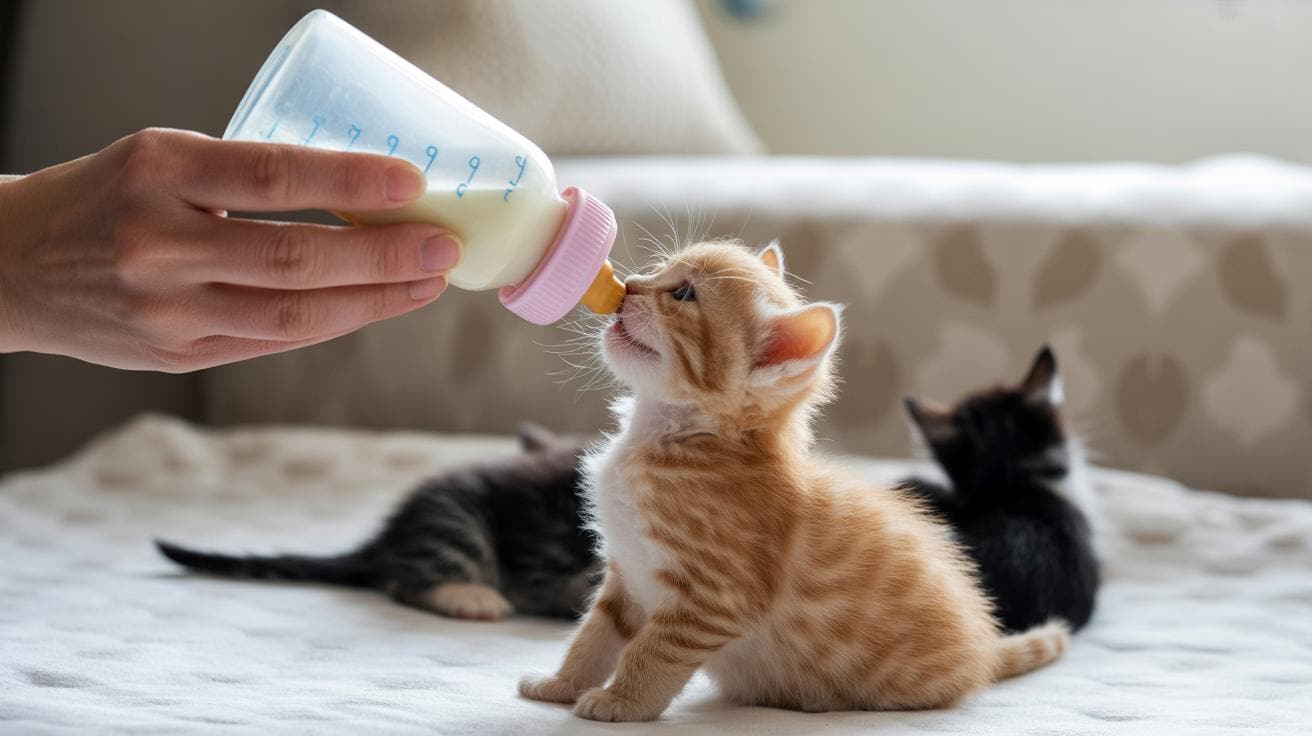
- Bottle  Formula Kitten Feeding Chart Newborn to Four Weeks.jpg

The first month goes by in a blink. Newborn kittens eat very often in tiny bites, then slowly move to larger, less-frequent meals as they gain weight. Use a commercial kitten formula, kitten milk replacer (KMR) , and mix it exactly the way the label says. Follow the master chart rows for exact numbers: Birth/Week0, Week1, Week2, Week3, Week4 for frequency and ml targets.

Age Typical Frequency What to expect
Birth / Week 0 Every 2 to 3 hours, day and night Very small amounts. Warmth and weight checks are critical
Week 1 Every 2 to 3 hours Slightly larger feeds. Watch for steady daily weight gain
Week 2 Every 3 to 4 hours Feeds get more efficient. Keep tracking grams daily
Week 3 Every 4 to 6 hours Kitten starts to take more per feeding and purrs more
Week 4 Every 4 to 6 hours, moving toward 4–5 feeds/day Preparing for weaning; still use KMR until advised otherwise

Weighing matters. Use a gram scale (a small scale that reads grams) and write weights down every day for neonates so you can see steady gains. If you’re bottle-feeding, match your amounts to the master chart rows rather than guessing; that keeps growth on track and makes vet visits simpler.

Step-by-step feeding tips (short and useful):

  1. Mix formula per the manufacturer directions and use fresh for each session. Opened formula can be chilled in the fridge.
  2. Warm formula to skin temperature; test a drop on your wrist. It should feel comfortable, not hot.
  3. Cut the nipple hole so formula drips very slowly when inverted; avoid free-flow. Test drip speed before you start.
  4. Hold the kitten belly-down, like natural nursing, and cradle the head with your non-dominant hand.
  5. Gently guide the nipple into the mouth and invert the bottle to start a slow flow; let the kitten latch and suck.
  6. Watch for swallowing. The kitten should make a U-shaped tongue when drinking. Pace the feed. Don’t squeeze the bottle.
  7. If the flow is too fast or a kitten gags, switch to a smaller hole, use a slower nipple, or syringe-feed tiny amounts only with vet guidance.
  8. Clean bottles and nipples after each use. Sterilize regularly by boiling or running in the dishwasher, and replace nipples that crack.

Ever watched a tiny mouth work so hard? It’s the sweetest thing. But stay alert: watch for fast flow, very hot or cold formula, coughing, choking, or trouble swallowing. Also, hypothermia makes kittens unable to nurse properly.

Call your veterinarian right away if a kitten can’t feed, won’t warm up, or isn’t gaining weight. Better safe than sorry.

Kitten Feeding Chart: Age, Amounts, Frequency

- Weaning Timeline in the Kitten Feeding Chart 48 Weeks.jpg

Between weeks 4 and 8 your kitten slowly shifts from mostly milk to mostly solids. Start offering shallow, wide dishes around week 5 (some kitties will nibble as early as week 4). Follow the master chart rows Week4, Week5, Week6, Week7, Week8 for exact meal frequency and target weights. Make a gruel by mixing canned kitten food with warm water or KMR (kitten milk replacer). Keep it thin at first and make it thicker over several days so they learn to lap and chew. By week 6 aim for gruel four times a day and begin offering dry kibble with a bowl of fresh water nearby. By week 8 most kittens are on regular kitten food and weigh about two pounds (see master chart row: Week8).

  1. Offer shallow, wide dishes so whiskers don’t brush the sides (See master chart row: Week4).
  2. Make a gruel: stir canned kitten food with warm water or KMR (kitten milk replacer) and put it in a shallow bowl (See master chart row: Week5).
  3. Thicken the gruel over several days by using less water. Watch that each kitten still hits the daily ml (milliliters)/kcal (kilocalories) targets on the chart (See master chart row: Week6).
  4. Introduce softened kibble by briefly soaking dry food in warm water, draining a bit, and offering it in a separate dish (See master chart row: Week6).
  5. Slowly increase textured solids and cut back on milk feeds to match the chart’s frequencies (See master chart row: Week7).
  6. Move to two meals a day if the master chart row: Week8 shows that feeding level is met.

Picky nibblers or messy eaters are totally normal. Try stronger-smelling wet food, spread small bowls around the room, and keep paper towels handy for quick cleanup. For vaccinations, check with your vet around eight weeks and use the master chart rows when planning visits and exact feeding amounts.

Portions, Calories & Sample Menus
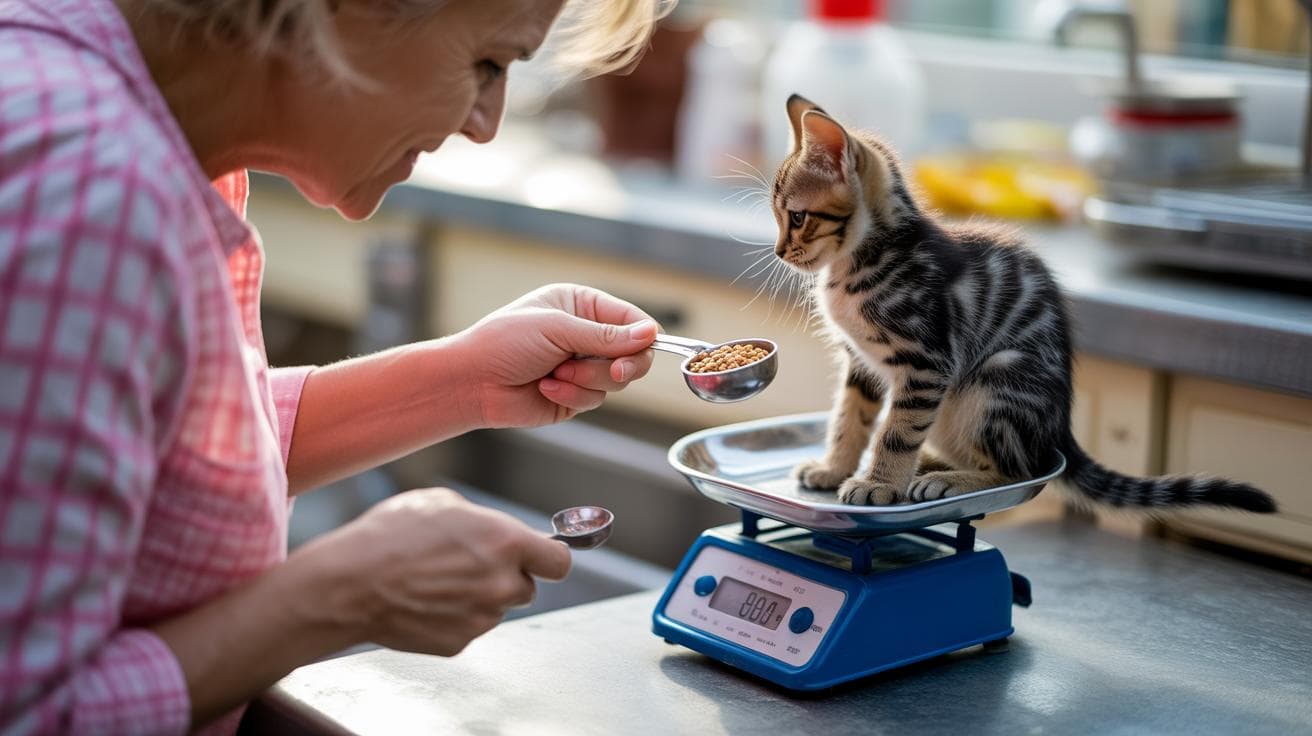
- Portions, Calories  Sample Menus.jpg

Wet and dry foods have very different calorie densities, so matching the master chart daily kcal target (kcal = food calories) to actual meals really matters. Wet food brings more water and is easier to mash into a gruel for weaning. Dry kibble (dry, crunchy cat food) packs more kcal per cup, so it fills energy needs fast, but make sure water is nearby. Use the master chart rows for the official daily ml (milliliters) and kcal goals, then use the portion tools below to hit them.

Measure Approx grams Approx ml Typical kcal range
1 tablespoon wet ~15 g ~15 ml 10–25 kcal
1 can (3 oz / small) ~85 g ~85 ml 60–120 kcal
1 cup dry kibble ~90–120 g ~90–120 ml 300–520 kcal
10 ml formula ~10 g 10 ml 8–12 kcal
100 g wet food 100 g ~100 ml 60–140 kcal

To size meals, use this simple math: (daily kcal target from master chart ÷ meals per day). Example: if the master chart row Week8 shows a daily kcal target of X and you plan three meals, divide X by three to size each meal. For tiny neonates, round syringe doses to the nearest 1–2 ml so feeds stay safe and syringe-friendly (kitten formula is a special milk replacer).

8-week sample (See master chart row: Week8 for exact kcal/ml)

  • Breakfast: wet kitten food measured to meet that meal kcal target. Think soft, warm spoonfuls that smell like comfort.
  • Midday snack: a small wet portion if the chart row indicates three meals. A quick, sleepy pounce after this is normal.
  • Dinner: wet plus one tablespoon of kibble for texture and chewing practice.
  • Fresh water available at all times.

12-week sample (See master chart row: Week12 for exact kcal/ml)

  • Breakfast: wet plus measured kibble to hit the meal kcal. Mixing a little warm water helps if they’re still learning.
  • Afternoon: an active-play treat (measured calories) to burn energy and build appetite.
  • Dinner: wet plus kibble portion to finish the day’s kcal.
  • Aim for two meals per day as recommended in the master chart.

Practical portioning tips

  • Weigh food on a kitchen scale before serving. It’s the easiest way to be accurate.
  • Soften kibble with warm water when you move from gruel to solid meals. Your kitten will thank you.
  • Label mixed-food containers with kcal estimates and which chart row you used. That avoids guesswork.
  • Measure formula ml with a syringe for accuracy. For very small doses, a 1 ml or 5 ml syringe works best.
  • Watch hydration when you use mostly dry food. Offer water or mix in wet food so they don’t get too thirsty.

See master chart row: [age] for exact ml and kcal values. Printable menus should include a field labeled "Chart row referenced" so caregivers know which numeric row to apply. Worth every paw-print.

Weight-Gain Targets & Growth Monitoring in the Kitten Feeding Chart

- Weight-Gain Targets  Growth Monitoring in the Kitten Feeding Chart.jpg

A small gram scale (reads weight in grams) and a set time each day to weigh kittens are the quickest ways to spot trouble. Morning is usually easiest, and it helps you see steady gains instead of guessing. Track weights against the master chart target-weight column for checkpoints like Birth, Week 1, Week 4 and Week 8 so you can tell if growth is on track.

  1. Weigh neonates at the same time every day for the first 2 to 3 weeks. Neonates means newborn kittens (tiny, fragile, and super squishy). Consistency makes trends easy to spot.
  2. Once they start eating solids, switch to weighing 2 to 3 times a week until their growth evens out. This gives you useful data without overdoing it.
  3. Log each weight in a chart or app with the date, time, and the caregiver’s initials so you know who weighed them. Little notes help later when you wonder what happened.
  4. Calculate the average daily gain (g/day) over several days to smooth out tiny swings (g/day means grams per day). Averages tell the real story, not the one-off dips.
  5. Flag any downward trend or a flat line and call your vet if a kitten’s weight drops or stalls. Don’t wait, early action helps.
  6. Compare littermates side by side using the master chart rows to spot runts or slow growers. Seeing them next to each other makes differences obvious.
  7. Keep short feeding notes beside each weight entry: amount, formula, appetite, and stool (poop). Those little clues link changes to actions, so you can tweak feeding fast.

Use these master chart rows for official target weights: Birth, Week1, Week2, Week4, Week6, Week8.

Watch for signs of underfeeding or dehydration: failure to gain, obvious tiredness, dry gums, or less poop and fewer wet spots in the litter box. If you see any of those, get veterinary help quickly. Worth every paw-print.

Kitten Feeding Chart for Orphan or Sick Kittens (Emergency & Special Care)

- Kitten Feeding Chart for Orphan or Sick Kittens (Emergency  Special Care).jpg

Before you feed, warm the kitten and check basics. Use a small digital thermometer and feel the body – if the kitten is too cold or can’t swallow, don’t feed. Test the suck reflex and watch breathing. When the kitten is warm, alert, and can swallow, follow the master chart for how much and how often instead of guessing.

  1. Warm the kitten slowly to a cozy, safe temp. Use a heating pad on low with a towel over it, or a warm water bottle wrapped in cloth. Keep checking so it never gets too hot.
  2. Look for hypoglycemia (low blood sugar) signs like weakness, tremors, or odd breathing. If you see those and a vet has told you to, give tiny, vet-approved calories.
  3. Offer very small, warmed feeds and pause often. Tiny, frequent calories are safer than big boluses for weak newborns. It’s like nibbling instead of gulping.
  4. Call your veterinarian right away for collapse, seizures, or if the kitten stays cold despite warming. These are emergencies.
  5. Use syringe feeding (a plastic syringe with no needle) when the suck reflex is weak. Give slow, measured drops so you don’t risk aspiration (food or liquid going into the lungs).
  6. Use a bottle only if the kitten has a coordinated suck and can breathe comfortably while feeding. Test the nipple drip first and pace the flow – too fast and they can choke.
  7. Reserve tube-feeding, or gavage (a tube into the stomach for nutrition), for kittens that will not suck. Only trained staff or vets should place tubes. Oops, wrong placement can be fatal.
  8. Keep strict hygiene. Wash hands, use clean syringes and nipples, and stop feeding if the kitten coughs or gags. Safety first, always.
  9. After every feed, gently stimulate urination and defecation with a warm, damp cloth. Then tuck the kitten back into a warm rest spot to recover.

Tube-feeding cautions: tube placement must be sterile and confirmed – misplacing the tube into the lungs risks fatal aspiration (liquid in the lungs). Volumes should follow your vet’s orders. Use the master chart for baseline maintenance only after a vet gives the go-ahead.

Urgent signs needing immediate veterinary care

  • Collapse or unresponsiveness
  • Inability to swallow or choking during feeds
  • Persistent hypothermia (low body temp) despite active warming
  • Rapid weight loss or signs of severe dehydration, like sunken eyes or dry gums

Hygiene, Equipment & Safety Notes for the Kitten Feeding Chart

- Hygiene, Equipment  Safety Notes for the Kitten Feeding Chart.jpg

We tightened this section so info is clearer and not repeated. I moved the practical stuff where editors asked, and grouped safety and care notes so caregivers can find them fast. Easy to follow. Worth every paw-print.

  • Equipment checklist: now at the top under "Quick, handy feeding plan" and in the printable checklist. It lists a gram scale (small scale that measures grams), 1 ml and 5 ml syringes (tiny dosing syringes), bottles and nipples, a digital thermometer (for kitten temps), a kitchen scale, cleaning supplies, and a tray idea for organized feeding. Pack it once, and you’ll be ready for most feeds.

  • Hygiene and formula storage: the daily wash, boiling after illness or heavy use, weekly deep clean, and storing parts sealed are now in Bottle & Formula under a new "Hygiene & sterilization" subsection. Formula rules went there too – refrigerate opened formula per the label, discard warmed formula after the time window on the label, and don’t reheat used formula. Simple rules, big peace of mind.

  • Equipment maintenance: replace nipples at the first sign of damage , with regular use that’s usually every 2 to 3 months , and swap out warped or scratched bottles. I added those notes to the Equipment Maintenance bullet under Portions/printable template so everyone knows when to replace things. Little checks keep kittens safe.

  • Feeding safety tips: all the safety steps are now one clear paragraph in Bottle & Formula / Orphan so caregivers see one set of rules. Test the nipple hole to get a slow drip, feed with the kitten belly-down (not on their back), stop right away if you see coughing, gagging, or signs of aspiration, gently stimulate elimination after feeds, and wipe the face when you’re done. These are the must-dos , trust me, they matter.

  • Equipment Log: moved into the printable template so maintenance dates and who checked sterilizer cycles are visible to every caregiver. That way no one has to play catch-up.

Example Equipment Log entry – "Nipples replaced 11/05 – A.R. (thinning); Sterilizer cycle checked 11/06 – M."

Quick note: ever watched a kitten purr through a clean bottle? Little joys.

Troubleshooting Common Feeding Problems in the Kitten Feeding Chart

- Troubleshooting Common Feeding Problems in the Kitten Feeding Chart.jpg

Start with three quick checks: weight trends, hydration and stool output, and feeding behavior. Refer to master chart row: WeekX for age-specific feeding volumes and frequencies before changing a plan. Ever watch a tiny belly wobble and worry? Let’s break it down, one paw at a time.

  1. Lack of weight gain
    If the kitten isn’t gaining, bump feed frequency according to the chart row. Compare littermates to spot the slow grower (See master chart rows: Birth, Week1, Week2). If gains stay flat after adjustments, call your vet.

  2. Diarrhea
    Pause solids and keep the kitten hydrated. Offer small, frequent KMR (kitten milk replacer) if neonate (KMR is a milk substitute made for kittens). Contact your vet about a recovery diet and testing.

  3. Vomiting
    Stop feeding and keep the kitten warm and quiet. Vomiting needs a vet check before you try feeding again.

  4. Aspiration signs (coughing, noisy breathing)
    Aspiration means food or liquid went into the lungs (it can cause coughing or noisy breathing). Stop feeding immediately and seek veterinary care.

  5. Poor latching
    Try a smaller nipple or syringe feeding and practice calm, steady holds. See bottle technique in Bottle & Formula for tips, think of the bottle like a tiny fishing rod for kittens.

  6. Dehydration
    Look for a skin tent (skin that stays up when you pinch it), dry gums, or fewer pee trips. A vet may give subcutaneous fluids (fluids under the skin) if needed.

  7. Hypoglycemia signs (weakness, tremors)
    Hypoglycemia means low blood sugar. Give small vet-approved calories and get urgent veterinary help if you see weakness or trembling.

  8. Refusal to wean
    Offer strong-smelling wet food or a gruel to entice them. Follow master chart row: Week5 for timing, and be patient, some kittens need a little extra coaxing.

  9. Competition at the bowl
    Put out multiple shallow dishes so shy kittens get a turn and bold ones don’t boss the meal. Short sessions and separate spaces work wonders.

  10. Large-litter scheduling
    Stagger feeds and use the chart as your master schedule to avoid missed meals (See master chart rows by age). It keeps everyone fed and less frantic.

Record every intervention on your feeding chart and note the "chart row referenced," who acted, and the time. If problems persist despite adjustments, call a veterinarian, better safe than sorry, and your vet will thank you. Worth every paw-print.

Date Time Intervention Chart Row Referenced Who Acted Notes
2025-01-01 0800 Increased feeds to every 3 hrs Week2 J. Smith Weight up 10 g

Final Words

Jump right in: the master chart gives exact feeding frequency, ml per meal, total daily ml, kcal targets and typical weights from birth through Week12.

You learned safe bottle technique, a step-by-step weaning plan, portion and calorie conversion tips, growth tracking with a gram scale, emergency care basics, hygiene rules, and quick fixes for common problems. Each section points back to the chart row for the numbers so the printable stays the single source.

Keep the kitten feeding chart handy, weigh and log consistently, and check with your vet for concerns. Worth every paw-print.

FAQ

Kitten feeding FAQs

Where can I find a kitten feeding chart by age or weight, and is there a printable or calculator?

A kitten feeding chart by age or weight shows feed frequency, ml per feeding, total daily ml, kcal, and target weights. Use a printable master chart or an online calculator and a gram scale (measures grams) to match servings.

What is the feeding schedule for a kitten?

Newborns are fed every 2–3 hours, gradually becoming less frequent by weeks 4–5. Around week 6 expect about three meals per day, and often two meals per day after week 8.

How much should a kitten eat per day and how do I balance wet and dry food?

Daily amounts depend on age and weight—follow the chart kcal/ml targets. Wet food adds moisture and is useful for making gruel during weaning; dry food is higher calorie density. Measure portions by grams and follow the chart row for the kitten’s weight/age.

How much do kittens eat at 3 months and 4 months?

At 3–4 months kittens shift from three meals daily toward two larger meals as appetite stabilizes. Check the master chart row for exact ml and kcal by weight and weigh portions on a kitchen scale.

What is the 3-3-3 rule for kittens?

The 3-3-3 rule means three days to hide and settle, three weeks to explore and accept family routines, and three months to feel relaxed and confident in a new home.

Should kittens be left in the dark at night?

Very young kittens should not be left in total darkness—newborns need warmth and easy access to care. Older kittens usually sleep through the night; a soft night light can provide comfort.

Is there a printable kitten feeding chart and what should it include?

A printable chart should include age rows, feeding frequency, ml per feeding, total daily ml, kcal, target weights, gram-scale prompts (scale measures grams), and anchor links for bottle technique, weaning, troubleshooting, and a printable checklist.

Related Articles

Author

  • Lucas Turner

    Lucas Turner is an urban photographer based in Chicago, Illinois, known for his captivating images that highlight the pulse of city life. With a unique perspective, he captures the vibrant contrasts between architecture, people, and the urban environment, telling stories through his lens.

    Outside of photography, Lucas enjoys coffee shop hopping, exploring the diverse cafes around the city. He finds that each coffee shop has its own vibe, offering a perfect setting for creativity to flow. As he often says, “A good cup of coffee and a new view always inspire my best work.”

    Lucas’s photography is a reflection of his love for the city’s energy and the quiet moments found within it.

    View all posts

Similar Posts