Is that wrestling between your cats just silly play or a fight that could end in vet bills? Ever watch them tumble and wonder which it is? Check out our guide on Best Toys to Reduce Play Aggression.
Play is mutual. Claws tucked (sheathed: hidden inside the paw), ears loose, soft nips, and both cats taking turns chasing like kittens after a toy. Your cat’s whiskers might twitch, and there’s a bouncy rhythm to it.
Aggression looks sharper. You’ll see claws out (unsheathed: extended), ears pinned back, and fur standing up (piloerection: raised fur). Add loud hissing, long, angry yowls, or bites that break the skin, and it’s time to step in.
I’ll walk you thplay rough easy-to-spot body language, give quick checklists, and share safe, simple steps to break up a fight or call for help, so you’ll know when to smile and when to act fast. Worth every paw-print.
Understanding Cats Play Fighting vs Aggression
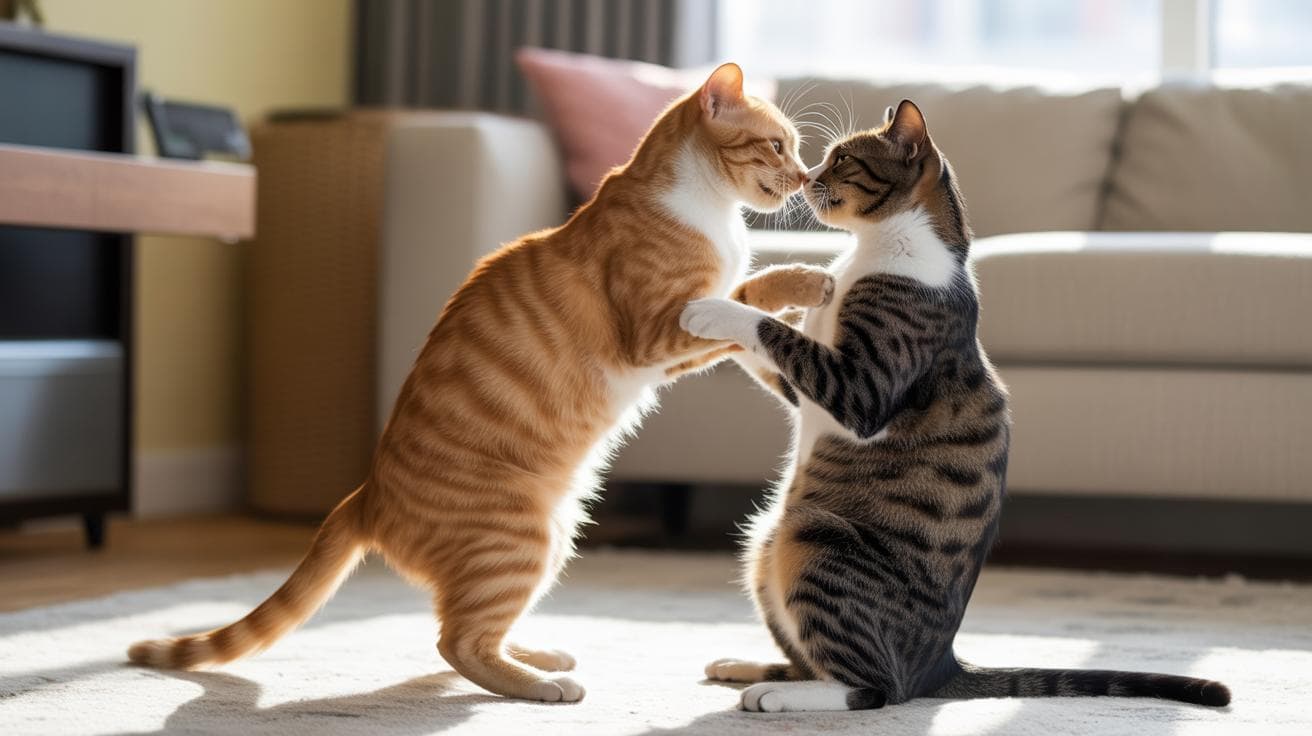
Play fighting feels gentle and mutual. You’ll see claws retracted (sheathed – tucked away), ears relaxed, no piloerection (raised fur), and soft nips that don’t break the skin. They take turns being the chaser or the one on top, and there’s lots of switching roles. Ever watch whiskers twitch as a toy mouse rolls? Play looks a bit like that, but with another cat.
Aggression is sharper and one-sided. Claws come out (unsheathed – extended and ready to scratch), ears are flattened or pinned back, fur stands up (piloerection), and you’ll hear loud hissing or growling. Bites that break skin or cause yelping mean it’s gone past play, and repeated pinning or nonstop chasing is a red flag.
Quick checklist of reliable markers to watch:
- Sheathed claws, relaxed ears, soft vocalizing, turn-taking = play.
- Unsheathed claws, pinned ears, raised fur (piloerection), loud hissing/growling = aggression.
- Bites that break skin or cause yelping are beyond play – those are injurious bites.
- Reciprocal chasing and role swaps suggest normal play; repeated pinning does not.
Safety DO / DO NOT:
- DO make a loud distraction out of sight – clap lids together or bang a pan to break their focus. It works more often than you’d think.
- DO use a barrier or a blanket to gently guide one cat into a quiet room and dim the lights so things calm down.
- DO NOT put your hands between fighting cats. You will get hurt.
- DO NOT assume a scuffle will safely "work itself out" if it’s loud, bloody, or keeps happening.
When to get help:
If behavior changes suddenly, fights leave deep puncture wounds, or the cats keep fighting despite separation, call your vet right away and ask about a behaviorist. If in doubt, get professional help , it’s worth the peace of mind and the paws.
Feline play body language: micro-signals, thresholds, examples, and the canonical comparison table

Tiny moves tell the story – watch patterns, not single frames. Spend 30 to 60 seconds watching an interaction to see if the same signals repeat. One flick or one hiss isn’t the whole picture. If you see a loop like "bat, chase, swap" happen three times in a row, that’s a repeating play loop you can trust.
Can’t tell by eye? Record it. Capture 30 to 60 seconds of video with audio, hold the phone horizontally, and note what happened right before play started (toy toss, doorbell, treat). Example clip: Record 45 seconds – "toy thrown, Cat A stalks, Cat B chases, soft chittering" – that short clip tells a pro more than a long description.
Kittens and adults read the rules differently. Kittens (roughest around 8 to 10 weeks) swap roles fast and tolerate harder mouthing. Adults switch roles less and may escalate sooner when space or resources are tight. Example: Kitten Luna, 9 weeks, switches roles every 6 to 10 seconds; Buddy, 3 years, stops after one long pin. Ever watch a kitten pounce and then immediately offer its belly? Cute chaos.
If signals escalate, act fast and keep it simple. Pause play. Separate calmly. Give them a low-light, quiet break, then reintroduce with a wand toy or extra distance. Short cue: "Pause, separate, wait 5 minutes, try a wand toy."
| Feature | Play (what to expect) | Aggression (what to expect) |
|---|---|---|
| Tail movements | Short, rhythmic flicks or loose sways during back-and-forth play | Rapid thrashing, lashing, or a puffed tail showing high arousal |
| Whisker position (vibrissae) | Forward when focused and stalking; relaxed after a role switch | Pushed forward with a hard stare, or pulled back when the cat is scared |
| Role reciprocity / turn-taking thresholds | Frequent swaps – roughly every 5 to 15 seconds; mutual breaks expected | One-sided pinning repeated (more than 3 times) or constant pursuit |
Quick action – interrupt now if any of these happen:
- Skin-breaking bites, loud yelps, or visible blood – stop and separate immediately.
- One cat pins another more than three times in a row or never gives turns – pause play.
- Tail thrashing with growls or fur standing up along the spine (piloerection) – separate and calm the area.
- Continuous chasing with no escape route for the pursued cat – create space and training redirect.
For full marker definitions (claws sheathed/unsheathed, pinned ears, piloerection (fur standing up), biting that breaks skin, normal turn-taking), see the Understanding Cats Play Fighting vs Aggression section. If wounds happen or behavior keeps escalating, record the footage and consult your vet or a behavior specialist for help. Worth every paw-print.
Context, age, and causes: when play among kittens or adults becomes aggression

Kittens have a short, important social window, about 2 to 9 weeks, when meeting littermates and other cats teaches them how to bite gently and take turns. Play usually peaks around 8 to 10 weeks, with quick role switches and rougher mouthing that’s still normal, think of tiny teeth and tumbling that look fierce but aren’t meant to hurt. Kittens that miss those lessons, like hand-raised ones (raised by people without littermates), often struggle later and may bite harder or have trouble sharing playtime as adults. Ever watched a kitten pounce and then suddenly go too far? That’s often the missing practice talking.
Adult cats follow different rules. Resource competition, like one food bowl, one litter box, or one sunny perch, raises tension fast; shared resources make a cat feel cornered. Hormones matter too, intact males (not neutered) can be more driven to fight, and neutering before one year often helps reduce that risk. Other common triggers are redirected aggression (a cat sees something outside, gets wound up, then lashes out at a housemate), pain-driven aggression (a sore hip or tooth makes a cat snap), and status or territory disputes (who gets top shelf, who guards the window). Genetics and ongoing household stress, loud noises, unpredictable routines, also push cats from playful wrestling toward real fights.
Quick context check , a three-step mini-protocol to figure out whether a scuffle is medical, environmental, or social:
- Rule out medical causes. Look for limping, sudden changes in appetite or grooming, or any recent vet issues; if in doubt, a vet visit can spot pain or illness that makes a kitty short-tempered.
- Check resource distribution. Aim for one litter box per cat plus one, plus several feeding stations and perches so nobody feels trapped or forced to share.
- Review recent changes. New pets, guests, remodeling, or sudden noisy street activity can trigger redirected aggression or stress, think of everyday disruptions that might have set them off.
(For core behavioral markers see the canonical comparison table in ‘Feline play body language.’)
Emergency & Follow-up: combined immediate protocol, wound care, and when to call a vet or behaviorist
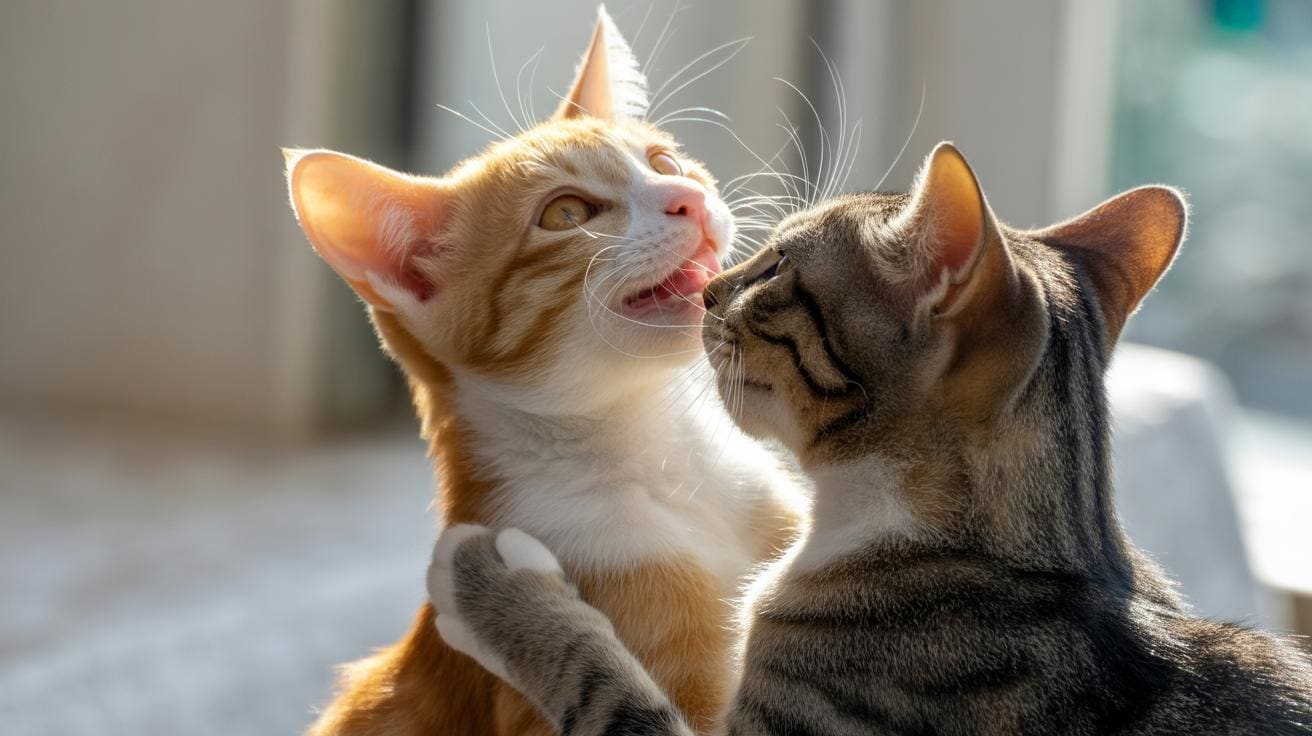
If cats start fighting, don’t stick your bare hands or arms between them. Ever. You will get hurt. Picture fur flying and a terrified yowl, your instinct might be to grab, but don’t. Instead, use low-risk moves that break their focus and get them apart without you becoming a bandage.
Quick, low-risk interrupts
- Make a loud noise out of sight: clap pot lids, bang a pan lid, or shake coins in a closed jar to surprise them and break eye contact.
- Toss a big, soft object near (not at) the cats , a blanket or pillow works , so they look at the thing instead of each other.
- Hold up a blanket, towel, or piece of cardboard as a visual barrier to guide one cat away calmly. Think of it like a temporary wall.
- After they separate, scoop a cat up wrapped in a towel (towel as shield) and move it to a quiet room with food, water, a litter box, and a hiding spot; close the door and dim the lights to lower arousal.
- Short rough play pause? Wait about 5 minutes before checking on them. After a serious scuffle, give them 10 to 20 minutes alone before trying any reintroduction steps.
Immediate actions (short checklist)
- Don’t put bare hands between cats.
- Create an out-of-sight loud distraction , lids, a shaken coin jar, anything noisy.
- Toss a large soft item near, not at, the cats (blanket, pillow).
- Use a barrier (blanket, cardboard, towel) to block view and steer one cat away calmly.
- Wrap and scoop a separated cat with a towel as a shield; move it to a quiet room with food, water, litter, and a hiding box; close door and dim lights.
- Wait ~5 minutes for brief play bursts; wait 10–20 minutes after a real fight.
Wound care and when to call a vet
Cat bites are risky. A bite often makes a deep puncture (a narrow hole that can trap bacteria), so even if it looks small, it can hide infection. Superficial scratches can be cleaned at home with soap and water, but puncture wounds need a vet check.
- Deep punctures or wounds that gape (open widely) require immediate veterinary care and often antibiotics (drugs that fight bacterial infection).
- Watch both cats for swelling, warmth, redness, limping, fever, or loss of appetite , those can mean infection or hidden injury.
- Humans who get bitten by a cat should see a doctor and check their tetanus status.
- Keep dated photos and simple notes about wounds and treatments; short video clips of the incident are very helpful for vets and behaviorists.
- If you’re unsure, err on the side of care. It’s nicer to get checked and feel relieved than to worry.
When to call for help , medical and behavioral
Call your vet right away if you see any deep puncture bite, heavy bleeding, a wound that opens, or signs of infection. Also call if fighting keeps happening, if a previously calm cat becomes suddenly aggressive, or if a cat is limping or clearly in pain. Get a medical exam first to treat wounds and rule out illness or pain. After medical issues are addressed, consult a behaviorist if the fights continue; bring short video clips and photos of incidents to help them understand what’s happening.
Concise medical checklist (for follow-up)
- Cat bites are often deep and infection-prone; punctures need vet assessment.
- Gaping wounds or heavy bleeding = immediate vet visit.
- Antibiotics may be prescribed for deep bites or infected wounds.
- Humans with cat bites should get medical attention and a tetanus check.
- Monitor both cats for fever, swelling, heat, limping, or appetite loss.
- Keep dated photos, short notes, and videos of incidents for vets and behaviorists.
See the "Feline play body language" canonical table for diagnostic markers used during follow-up assessments.
Understanding Cats Play Fighting vs Aggression

Give every cat a way out so nobody feels cornered. Put litter boxes in separate rooms (one per cat plus one extra) and spread feeding spots, water bowls, and beds around the house so shy kitties can slip away. Add vertical territory (cat trees, window perches, wall shelves) so they can sit up high and watch without bumping into roommates.
Use toys that steer energy away from real fights. Try wand or fishing-pole toys (a human-led teaser, like a fishing rod for cats) for supervised chases, toss ping-pong balls for quick redirection, and leave puzzle feeders (food-dispensing toys) when you’re out so mealtime becomes brain work. Schedule short, focused play sessions two or three times a day, 10 to 15 minutes each, to burn off twitchy energy and get that satisfying pounce practice.
Make solo play safe and fun. Provide boxes and tunnels with multiple exits so a cat never feels trapped, and pick heavier balls that roll in odd ways to keep play interesting. Pheromone diffusers (a device that releases a calming cat scent) can lower background tension, and spaying or neutering (surgical sterilization) often helps reduce fighting drives.
Small, practical swaps give big results. Think measurable changes, not vague fixes, more boxes, more perches, staggered meal times, and record short video clips to track behavior over weeks. Use the canonical comparison table in ‘Feline play body language’ when you’re checking whether interactions are play or something more serious. Ever watched your kitty chase shadows and then suddenly remember it’s dinner time? Yep, those little cues matter.
Worth every paw-print.
Numbered priority changes to implement:
- Add one litter box per cat plus one extra, spread through the home (easy escape routes).
- Create at least three vertical spots (trees, shelves, window perches).
- Place two or more feeding stations in different rooms to reduce face-offs.
- Schedule 2 to 3 interactive play sessions of 10 to 15 minutes daily to burn energy.
- Add puzzle feeders (food-dispensing toys) for meal-time enrichment and slow eating.
- Set up boxes and tunnels with multiple exits for safe solo play.
- Use a pheromone diffuser (calming scent device) and complete spay/neuter (surgical sterilization) if not already done.