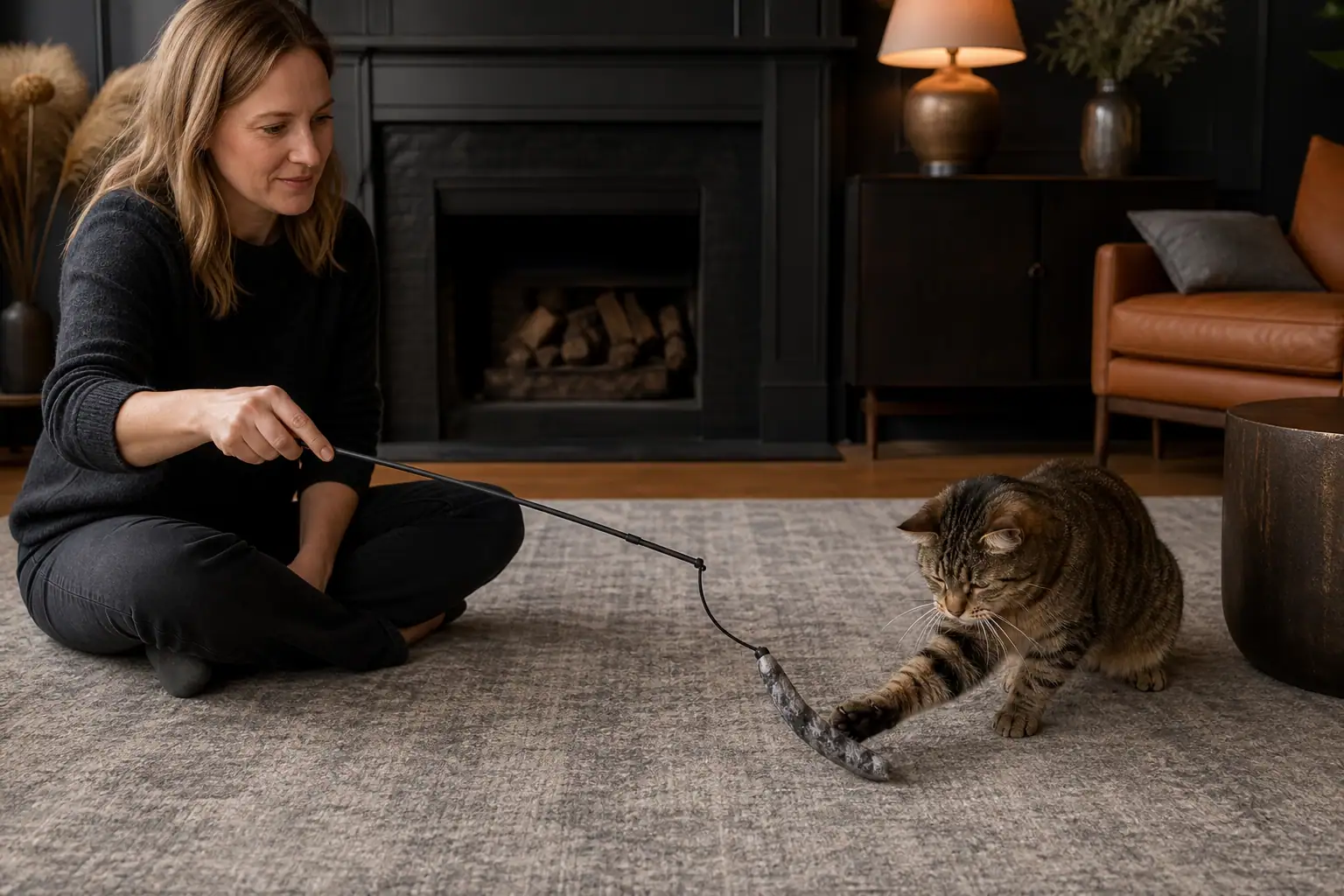
The best cat toys for blind cats are easy to locate without sight, satisfying to catch, and safe for that cat’s bite and play style. Start with an enclosed rattling ball track, a crinkle or rattle toy that is too large to swallow, a scented kicker, a shallow puzzle feeder, and a supervised wand lure that makes a soft, consistent sound close to the floor.
Blind cats do not need a pile of special gadgets. They need clear sensory clues, a predictable play area, and time to investigate. Some will chase a rolling ball by sound; others prefer to wrestle a scented kicker or search a food puzzle. The right choice is the one your cat can find, capture, and use confidently without loose parts, sharp edges, or surprise obstacles.
Quick picks: the best toy types for blind cats
A good starter set covers more than one sense and more than one part of the hunting sequence. You can build it with ordinary cat toys; the label does not need to say “for blind cats.”
| Toy type | Why it can work | Main safety check |
|---|---|---|
| Enclosed ball track | The ball stays in a known area and gives repeatable sound and vibration. | Confirm the base does not tip and the ball cannot be removed or swallowed. |
| Large rattle or crinkle ball | Sound continues as the toy rolls, helping the cat follow and recapture it. | Avoid thin foil, exposed bells, glued pieces, and any ball that fits fully in the mouth. |
| Catnip or silvervine kicker | Scent helps the cat find it; length gives room to grip, bite, and bunny-kick. | Inspect seams, stuffing, plant material, tags, and wet or shredded fabric. |
| Textured wand lure | Your movement creates sound while the long handle keeps claws away from hands. | Supervise every session and store the cord and lure afterward. |
| Shallow puzzle feeder | Food scent and paw contact reward slow exploration and problem-solving. | Start easy, count food as part of the normal meal, and prevent tipping or chewing. |
| Large soft kicker or capture toy | A predictable target lets a rough player finish the catch with the whole body. | Choose dense fabric, strong seams, no hard decorations, and no loose stuffing. |

How blind cats find and follow toys
Vision is only one part of feline play. A blind cat can use hearing to place a rustle or rattle, scent to locate catnip or food, paw pads and whiskers to investigate nearby surfaces, and memory to move through a familiar room. Cats Protection notes that blind cats often adapt well and use whiskers, scent, and a familiar layout to navigate.
The useful design principle is feedback: when your cat touches or moves the toy, something predictable should happen. A track ball rolls and rattles. A crinkle toy answers a paw tap. A puzzle releases one piece of food. A kicker stays in place long enough to bite and rake. That feedback tells the cat where the target went and makes another attempt worthwhile.
Sound does not have to mean loud. In fact, a sudden squeal or motor starting beside a resting cat may be startling. Favor soft rattles, rustling fabric, floor vibration, and noises that begin because the cat or owner moves the toy. If your cat is partly sighted, contrast and gentle light may help too, but do not assume a flashing toy is useful to every visually impaired cat.
Match the toy to how your cat likes to play
Blind cats are individuals first. Watch what your cat does after locating a target, then choose for that behavior.
- Chaser: try a large rattling ball, an enclosed track, or a softly rustling lure dragged along the floor. Keep the route short and free of furniture legs.
- Ambusher: move a wand lure around the edge of a familiar box or tunnel, letting sound disappear and return. Keep entrances in their usual positions.
- Wrestler: offer a long, densely stuffed kicker with a recognizable texture or scent. This is often a better finish than asking a rough cat to grab a small bell toy.
- Forager: begin with treats in an open egg-cup-style puzzle or a few pieces of kibble on a textured mat, then add difficulty gradually. Our guide to puzzle cat toys explains how to prevent frustration and chewing.
- Chewer or shredder: prioritize size, visible seams, dense construction, and supervised sessions. Use the inspection rules in our durable cat toys guide; no toy is indestructible.
- Cautious explorer: start with stationary scent and texture rather than fast motion. Let the cat approach, sniff, and leave without being pursued by the toy.