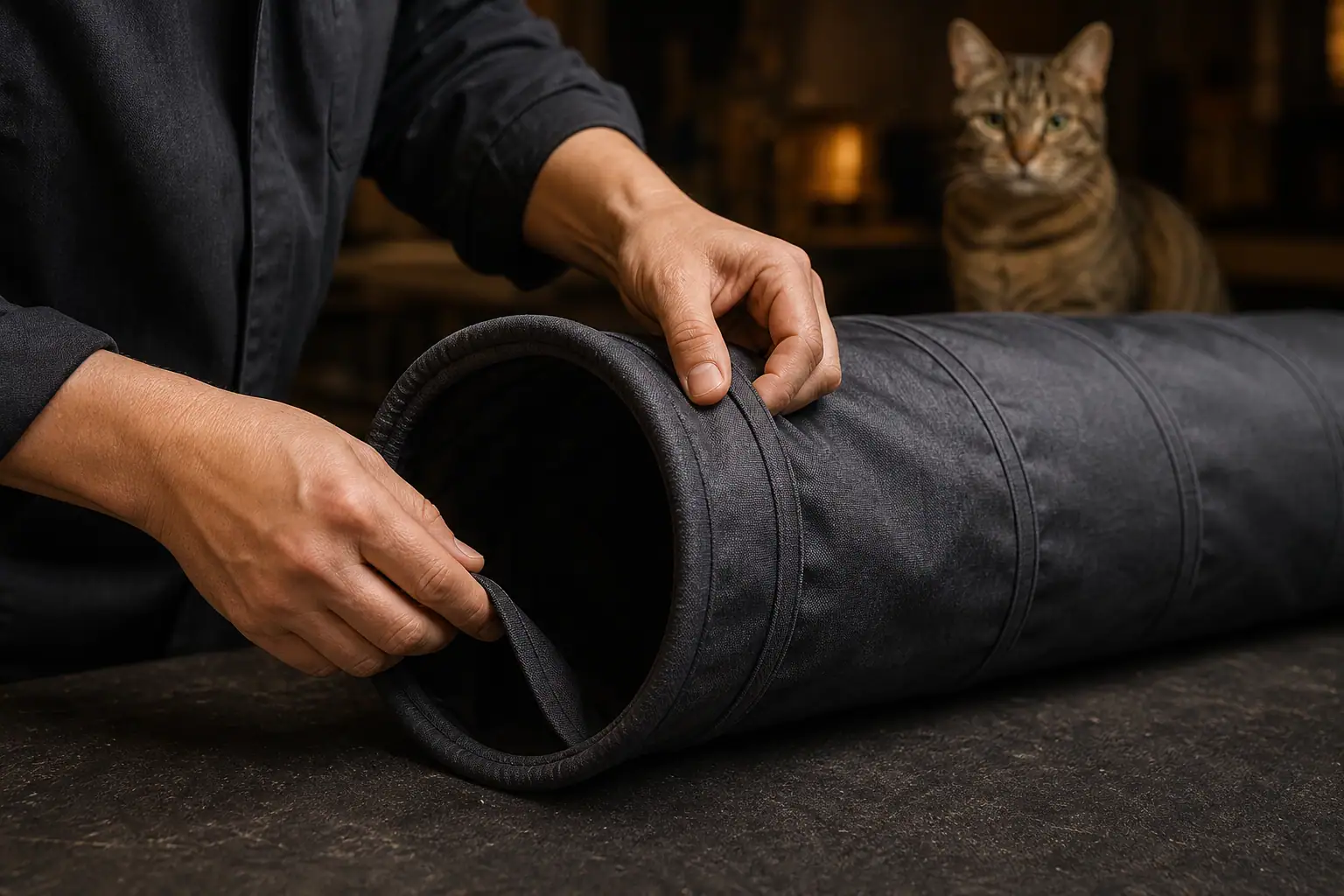
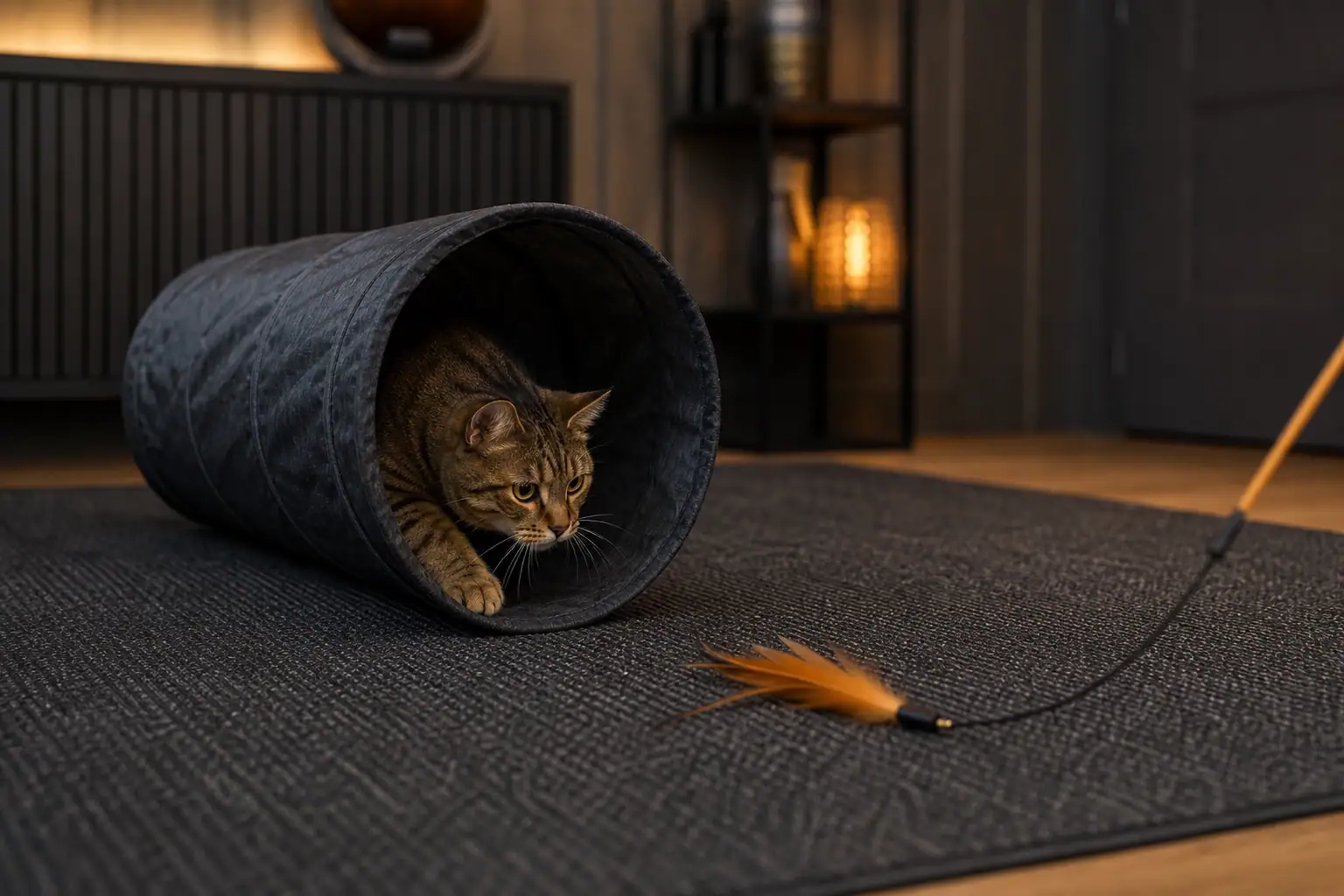
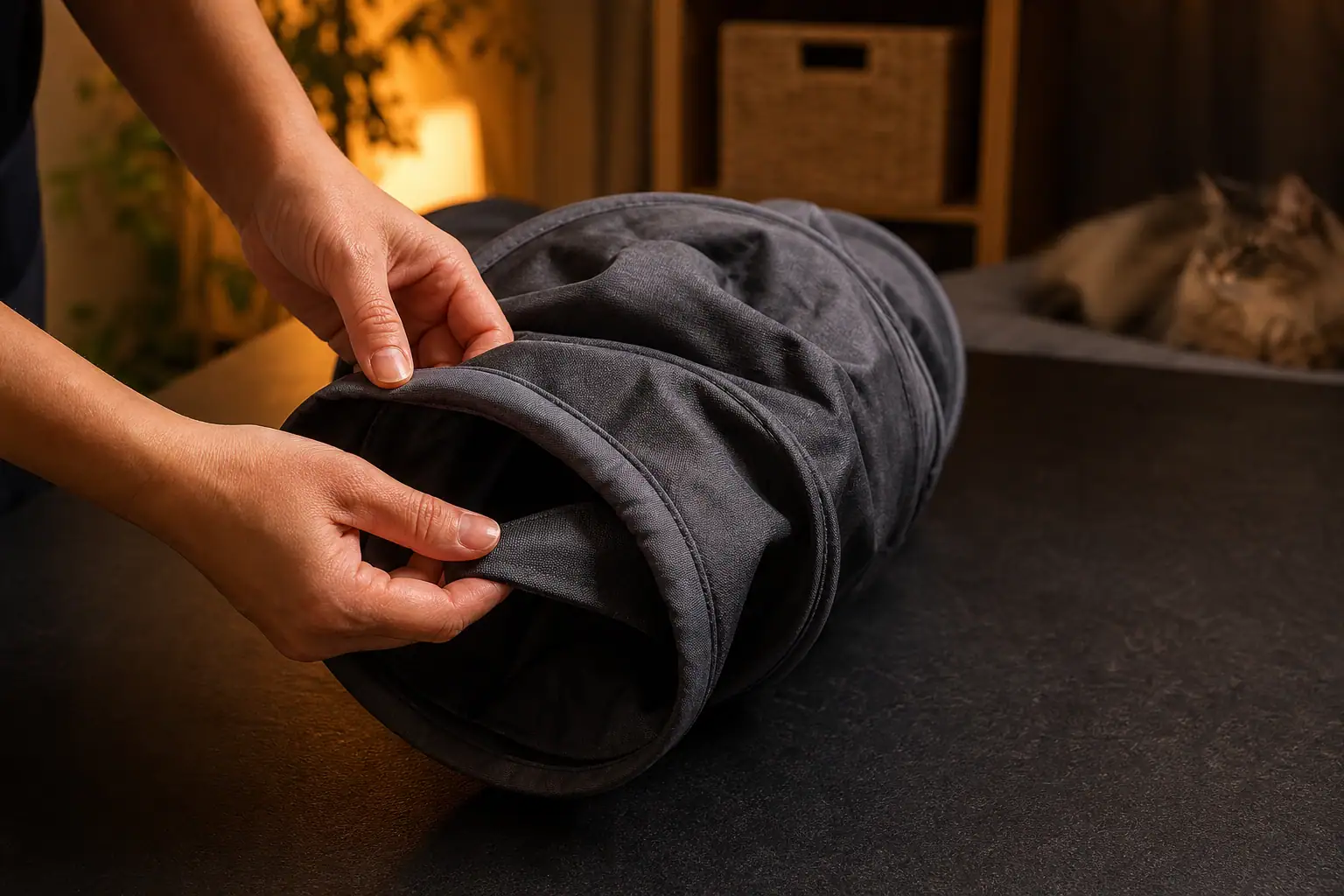
A good cat tunnel toy is wide enough for your cat to enter and turn without squeezing, stable enough not to roll under a full-speed pounce, and simple enough to inspect. Start with a straight, two-exit tunnel made from tightly woven fabric over a fully covered spring frame. Choose a larger internal diameter for a broad, long-haired, or mobility-limited cat, and remove dangling balls, elastic, or ties if your cat chews or pulls attachments.
A tunnel can support hiding, stalking, chasing, and ambush play, but it is not automatically safe because it is soft or collapsible. Supervise the first sessions. Check the entrances, peek holes, frame channels, stitching, and attachments after hard play, and retire the tunnel if wire becomes exposed, fabric tears through, an exit collapses shut, or a piece goes missing.
Quick Choice: Match the Tunnel to the Cat
| Cat or household | Useful starting design | Priority check |
|---|---|---|
| First-time tunnel user | Straight, quiet, two open ends | Cat can see a clear route through and choose whether to enter |
| Large or long-haired cat | Wide straight or gentle-curve tunnel | Shoulders and coat clear the smallest internal opening |
| Rough player | Simple tunnel with dense fabric and no hanging toy | Frame ends stay enclosed after pouncing, rolling, and biting |
| Noise-sensitive or cautious cat | Low-crinkle fabric with a short sight line | No startle, freezing, flattened ears, or immediate retreat |
| Multi-cat home | Two or more full-size exits; optional side opening | No cat can guard the only way out |
| Small apartment | Collapsible straight or U-shaped tunnel | Secure storage loops cannot become chewable cords during play |
| Senior or mobility-limited cat | Short, wide, stable tunnel without a high lip | Easy entry, backing out, and turning on a nonslip surface |
Retail play tunnels are often around 9–10 inches in diameter, while some models marketed for larger cats offer an opening near 11 inches. Those are shopping references, not safety standards. A cat’s shoulder width, coat, mobility, and confidence matter more than weight or a “large” label.
Why Cats Like Tunnels
A tunnel combines two resources cats often value: partial concealment and a route for play. It can become a hide, a runway, a place to watch from cover, or the middle of a stalk-and-pounce sequence. That makes it more flexible than a toy that performs only one movement.
The peer-reviewed AAFP and ISFM Feline Environmental Needs Guidelines identify safe places and opportunities for play and predatory behavior as core parts of a healthy feline environment. They also recommend multiple hiding places and more than one entry for safe places in multi-cat homes so another cat cannot easily block access.
That does not mean every cat will charge straight in. Hiding can be restful, playful, or a way to cope with uncertainty. Respect the cat’s choice. A relaxed tunnel user may loaf inside, watch with neutral ears, chase a lure through, or leave casually. A cat that crouches tightly, flattens the ears, lashes the tail, startles at every crinkle, or refuses to pass an exit may need a quieter, wider, shorter setup—or no tunnel at all.
Size and Shape: Test the Smallest Opening
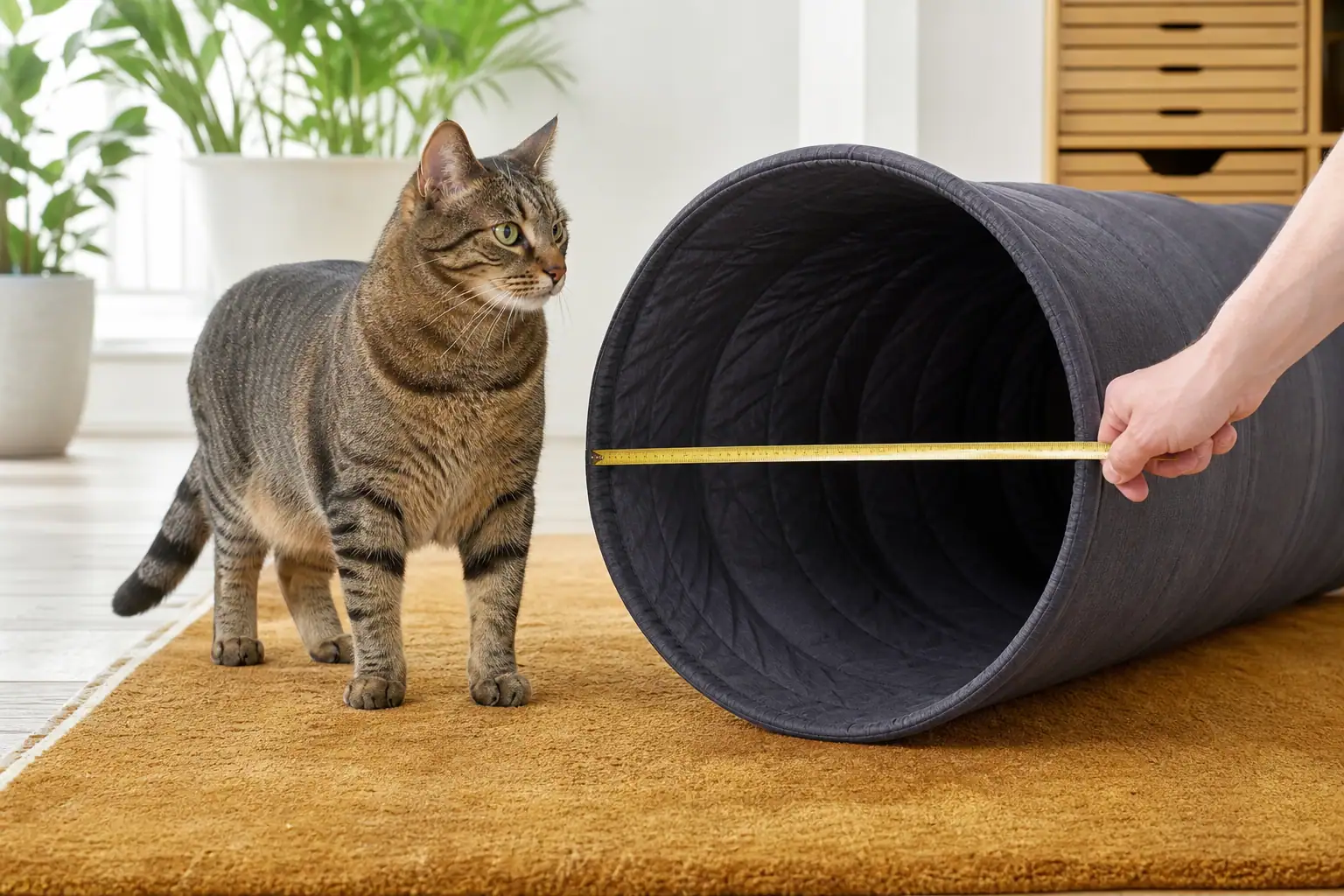
Manufacturers may list the widest entrance while the actual pinch point is a fabric collar, center junction, sharp curve, or flattened section. Check the entire route. Your cat should be able to walk through without compressing the shoulders, dragging the back, or forcing the belly over a tall rim.
- Measure the tunnel, not the package. Confirm the internal diameter at the ends and the narrowest middle point. Product photos can make a short, narrow tube look generous.
- Make a no-pressure comparison. While your cat stands naturally, note shoulder width and standing height. Choose an opening visibly larger than both; add more clearance for long fur, a belly that hangs low, arthritis, or an uncertain cat.
- Open it fully on a nonslip floor. Watch one voluntary pass without a chase toy. The frame should keep its shape, and the cat should not brush, stumble, or become wedged while turning or backing out.
- Recheck under play speed. A tunnel that works for walking may roll, bunch, or collapse during a sprint. Stop if an entrance folds toward the cat’s face or the whole tunnel travels across the floor.
Choose geometry by use rather than novelty. A straight tube has the clearest sight line and is easiest to inspect. A gentle S or U creates ambush cover without a complex junction. A three-way tunnel gives more escape choices but adds a heavily stressed center seam. A donut tunnel bed can double as a resting place but needs a wide passage, a washable cover, and enough structure that a cat lying on top does not trap one inside.
A wall-mounted cat tunnel system is a different product category. Treat every bracket, connector, height transition, load rating, and landing surface as furniture hardware—not as a soft floor toy. Floor-level tunnels are the safer starting point for kittens, seniors, and cats with balance or mobility concerns.