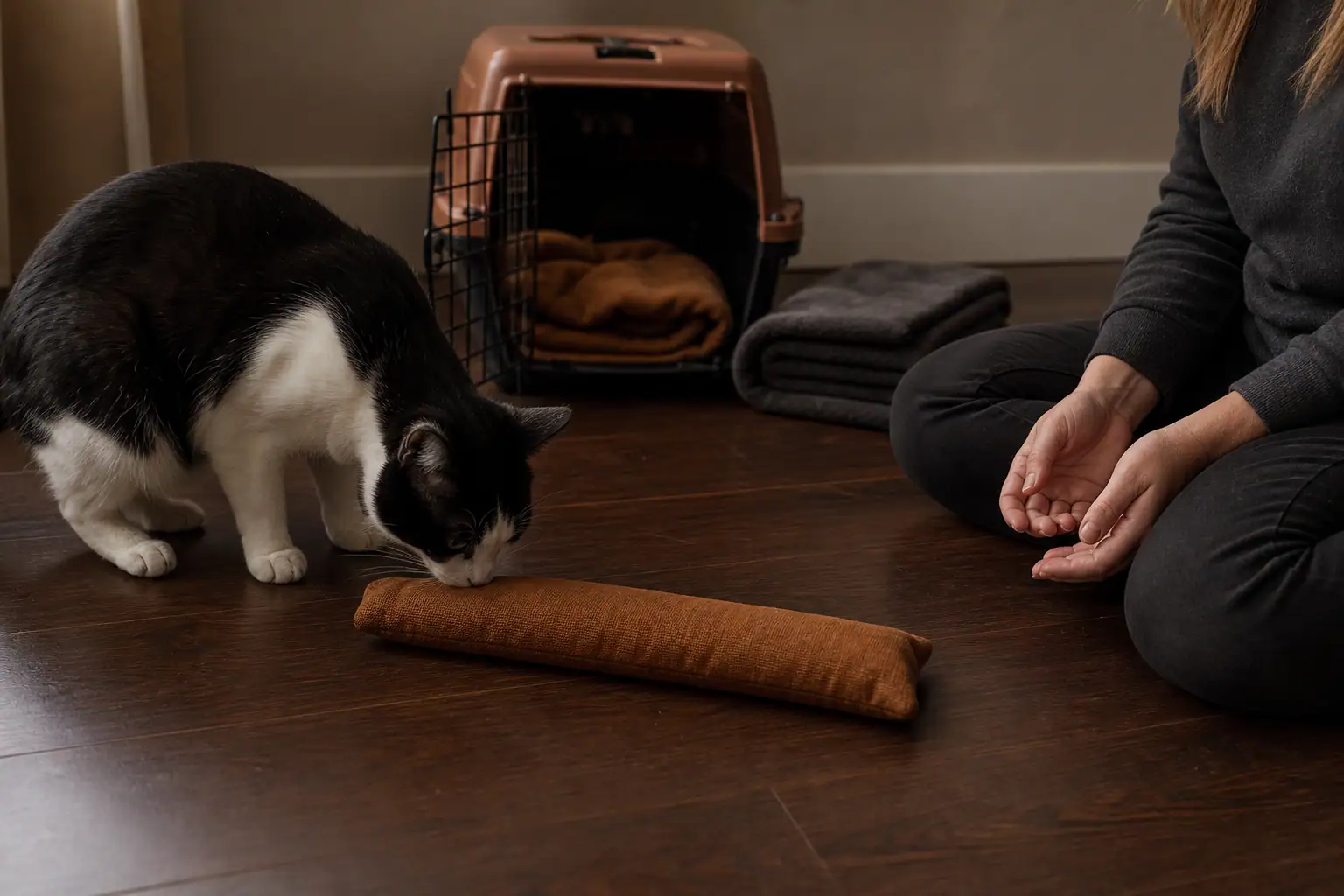
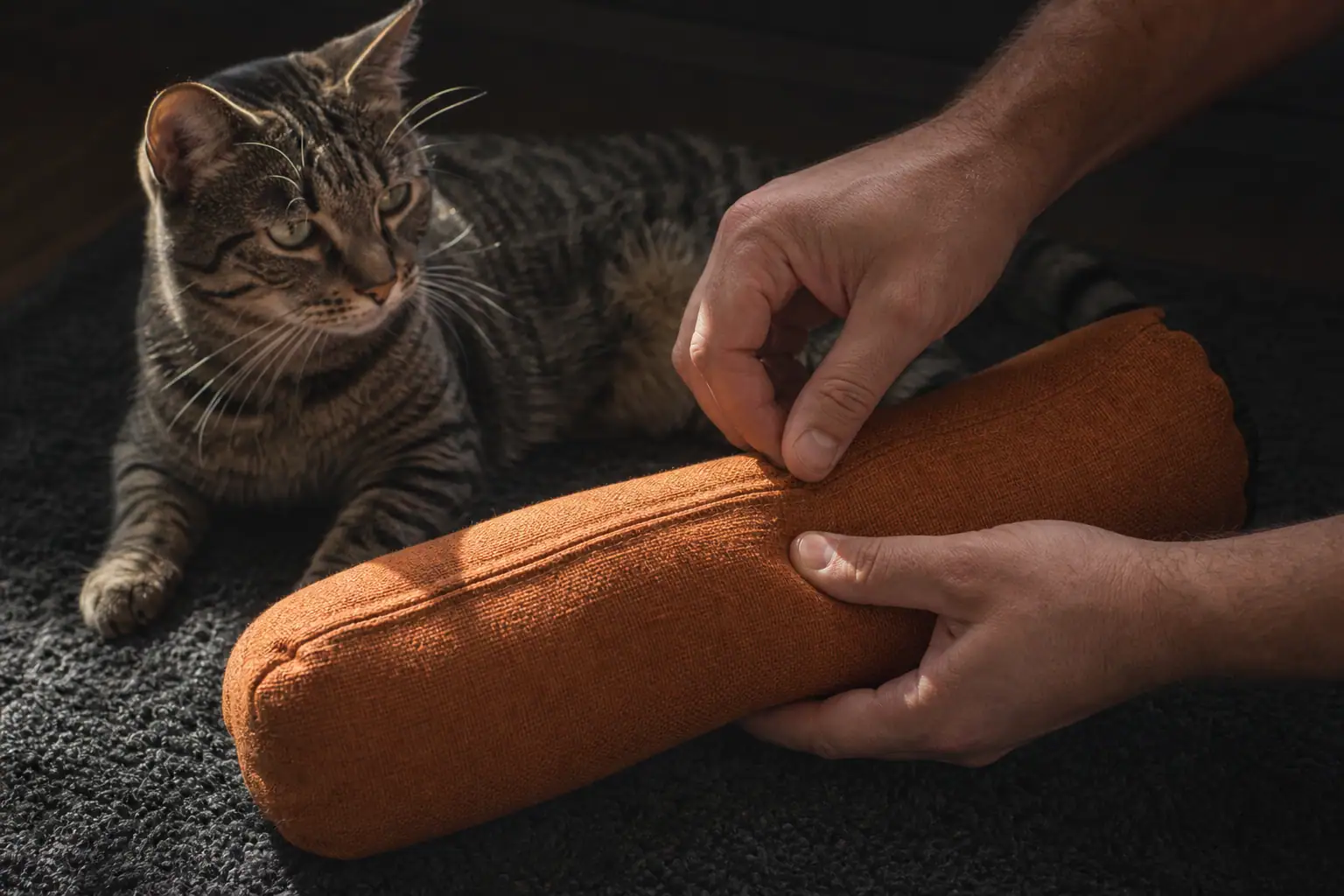
The best cat toys for anxious cats are quiet, predictable, easy to control, and simple to leave. Start with a slow ground-level wand, a shallow food puzzle, a large soft kicker, a stable enclosed ball track, or a familiar toy that already carries your cat’s scent. Introduce one option at a time, let the cat approach voluntarily, and stop before play shifts from curious to tense.
A toy can support a calmer routine, provide an appropriate outlet for hunting behavior, and help a cat build confidence through small successful choices. It cannot diagnose anxiety, remove a household stressor, or treat pain or illness. If hiding, appetite, litter-box use, grooming, sleep, movement, or social behavior has changed, begin with a veterinary conversation—not a louder toy.
This guide is for owners who want something more useful than a list of products labeled “calming.” It explains how to match a toy to your cat’s response, introduce it without pressure, build a repeatable play routine, and keep rough play safe.
Best cat toys for anxious cats at a glance
| Toy type | Why it can work | Calm setup | Main caution |
|---|---|---|---|
| Fabric wand lure | You control speed, distance, and pauses | Drag slowly away at floor level; offer frequent catches | Supervise and store the cord, lure, and wand after play |
| Shallow food puzzle | Rewards sniffing, searching, and small choices | Leave food partly exposed and use a familiar meal | Count food in the daily diet; do not make hunger part of the challenge |
| Large fabric kicker | Gives teeth and hind feet a stationary target | Place it nearby without touching the cat with it | Inspect seams and filling before and after forceful play |
| Enclosed ball track | Moves only when the cat chooses to bat it | Secure it on a nonslip surface near—but not inside—a safe area | Check for cracks, loose caps, claw traps, and detachable parts |
| Oversized quiet ball | Supports brief chase or paw play without a motor | Roll gently across a rug in a clear room | Avoid foam, loose fibers, external bells, and swallowable sizes |
| Familiar comfort toy | Known scent and texture may be less threatening than novelty | Keep it in a chosen resting area if the cat already seeks it out | Do not assume a plush toy is soothing; follow the cat’s response |
The joint AAFP/ISFM Feline Environmental Needs Guidelines describe play and predatory behavior as one of five pillars of a healthy feline environment. They recommend opportunities to search, chase, pounce, catch, manipulate, and forage, while giving separate resources and individual play in multi-cat homes. That framework is more reliable than expecting one electronic toy to “switch off” anxiety.

First, work out what “anxious” looks like for your cat
Anxiety is not simply low interest in toys. A cautious cat may watch from a doorway for several minutes and then play comfortably. A frightened or distressed cat may freeze, crouch low, scan the room, startle easily, hide, flee, or use hissing and swatting to create distance. Some cats become restless or vocal; others become unusually still.
Compare the behavior with your cat’s normal baseline. The AAHA list of common anxiety and distress signs includes changes in activity, hiding, escape attempts, hypervigilance, altered eating or drinking, vocalization, and increased or decreased grooming. One sign in one situation is not a diagnosis; a pattern, intensity, recovery time, and change from normal are what make the observation useful.
Take a 24-hour baseline before buying anything
- Trigger: what happened just before the response—a visitor, appliance, outside cat, household cat, departure, movement, touch, or no obvious event?
- Distance: how far does your cat move away, and is there a clear route to a safe place?
- Body: are the muscles loose or tense; are the ears neutral or flattened; is the tail still, tucked, or thrashing?
- Daily functions: are eating, drinking, toileting, grooming, sleeping, and movement normal?
- Recovery: does the cat return to normal within minutes, or remain withdrawn or alert long after the event?
- Play preference: does the cat watch, stalk, sniff, bat, chase, grip, kick, or ignore each kind of movement?
Record short video from a respectful distance when it is safe. Do not recreate a frightening event for the camera. A simple log helps your veterinarian separate a situational response from pain, illness, inter-cat tension, or a longer behavior problem.
Do not mistake pain or illness for anxiety
Hiding, irritability, reduced play, overgrooming, and litter-box changes can occur with both distress and medical problems. Cornell’s Feline Health Center notes in its guide to excessive licking in cats that medical causes should be ruled out before overgrooming is treated as stress-related. The same caution belongs here: toys are an enrichment tool, not a diagnostic test.
Choose the toy by control, not by the word “calming”
A useful anxiety-sensitive toy gives the cat control over four things: whether to approach, when movement begins, how intense the interaction becomes, and when to leave. Packaging cannot guarantee that. One cat may find a purring plush comforting; another may avoid the unfamiliar sound. One may enjoy a motorized ball; another may stay on alert because its direction is unpredictable.
For a cat who startles at sound
Begin with silent, human-controlled movement: a broad fabric lure on a rug, an oversized felt ball, a cardboard hide with a toy peeking around the edge, or a stationary kicker. Skip crinkle fabric, chirping modules, hard balls on tile, loose bells, and motors until you know the cat’s sound tolerance. Our quiet cat toys guide compares materials and setups for noise-sensitive homes.
For a cat who watches but will not chase
Watching is information, not failure. Place a simple lure at the edge of the cat’s usable space and make one small movement away, then pause. Try partially hiding it behind a box rather than waving it toward the cat’s face. A head turn, forward whiskers, sniff, weight shift, or single paw reach can be the whole first session.
For a cat who prefers food
Use a shallow puzzle with a few pieces of the cat’s regular measured meal visible and easy to remove. Let the first touch succeed. Once the cat approaches comfortably on several occasions, cover one compartment or move a piece slightly farther—not both. Food puzzles should add choice and searching, not frustration. Cats on a prescription diet, with food allergies, or with appetite or weight changes need a veterinarian-approved plan.
For a cat who bites and bunny-kicks hard
Offer a large, simple kicker that is comfortable to grip and too large to swallow. Favor reinforced seams, a dense washable outer fabric, secure filling, and few attachments. “Anxious” does not mean physically gentle: some cats redirect arousal into intense grabbing and kicking. Choose for the bite style you actually see, and read our durable cat toy guide for construction and failure-point checks.
For a cat who wants to initiate play alone
A captive ball track, stable puzzle, large simple kicker, or sturdy cardboard search box can allow self-directed interaction without random electronic motion. “Self-play” still needs a safety decision: strings, feathers, wire, elastic, exposed batteries, small caps, and toys the cat dismantles do not become safe just because the owner leaves the room. Use our self-play cat toy checklist to sort true leave-out options from supervised toys.