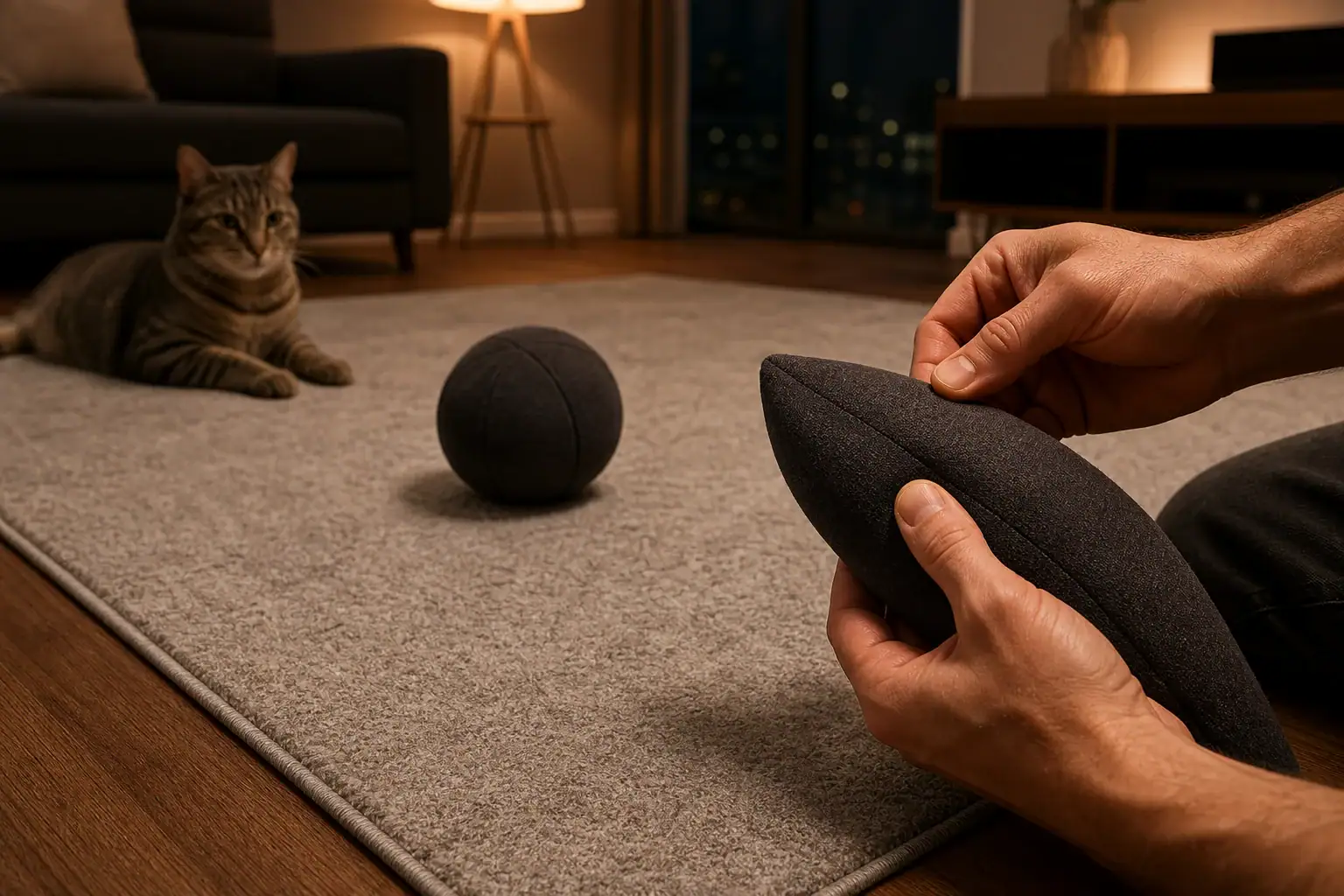
The best quiet cat toys are soft on the outside, free of bells, squeakers, crinkle film, and motors, and unlikely to skitter across hard floors. Good options include a large fabric kicker, a dense felt or fabric ball, a soft-covered rolling toy, and a stationary food puzzle. For interactive play, a simple fleece lure moved across a rug is quieter than a toy with hard clips, feathers, or a rattling reel.
Quiet does not automatically mean safe to leave out overnight. A silent foam ball can be a poor choice for a cat that bites off pieces, while a sturdy puzzle may still become noisy when shoved into a wall. Choose for your cat’s play style first, test the toy in the room where it will be used, and leave out only intact toys your cat has already handled safely.
Best Quiet Cat Toys by Play Style
Start with the behavior your cat repeats. A wrestler needs a different low-noise outlet from a cat that stalks, rolls objects, or searches for food.
| Play style | Quiet option | Why it is quieter | Main safety check |
|---|---|---|---|
| Biting and bunny-kicking | Large fabric kicker with no rattle or crinkle layer | Soft contact with the floor and furniture | Check seams, filling, and fabric thinning after hard play |
| Chasing and fetching | Dense felt ball or fabric-covered ball that is too large to swallow | No hard shell striking baseboards | Remove it if fibers pull free or the covering separates |
| Batting | Soft one-piece rolling toy on a low-pile rug | Soft surface reduces impact and rolling noise | Avoid biteable foam for cats that tear or eat soft material |
| Searching and foraging | Stationary puzzle with large captive pieces | No loose ball racing around the room | Use part of the normal ration; clean out food after use |
| Stalking with a person | Wide fleece lure on a plain wand | No bell, motor, hard lure, or metal clip hitting the floor | Supervise continuously and store the whole wand after play |
| Hiding and pawing | Stable cardboard box with a large fabric toy partly concealed | The target stays in a small, soft play zone | Remove tape, staples, handles, sharp tears, and swallowed cardboard |
A product label cannot tell you whether a toy will stay quiet in your home. A felt ball may be nearly silent on carpet and surprisingly audible when a cat drops it down wooden stairs. A stationary puzzle may be quiet until it slides. Treat the table as a shortlist, then run the home test below.

What Actually Makes a Cat Toy Noisy?
Most toy noise comes from four places. Check all four before deciding that a toy is suitable for sleep hours, a shared wall, or a sound-sensitive cat.
- Built-in sound: bells, rattles, squeakers, crinkle film, beeps, and recorded prey sounds are intentionally audible. Even a “gentle” crinkle may be too much beside a bedroom.
- Impact: hard plastic, wood, metal clips, and dense rubber knock against floors, doors, bowls, and baseboards. Lightweight does not always mean quiet; a hollow ball can amplify every bounce.
- Movement: motors, gears, vibrating parts, and automatic restarts create hums and sudden bursts. The lure may be soft while the drive unit is not.
- The room: tile, hardwood, empty hallways, stairs, and walls shared with a neighbor magnify sound. Rugs, curtains, and upholstered furniture absorb more of it.
There is also a difference between quiet for you and comfortable for your cat. A high-pitched electronic sound may be easy for a person to miss but still provoke ear flicking, freezing, retreat, or refusal to approach. The feline veterinarians behind Cat Friendly Homes advise keeping noise low around stressed cats and letting cats control their distance from unfamiliar experiences.
A 60-second home sound test
- Place the toy on the exact floor where your cat will use it.
- Roll, tap, or activate it as play would, not just as a slow demonstration in your hand.
- Listen from the bedroom or the other side of the shared wall. Check whether it travels under furniture or reaches the stairs.
- Then watch one supervised session. Stop if your cat startles, flattens the ears, repeatedly retreats, attacks the mechanism, or tries to dismantle the toy.
Do not make a noisy toy “soft” by wrapping it in loose socks, tape, yarn, or glued fabric. A homemade covering can shift, expose adhesive, block a motor, trap heat, or create pieces to swallow. Choose a purpose-built softer design or change the play surface instead.
Make the Play Zone Quieter Before Buying More Toys
The room often matters more than the product. A small setup change can quiet several toys at once and reduce nighttime collisions.
- Create a rug-sized play zone. Use a secure, low-pile, washable rug or non-slip mat with no curling corners or loose loops. Place rolling and kicking toys in the middle, away from hard furniture edges.
- Block the loud route. Close access to stairs or echoing hallways if you can do so without trapping the cat away from food, water, litter, resting places, or family members.
- Choose captive movement. A ball enclosed in a stable track may travel less than a loose ball, but test it: some tracks rattle loudly and some cats can pry off the cover.
- Move automatic play out of sleep hours. Timers and motion sensors can restart unexpectedly. Use motorized toys during a planned, observed window and switch them off afterward.
- Keep the floor clear. A quiet toy becomes noisy when it hits a metal bowl, wastebasket, doorstop, or another hard toy.
If a cat needs more variety without more gadgets, rotate texture, movement, hiding places, and food-search games. Our guide to sensory toys for cats explains how to build interest without relying on loud sound effects.