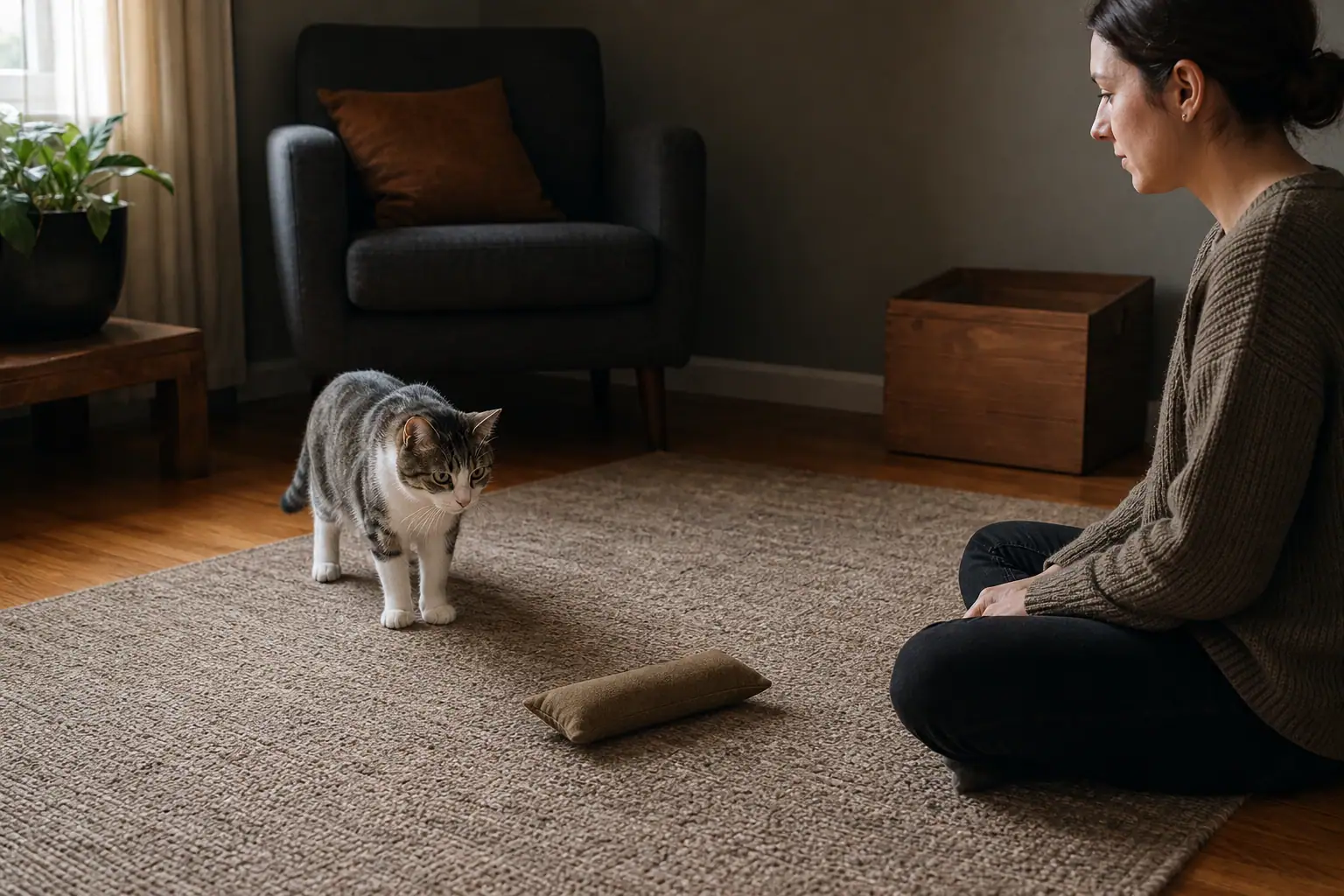
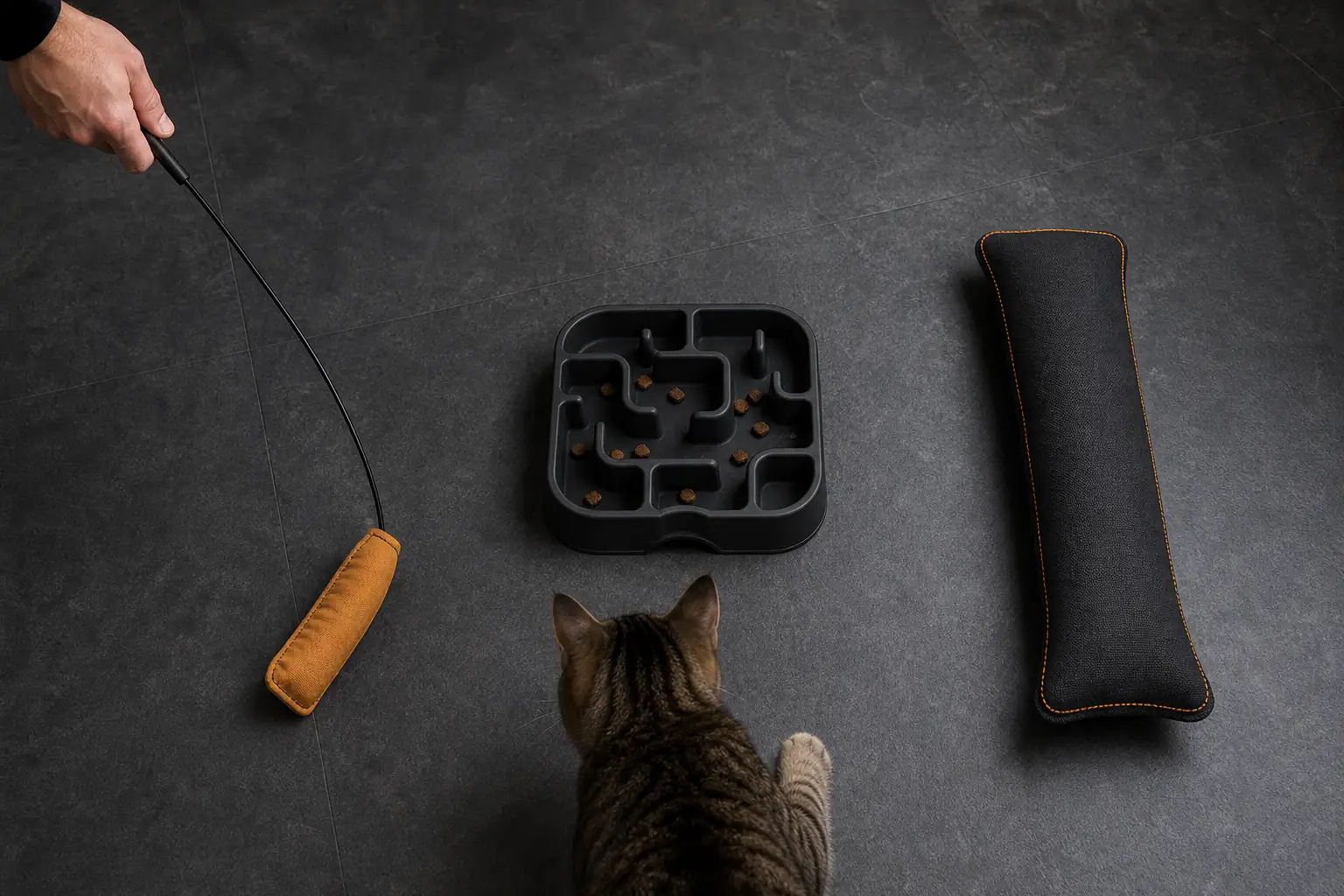
The best sensory toys for cats give them something meaningful to detect and do: track motion, follow a scent, locate a sound, feel a texture, or work for food. A useful starter kit is not a pile of flashing gadgets. It is one visual chase toy, one scent or food puzzle, and one sturdy toy your cat can grab and kick.
Choose each toy by the sense your cat actually uses during play, then watch what happens. Keep the toy if it produces relaxed stalking, chasing, pouncing, sniffing, pawing, or wrestling. Change the speed, setting, or toy if your cat freezes, flattens their ears, lashes their tail, hides, or tries to dismantle it. Sensory enrichment works best when it is specific, adjustable, and safe to finish with a real catch.
What Counts as a Sensory Toy for Cats?
A sensory toy creates feedback your cat can notice through sight, smell, hearing, touch, or taste. Most good toys use two or three channels at once. A fabric kicker may offer texture, scent, and resistance. A rolling food puzzle combines movement, sound, smell, and a food reward. A wand lure provides visual motion plus a physical capture.
The point is not maximum stimulation. It is a clear play job. The AAFP and ISFM feline environmental needs guidelines recommend giving cats opportunities to play and perform parts of the predatory sequence, including locating, stalking, chasing, pouncing, catching, and biting. A toy is more useful when it lets your cat complete several of those actions instead of merely watching an effect they cannot reach.
| Sensory channel | Useful toy features | Good for | Main caution |
|---|---|---|---|
| Sight and motion | Low, irregular movement; a lure that pauses and hides | Chasers, stalkers, deaf cats | Avoid frantic motion and uncapturable light-only play |
| Smell | Catnip or silver vine in a closed pouch; hidden food | Sniffers, stationary-toy play, some senior cats | Use cat-appropriate products, not essential oils |
| Sound | Soft rustle, rattle, or rolling sound | Auditory hunters, cats with limited vision | Loose bells and hard noise-makers can be unsafe or startling |
| Touch and vibration | Firm fabric, ridges, give-and-resistance, floor vibration | Wrestlers, kickers, deaf cats, rough players | Inspect seams, edges, stuffing, and chew damage |
| Taste and foraging | Food puzzle with adjustable difficulty | Food-motivated cats, beginners, indoor routines | Count food toward the daily diet and clean residue promptly |
Choose Toys by Sense, Not by Marketing Label
Sight and motion: make the toy move like cautious prey
Use a wand lure, a large lightweight toss toy, an enclosed track ball, or a motion toy with a predictable off switch. Move the lure away from your cat, across the floor, around a corner, and behind a box. Pause often. A target that constantly rushes toward the cat can feel confrontational; a target that disappears and reappears creates a reason to stalk.
Let your cat catch the lure regularly. If you use a laser, keep it away from eyes and reflective surfaces, use it briefly, and transition to a physical toy or food reward the cat can capture. The Titan Claws guide to safer laser play explains how to avoid an all-chase, no-catch session.
Smell: test a preference instead of assuming catnip wins
Offer catnip and silver vine separately on different days, ideally in intact refillable pouches or sturdy toys designed for the material. Do not rub a new scent onto every toy at once. Your cat needs a clean comparison, and you need to know which item caused the response.
Individual preference is real. In a study of 100 domestic cats, 68% responded to catnip and 79% to silver vine; 71% of the catnip nonresponders reacted to silver vine. That does not promise a response from your cat, but it makes silver vine a reasonable second test when catnip earns a shrug.
Newer research adds a practical detail. A 2025 study of 31 pet cats found that cats interacted more with moving toys than stationary ones. Adding each cat’s preferred catnip or silver-vine scent increased interaction with a stationary toy, but did not add a measurable benefit to a moving toy. In other words, scent can revive a quiet kicker or cushion; a moving lure may already be doing enough.
Sound: use quiet location cues, not volume
For a hearing cat—especially one with limited vision—a soft rattle, paper rustle, or rolling sound can reveal where the “prey” went. Test the sound at a distance and low intensity. The goal is orientation, not surprise.
Skip toys with exposed bells, rigid noisemakers small enough to swallow, or parts your cat can pry free. If a cat startles, retreats, stops grooming, or scans the room after the toy has stopped, choose a quieter option. A deaf cat does not need a louder toy; use visible motion, scent, touch, and floor-level vibration instead.
Touch and texture: give rough play somewhere appropriate to land
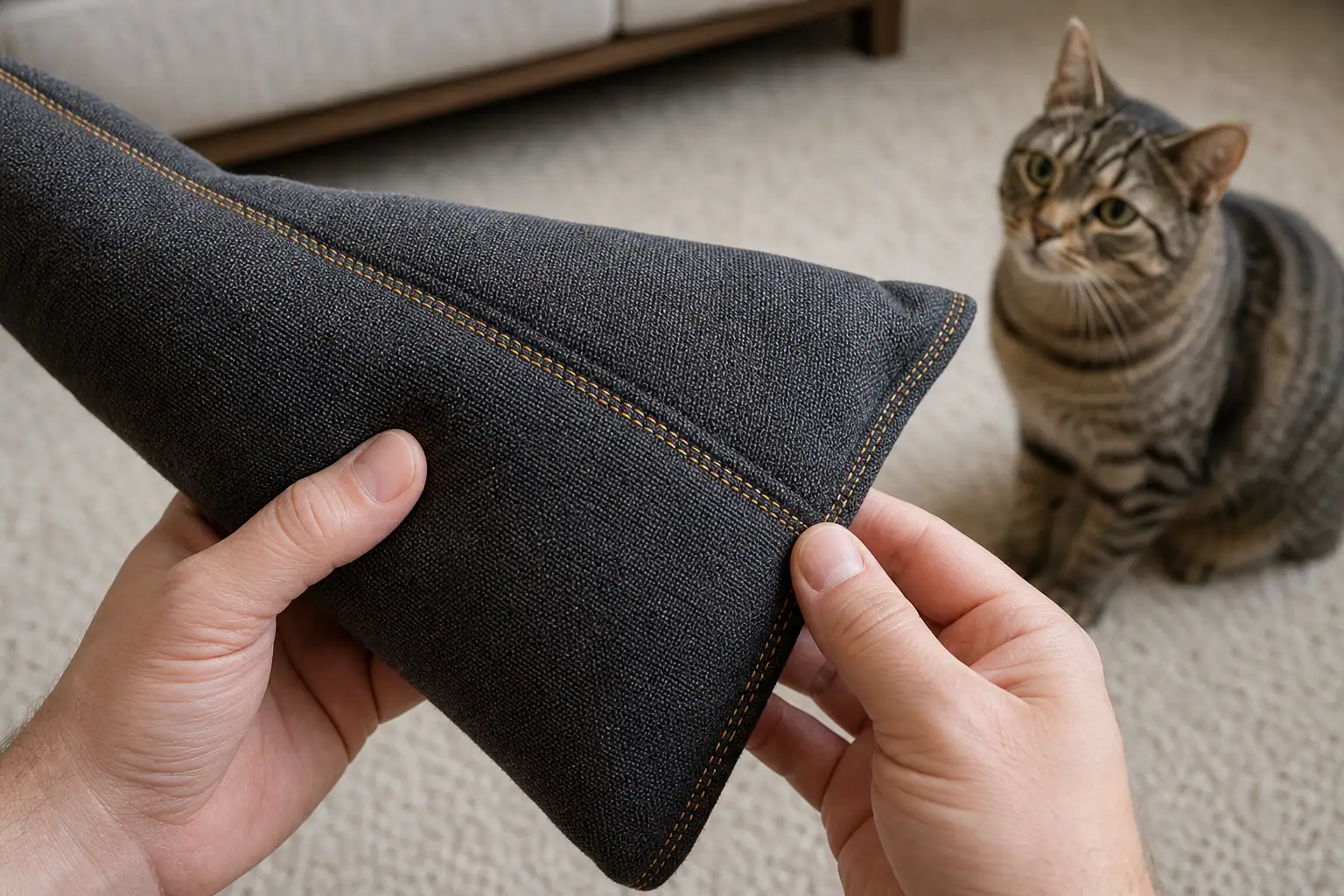
A firm kicker lets a cat grasp with the front paws, bite, and rake with the back feet while keeping those actions away from hands. Look for a size your cat can wrap around, a surface with traction, and seams you can see and inspect. An enclosed track, corrugated scratch surface, shallow box, and textured food mat can offer different paw feedback without dangling parts.
For cats that focus on seams or chew until filling appears, sensory appeal must come second to failure behavior. Choose simple shapes, minimal attachments, reinforced construction, and supervised use. The Titan Claws durable cat toy guide shows how to judge a toy by materials, seams, and the way your cat attacks it rather than by an “indestructible” label.
Taste and foraging: turn part of a meal into a search
A puzzle feeder is both a sensory toy and a problem. Begin with an easy open tray, a few pieces of the cat’s normal food, and visible rewards. Increase difficulty only after the cat succeeds without pawing frantically, biting the device, or walking away.
Food puzzles should be stable, washable, free of sharp edges, and large enough that parts cannot be swallowed. Include the food in the cat’s normal daily intake. If your cat has a prescribed diet, dental pain, mobility limits, or a medical reason for a specific feeding schedule, ask your veterinarian before changing how meals are delivered.
Build a Three-Toy Sensory Starter Kit
You do not need five toys for five senses. Start with three toys that produce different behaviors and can be inspected easily.
- One chase-and-catch toy: a supervised wand with a sturdy, replaceable lure or a large toss toy. This covers visual tracking, motion, touch, and capture.
- One search-and-solve toy: a beginner food puzzle or a few pieces of normal food hidden in a clean, shallow activity box. This covers scent, taste, paw use, and problem-solving.
- One hold-and-wrestle toy: a firm, intact kicker with no hard internal pieces or loose decorations. Add catnip or silver vine only after testing the unscented toy.
Run each toy alone for two or three short sessions before combining them. This avoids the common mistake of switching on motion, sound, lights, and scent together, then having no idea which feature attracted—or worried—the cat.