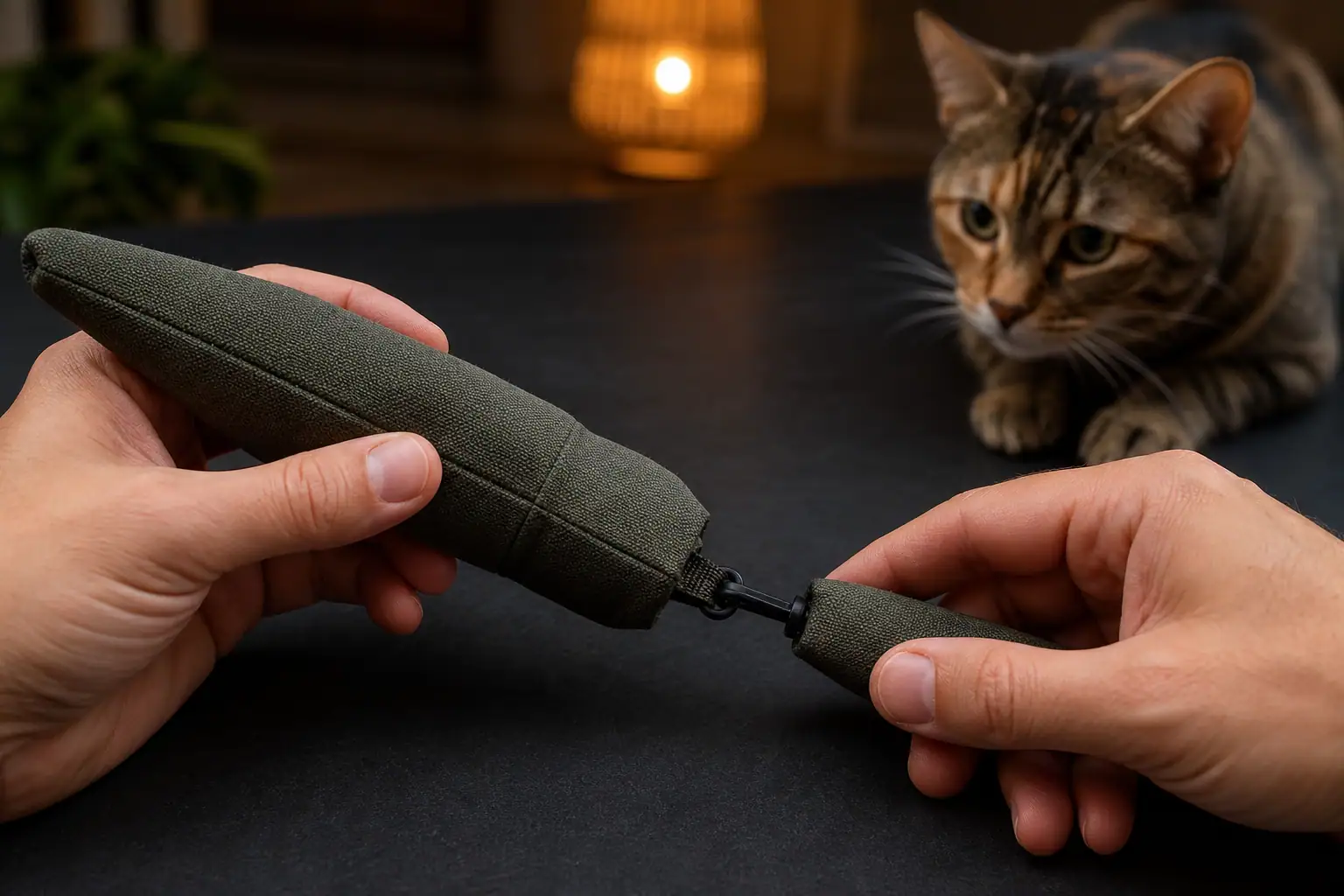
The best cat toys for deaf cats are easy to locate with sight, scent, touch, or floor-level vibration; give the cat something physical to catch; and stay safe under the cat’s actual style of play. A high-contrast wand lure, a sturdy kicker, a stable puzzle feeder, a track or rolling toy, and a tunnel can all work well. A toy does not need sound—or a “special-needs” label—to be engaging.
Deaf cats are individuals. One may chase the smallest flicker of movement, while another would rather sniff out treats or wrestle a large fabric toy. Start with the senses and play patterns your cat already uses, then adjust the toy’s size, movement, texture, and placement. Do not assume a deaf cat automatically has sharper vision or smell; the useful point is that play can be offered through more than one sensory channel.
If your cat has newly stopped responding to sound, or also has ear discharge, repeated head shaking, pain, dizziness, or disorientation, arrange a veterinary examination before treating the change as a toy-selection problem. Cornell’s Feline Health Center explains that feline deafness may be congenital or acquired, and some underlying ear conditions are treatable.
Quick picks: the best toy types for a deaf cat
Choose a small mix rather than a basket full of near-identical toys. This table is a starting point; your cat’s mobility, vision, food needs, and bite strength should make the final decision.
| Toy type | Why it can work | Main safety rule |
|---|---|---|
| High-contrast wand with a fabric lure | Clear movement supports stalking, chasing, pouncing, and catching. | Use only with active supervision; store the wand and cord after play. |
| Large fabric kicker | Texture, scent, pressure, and resistance make a satisfying physical catch. | Choose a size that cannot be swallowed and inspect seams after hard biting. |
| Stable puzzle feeder | Food scent and paw work create a locate-and-extract challenge. | Count treats as part of the daily diet and start with an easy puzzle. |
| Oversized rolling ball or enclosed track | Visible motion and vibration through a hard floor can help the cat follow it. | Avoid detachable bells, caps, elastic, and balls small enough to enter the mouth. |
| Wide tunnel or cardboard hide | Supports hiding, ambushing, exploring, and choice without relying on sound. | Remove loose wires, exposed staples, torn mesh, tape, and chewed cardboard pieces. |
| Motion toy with a guarded mechanism | Unpredictable visible movement can renew interest for some cats. | Test while present; retire it if the cat can reach the motor, battery, or moving joint. |
The joint AAFP/ISFM feline environmental-needs guidelines recommend play that lets cats perform parts of the predatory sequence, including locating, stalking, chasing, pouncing, catching, and manipulating prey. They also recommend rotating toys and putting away items with string or ingestible parts after play. Those principles matter more than whether a package says it was designed for deaf cats.
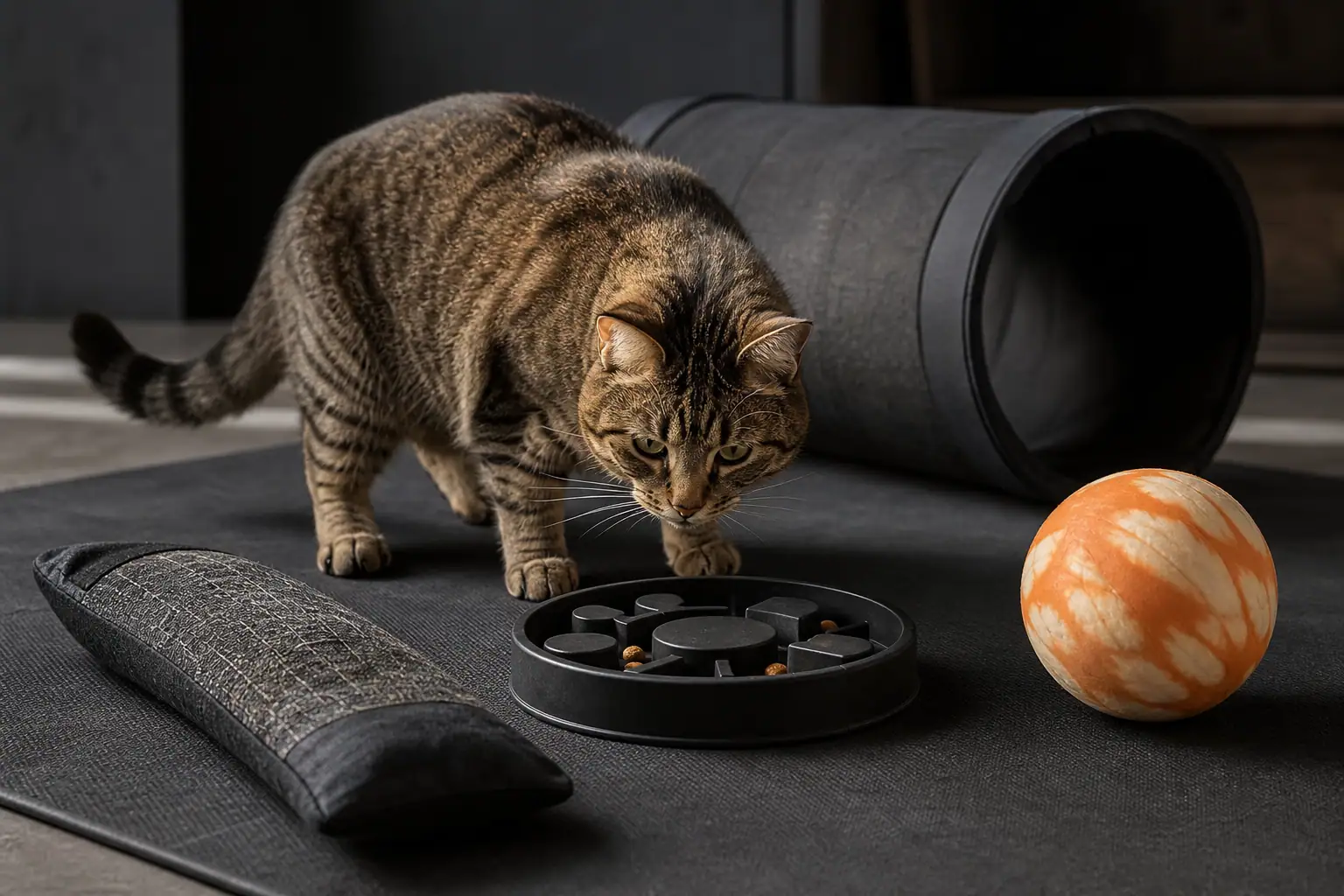
Choose by sensory channel, not by sound
Sight: contrast and prey-like movement
Use a lure that stands out against the floor. A cream toy can disappear on a pale rug, while a charcoal or rust-colored lure may be much easier to track. Move a wand across the cat’s field of view rather than suddenly dropping it from behind. Ground-prey movement—short dashes, pauses, and retreats behind furniture—usually gives the cat more information than frantic circles in the air.
Let the cat catch the lure regularly. Endless pursuit without capture can turn an exciting game into a frustrating one. If you use a light pointer, never aim at eyes or reflective surfaces and finish by guiding the cat to a physical toy or food reward. Our guide to safer laser-toy play covers that catch-and-finish routine in detail.
Scent: a trail worth investigating
A few pieces of the cat’s normal food hidden in an easy puzzle can turn scent into a hunting cue. You can also rub a familiar cloth lightly over a washable toy, or use catnip or silver vine if your cat responds well to it. Not every cat reacts to plant attractants, and a strong smell is not a substitute for a safe structure.
Avoid essential oils, concentrated fragrance, and improvised scent products. The goal is a mild, familiar cue—not an overpowering odor on something the cat will bite and lick. Wash food puzzles according to their care instructions and discard porous toys that stay damp or develop an unusual odor.
Touch and vibration: useful information under the paws
A ball rolling across wood or tile, a lure dragging over a textured mat, and a kicker resisting the hind feet all create tactile feedback. Try play on a firm surface if a thick carpet seems to swallow the toy’s movement. A gentle footfall or tap on the floor can also announce that you are nearby before play begins, but it should be a consistent cue—not a startling stomp beside the cat.
A vibrating collar is not a toy and is not necessary for enrichment. Do not improvise with vibration devices attached to the cat. If you are considering any wearable training tool, discuss its fit, purpose, and conditioning plan with a veterinarian or qualified feline behavior professional.
A 10-minute play routine a deaf cat can predict
Predictability helps a cat understand when interaction is beginning and ending. Cats Protection’s deaf-cat guidance recommends distinct, consistent visual signals and notes that deaf cats can startle when approached without warning. Build those ideas into the game.
- Announce yourself. Move into the cat’s line of sight. Use one calm hand signal, switch a nearby room light once, or create a gentle floor vibration from a respectful distance. Never flash a bright light into the cat’s eyes.
- Invite, do not corner. Present the lure several feet away and give the cat space to approach, retreat, or watch.
- Start small. Make one or two slow movements across the visual field. If the cat orients, let the “prey” pause.
- Run the hunt. Alternate short escapes with stillness. Move away from the cat more often than toward the cat, and use furniture edges as hiding points.
- Offer repeated catches. Let the cat pin, bite, or bunny-kick an appropriate physical toy. Keep hands and feet out of the game.
- Finish clearly. Slow the prey, allow a final catch, then offer a small food reward if it fits the cat’s diet. Use the same visual “all done” cue each time.
- Inspect and store. Check the toy while the session is fresh in your mind. Put away wands, strings, feathers, elastic, and damaged toys.
Ten minutes is a framework, not a quota. A kitten may want several energetic rounds; a senior cat may prefer shorter floor-level sessions. Watch for re-engagement instead of forcing a schedule. If you need help setting the frequency, see our practical guide to how often to play with your cat.