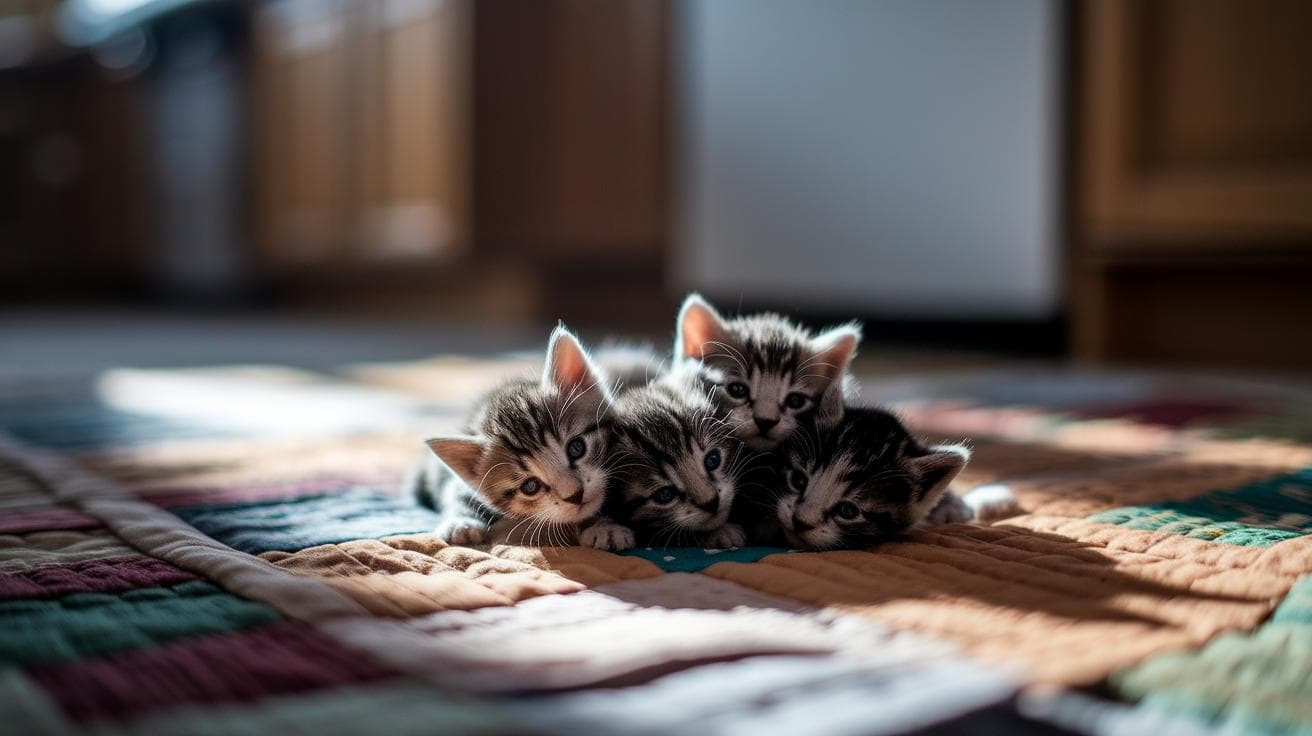
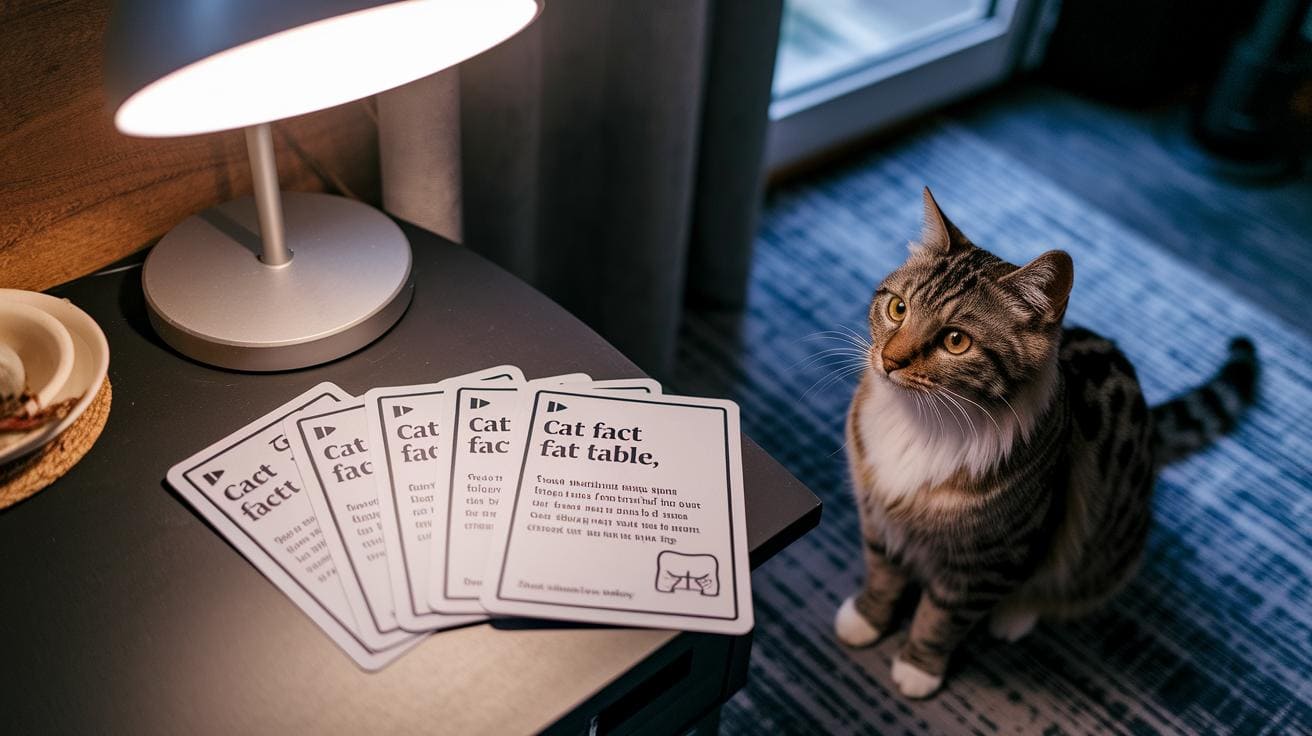
88 million pet cats live in the U.S. Are we raising tiny tigers or just a house full of purring ninjas? They snooze 12 to 16 hours a day, then explode into lightning-fast dashes across the living room at dawn and dusk, claws clicking on hardwood and whiskers twitching.
This post shares 25 quick cat facts that answer common questions, bust myths, and give you neat, shareable tidbits for friends, family, or that curious kid at the shelter. We're talking practical stuff you'll actually use, not just random trivia. Ready for fun, useful cat trivia that helps you care for them? Ever watched your kitty chase a shadow? It's like mini hunting practice, and it's oddly purrfect.
Quick Cat Facts That Immediately Answer Common Questions

There are about 88 million pet cats in the U.S. I know, that’s a lot of whiskers. Most cats sleep 12 to 16 hours a day, they’re busiest at dawn and dusk, and indoor cats usually live longer than outdoor cats.
- Archaeology shows people started domesticating cats around 3600 B.C. (Source: Cornell).
- A house cat’s genome (its full set of DNA) is about 95.6% the same as a tiger’s, so they’re surprisingly close cousins (Source: AVMA).
- Cats typically sleep 12 to 16 hours daily, which adds up to roughly 70% of their life asleep. Perfect for small nap breaks, right? (Source: ASPCA).
- Cats are crepuscular (active at dawn and dusk), so don’t be surprised if yours turns into a tiny karate master at sunrise or sunset (Source: Cornell).
- The world’s longest domestic cat measured 48.5 inches from nose to tail tip (Source: Guinness World Records).
- A house cat can jump up to six times its body length in one bound , who needs a ladder? (Source: AVMA).
- In short bursts, cats can outrun top human runners for a few meters, so that living-room dash is real (Source: Cornell).
- A group of cats is called a clowder , handy trivia for your next classroom show-and-tell (Source: Oxford).
- Felicette was the first cat sent into space during a French mission in 1963. True story. (Source: NASA).
- Adult cats have about 230 bones, which is more than the average human bone count. That’s a lot of tiny skeleton pieces to admire. (Source: Cornell).
- Most domestic cats have 18 toes: five on each front paw and four on each back paw. Polydactyl cats are the fun exceptions. (Source: AVMA).
- Cats have about 473 taste buds and can’t taste sweetness the way we do , so no candy for them, please (Source: ASPCA).
Want more detail? See Cat Anatomy Facts: Whiskers, Bones, Tongue, and Ear Muscles for structure and care; Feline Senses Explained: Vision, Hearing, Smell, Taste, and Purring for perception and toy picks; Diet and Health Facts Every Cat Owner Should Know for nutrition and dental guidance; Cat Behavior Facts: Communication, Tail Language, and How to Respond for body language.
Cat Anatomy Facts: Whiskers, Bones, Tongue, and Ear Muscles

Structural anatomy shows how a cat’s body is built and why some care choices matter. That’s useful when you’re checking paws, brushing fur, or choosing a new toy. Think of it as the behind-the-scenes guide to keeping your kitty happy and safe.
Whisker Structure and Care
Whiskers are thicker, coarser hairs with roots about three times deeper than regular fur. They sit in roughly 12 per cheek, in four rows, and have tiny scent glands at the base. Whiskers are like built-in measuring tapes for cats; they help your cat sense space and stay balanced. Want more detail? See do cat whiskers help with balance.
Never trim whiskers. They’re sensory tools, not decoration.
Watch for whisker fatigue, narrow bowls or cramped toys can irritate them. Ever seen a cat refuse a food bowl? That could be why.
If whiskers fall out suddenly or behavior changes a lot, check with your vet.
Skeletal and Oral Structures
Adult house cats have about 230 bones. Their clavicles (collarbones) are small and free-floating (not fused to the shoulder), tucked in shoulder muscle so cats can slip through tight spots and twist in midair. That’s why they can look so gravity-defying when they jump.
The dewclaw (a thumb-like nail on the inner wrist) helps with gripping while climbing or grabbing toys. It usually causes no trouble, but check it for broken nails or stuck debris. Trim only if it’s growing into the pad.
The middle of a cat’s tongue is lined with papillae (small backward-pointing spines). Those rough bits help grip meat and groom fur, giving that satisfying rasp as your kitty cleans. If your cat grooms less or starts drooling, it could mean mouth pain, book a dental check.
| Feature | Cat value | Practical implication |
|---|---|---|
| Whiskers | ~12 per cheek, 4 rows, roots 3× deeper, tiny scent glands | Do not trim; use wide bowls; watch for whisker fatigue |
| Dewclaw | Inner wrist “thumb” (helps grip) | Check for injury; trim if the nail grows into the pad |
| Tongue spines | Papillae (small backward-pointing spines) for grooming and gripping meat | Watch grooming habits; schedule dental exams if things change |
| Collarbone | Free-floating clavicles (collarbones) set in muscle | Lets cats fit through narrow spaces; handle shoulders gently |
| Ear muscles | 20+ muscles that can rotate independently | Protect ears from loud noise; avoid rough handling |
See Feline Senses Explained: Vision, Hearing, Smell, Taste, and Purring to learn how anatomy and sensing work together when your cat explores the world.
Feline Senses Explained: Vision, Hearing, Smell, Taste, and Purring
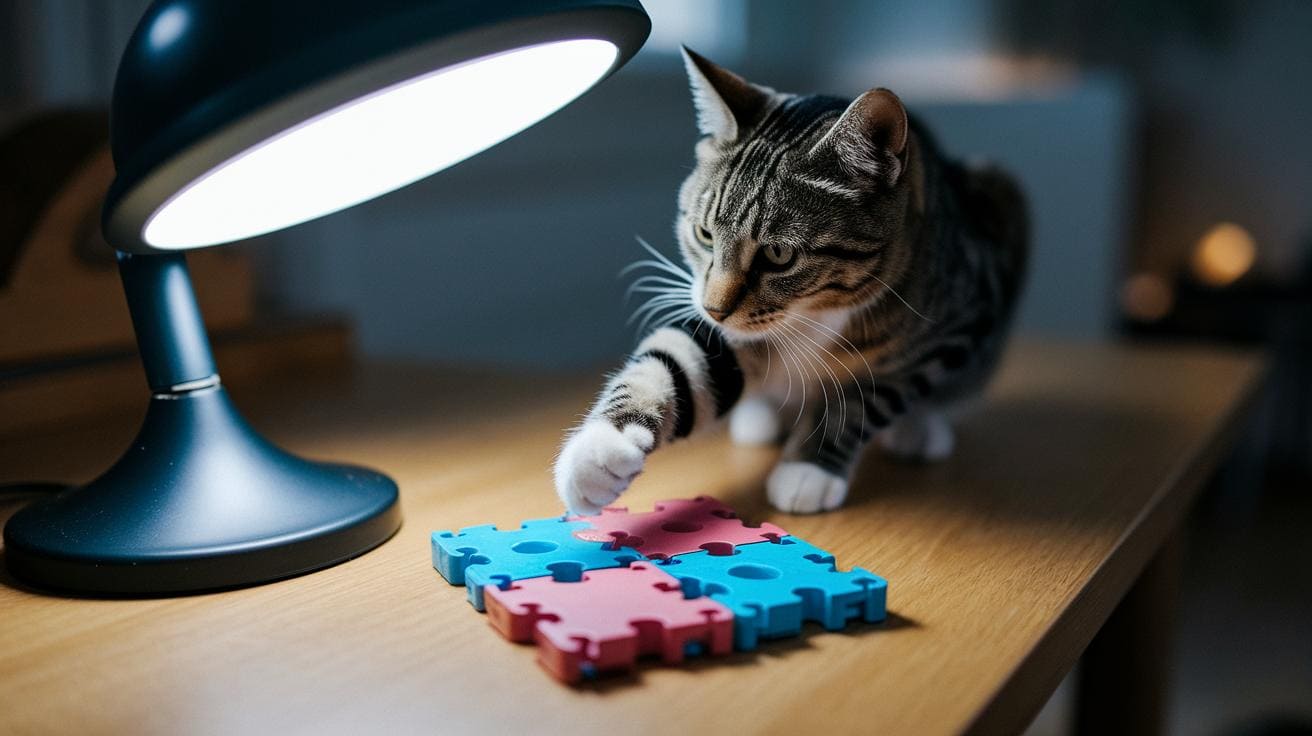
Cats come with built-in super-senses that help them hunt, play, and pick a favorite spot on the sofa. Learn how they sense the world and you’ll choose better toys, lighting, and comfy napping places for your kitty.
Purring isn’t just a happy sound. Cats purr when they’re content, when they’re stressed, and sometimes while they’re healing. You can feel the gentle vibration under your hand. Some researchers say purr frequencies may even help bone and muscle repair (see Cornell Feline Health Center or AVMA).
Vision is a big deal for cats. They have lots of rods (light-sensitive cells) and a tapetum lucidum (a reflective eye layer that boosts night vision), so they see well in low light – about eight times dimmer than humans. They’re a bit nearsighted and can’t focus sharply on things closer than about one foot, so tiny toys waved too close can look blurry. Low-contrast toys disappear in dim rooms, so pick bold colors or toys that move, especially at dawn and dusk when your cat is most awake. Ever watched your cat’s whiskers twitch as a toy rolls across the carpet? That’s the good stuff.
Hearing is like a built-in radar. Cats hear up to about 64 kHz (that’s into the ultrasonic range) and can swivel their ears nearly 180 degrees to zero in on a sound. Toys that mimic high-pitched prey noises are irresistible. Also, give your cat quiet hiding spots and try to reduce loud household noise – sudden loud sounds can be really stressful.
Smell rules a lot of cat behavior. They have a vomeronasal or Jacobson’s organ (an extra scent detector in the roof of the mouth) that reads pheromones and tiny scent cues. That’s why they react so strongly to certain smells. Many cats dislike citrus, so stick to safe scents and even use pheromone products if your vet recommends them.
Taste is different from ours. Cats have about 473 taste buds and they don’t taste sweetness the way we do. That affects which treats and foods they prefer, so experiment with textures and savory flavors instead of sugary snacks.
Quick takeaways:
- Choose high-contrast, moving toys for low-light play.
- Hold toys out at arm’s length so your cat can focus.
- Provide quiet hideouts and cut down on loud noises.
- Use toys or sounds that mimic high-frequency prey.
- Avoid citrus scents and consider vet-approved pheromone aids.
For verification, consult Cornell Feline Health Center, ASPCA, or AVMA.
Worth every paw-print.
Cat Behavior Facts: Communication, Tail Language, and How to Respond

Cats talk to us with sounds, tail moves, ear and eye signals, and scent marks (tiny smells they leave to say "this is mine"). For more on how they sense the world and how they’re built, check Feline Senses Explained: Vision, Hearing, Smell, Taste, and Purring and Cat Anatomy Facts: Whiskers, Bones, Tongue, and Ear Muscles. Ever watched a whisker twitch? Yep, that’s part of the conversation.
- Slow blink , means trust and relaxation. Blink back slowly to reassure them. (Cornell Feline Health Center)
- Tail neutral or upright , a confident hello. Try a gentle pet near the base if kitty leans in. (RSPCA)
- Tail twitching , focused or playful energy. Redirect it with a wand toy for a quick burst of exercise. (AVMA)
- Tail puffed , signals fear or a defensive state. Give space and an easy path to retreat. (Cornell Feline Health Center)
- Tail tucked , shows stress or submission. Don’t pick them up; calmly remove whatever upset them. (RSPCA)
- Tail wrapped or draped over you , affection or relaxed trust. Stroke gently only if your cat invites it. (Cornell Feline Health Center)
- Ear rotation or flattening , could mean alertness or worry. Watch the whole body and back off if ears stay flat. (American Veterinary Society of Animal Behavior)
- Dilated pupils , can be excitement, low light, or fear. Look at the situation and stay calm. (Cornell Feline Health Center)
- Chirps and trills , attention-seeking or hunting chatter. Answer with play or a treat; see what do cat chirps mean for more. (Cornell)
- Kneading , comfort behavior that harks back to kittenhood. Offer a soft lap or plush for safe kneading. (RSPCA)
- Rubbing and marking , they’re leaving scent to bond or claim territory. Let them claim a spot or give a cuddle. (Cornell Feline Health Center)
- Hissing and growling , a clear warning. Stop approaching and give a clear escape route right away. (AVMA)
- Zoomies after using the litter box , a sudden burst of energy. Play later and watch for signs of discomfort. (Cornell Feline Health Center)
- Belly exposure , could mean full trust or an invite to play. Approach slowly and back off if the belly looks tense. (RSPCA)
If your cat freezes, ears flat and hissing, use a calm script: stop, step back, lower your voice, toss a treat toward a safe exit, then leave the room for a bit. Simple. For playful invites like chirps and a twitching tail, try two minutes of wand play, a quick treat, then a calm cool-down to reward good interaction. I once watched Luna leap six feet for a feather on a string – pure joy.
Quick enrichment and training ideas: two short play sessions a day, puzzle feeders to encourage foraging, tall perches for vertical space, and sturdy scratching posts near favorite furniture. Routine play plus predictable feeding lowers stress, cuts down on unwanted marking, and turns zoomies into fun instead of chaos.
- Do offer high-value play sessions at dawn or dusk when cats are most active.
- Do provide vertical space and sturdy scratching options.
- Do respond calmly to hisses and flattened ears.
- Don’t grab a struggling cat.
- Don’t punish reactive behaviors – it just makes fear worse.
- Don’t cut whiskers or force belly exposure.
Worth every paw-print.