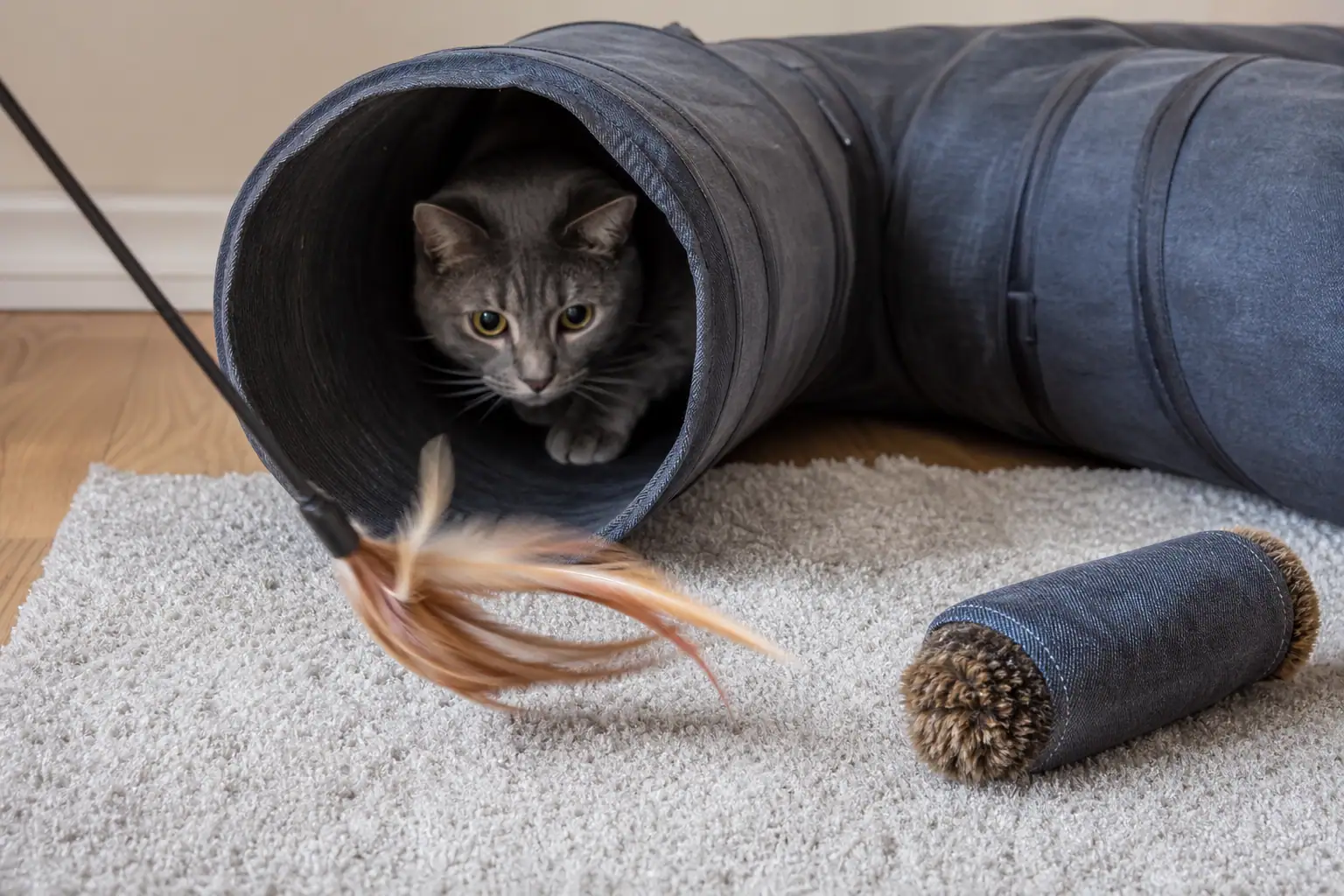
A feather wand cat toy is one of the best tools for giving an indoor cat a real chase. The wand keeps your hands away from teeth and claws, the feather lure moves like prey, and you can control the speed, distance, hiding places, and final catch. For cats that shred ordinary toys, that control matters as much as the toy itself.
The safest feather wand is not the flashiest one. Look for a comfortable wand, a cord that is not fraying, a secure lure attachment, feathers that do not shed sharp quills or loose pieces, and a design you can inspect after every rough session. Use feather wands for supervised play, then put them away. Strings, clips, feathers, and elastic cords are not good leave-out toys.
What a Feather Wand Cat Toy Does Well
Feather wands work because they let you imitate parts of the hunting sequence: hiding, watching, stalking, chasing, pouncing, catching, biting, and raking. That is why many cats ignore a feather dragged in a straight line but explode with interest when it disappears behind a chair leg, pauses under a paper bag edge, or flutters just out of reach.
The AAFP and ISFM feline environmental needs guidelines describe play as a way for cats to express predatory behavior, including stalking, chasing, pouncing, and biting. A wand toy is useful because it lets the owner create that sequence without inviting the cat to hunt hands or feet.
For Titan Claws readers, the main benefit is controlled intensity. A hard-playing cat can sprint, jump, and catch the lure while you keep fragile parts off the floor between sessions. That is different from leaving a feather toy out all day, where the same cat may chew the feathers apart, swallow thread, or work a clip loose.
What Current Product Pages Often Miss
The search results for feather wand cat toy are mostly product pages, marketplace grids, and best-of roundups. They are useful for seeing options, but many skip the owner decisions that prevent problems: how long sessions should be, how to let the cat catch the lure, what to inspect, and when feather toys are a poor match for a destructive chewer.
A good feather wand is a routine, not just an object. You need a chase toy, a way to end the chase, a storage habit, and a replacement plan. If a ranking page only tells you that a lure spins, chirps, sparkles, or includes extra attachments, it has not answered the safety question for a cat that plays hard.
Titan Claws already covers adjacent decisions in Cat Toy on Stick: How to Choose and Use Wand Toys Safely and Cat Feather Toys: How to Choose and Use Them Safely. This guide narrows in on feather wands: the handle, cord, lure, play pattern, and inspection points that matter most.
How to Choose a Better Feather Wand
Start with your cat’s play style. A gentle chaser can use a light feather teaser. A jumper needs more wand length so the lure can move without your hand entering the landing zone. A cat that grabs and bites needs sturdier attachments, shorter supervised sessions, and a separate capture toy for the finish.
- Wand length: choose enough reach to keep hands and arms away from the pounce zone. Very short teasers are harder to use safely with intense cats.
- Handle and shaft: look for a wand that flexes without splintering, cracking, or whipping unpredictably.
- Cord: avoid frayed string, thin elastic that snaps back sharply, or cord long enough to wrap around a cat during chaotic play.
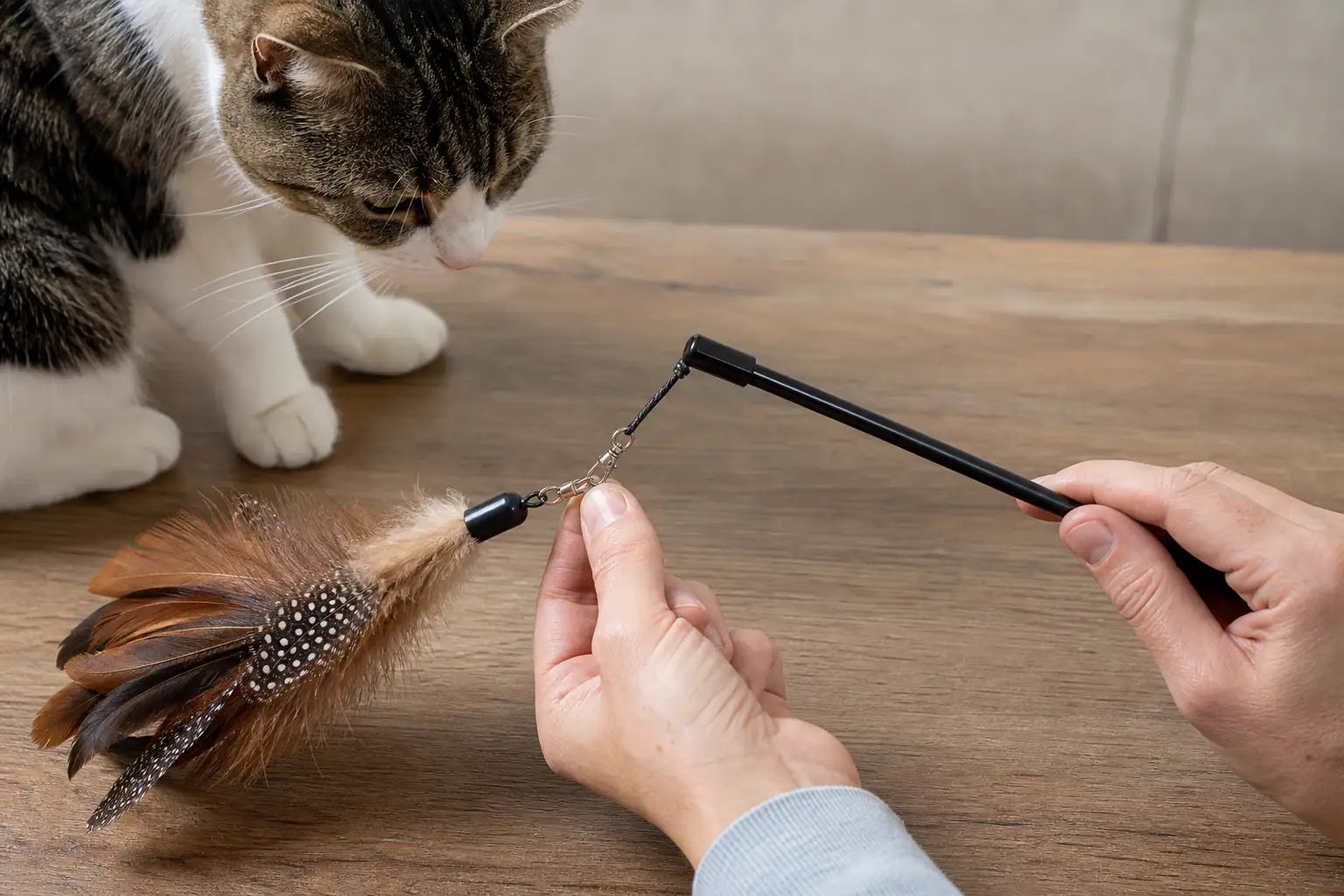
- Attachment point: inspect swivels, clips, knots, crimps, and glue points. A removable lure is convenient only if the connector stays secure.
- Feathers: skip lures that shed pieces before play even starts. Feathers should be firmly bound and easy to replace once damaged.
- Noise parts: bells and crinkle details can add interest, but they are also small parts. Chewers need stricter supervision and faster retirement.
Do not buy based on the number of replacement attachments alone. A bulk pack of weak lures can be worse than one sturdier wand paired with a safer end-of-play toy.
Are Feather Wands Safe for Cats?
Feather wands can be safe when they are used as supervised interactive toys. They become risky when cats are left alone with string, elastic, wire, clips, bells, feathers, or small lure parts that can be chewed off and swallowed.
Cornell Feline Health Center advises avoiding toys with small pieces or strand-like parts that can separate and be swallowed. VCA Animal Hospitals also warns that wand or fishing-pole toys should not be left with cats unattended because string can tangle or be ingested.
Use extra caution if your cat has a history of eating non-food objects, pulling stuffing, chewing cords, or swallowing fabric. Those cats may still enjoy feather wand play, but the wand belongs in your hands during the session and in a closed drawer afterward.