Field Note

Electronic Cat Toys: A Safety-First Guide to Smarter Play

Choose electronic cat toys by motion, safety, durability, and play style. Compare types, inspect failure points, and build better sessions at home.

Electronic cat toys can add useful movement and variety to an indoor cat’s day, but the best one is not automatically the fastest, smartest, or most expensive. Choose a toy whose motion matches how your cat already likes to hunt, whose motor and batteries stay inaccessible, and whose attachments can survive your cat’s actual bite-and-kick style. Use it in short sessions, let your cat catch something physical, and inspect it every time rough play changes its shape.

For many cats, a covered-motion toy, an oversized rolling toy, or a motion-activated kicker is a better starting point than an automatic laser. Electronic play should supplement wand play, food puzzles, climbing, scratching, and time with you—not replace them. If your cat dismantles plush, gnaws plastic, or carries toys away, treat every motorized toy as supervised-only until repeated testing proves otherwise.

This guide compares the main types of electronic cat toys, shows you where each can fail, and gives you a practical routine for using one without leaving it running all day.

Electronic cat toys at a glance

Start with the game your cat enjoys, then evaluate the mechanism. A shy stalker and a cat that launches into full-speed tackles should not be given the same motion pattern simply because both toys say “interactive” on the box.

Electronic toy type Often suits Check before buying Default use
Covered-motion or peekaboo toy Stalkers that watch, wait, and swat Paw openings, reachable drive parts, replaceable lure, stable base Supervised until tested
Rolling ball or mouse Ground chasers that like short sprints Size, casing seams, wheel gaps, collision shutoff, cleanability Clear-room supervision
Motion-activated kicker or flopping plush Cats that grab, bite, and rabbit-kick Reinforced cover, protected switch, fully enclosed removable module Supervised, especially for chewers
Rotating wand or lure Cats that chase circular or erratic movement Detachable feathers, string, exposed wire, pinch points, tip-over risk Active supervision only
Remote-control or app-driven toy Cats that enjoy responsive, changing routes Secure wheels, small accessories, privacy needs, charging design Owner-controlled play
Automatic laser Visually motivated cats that chase light Laser classification, beam path, reflections, physical catch plan Supervised and brief

If your priority is movement rather than electronics, our guide to cat toys that move also covers tracks, tunnels, rolling toys, and owner-driven options with fewer mechanical parts.
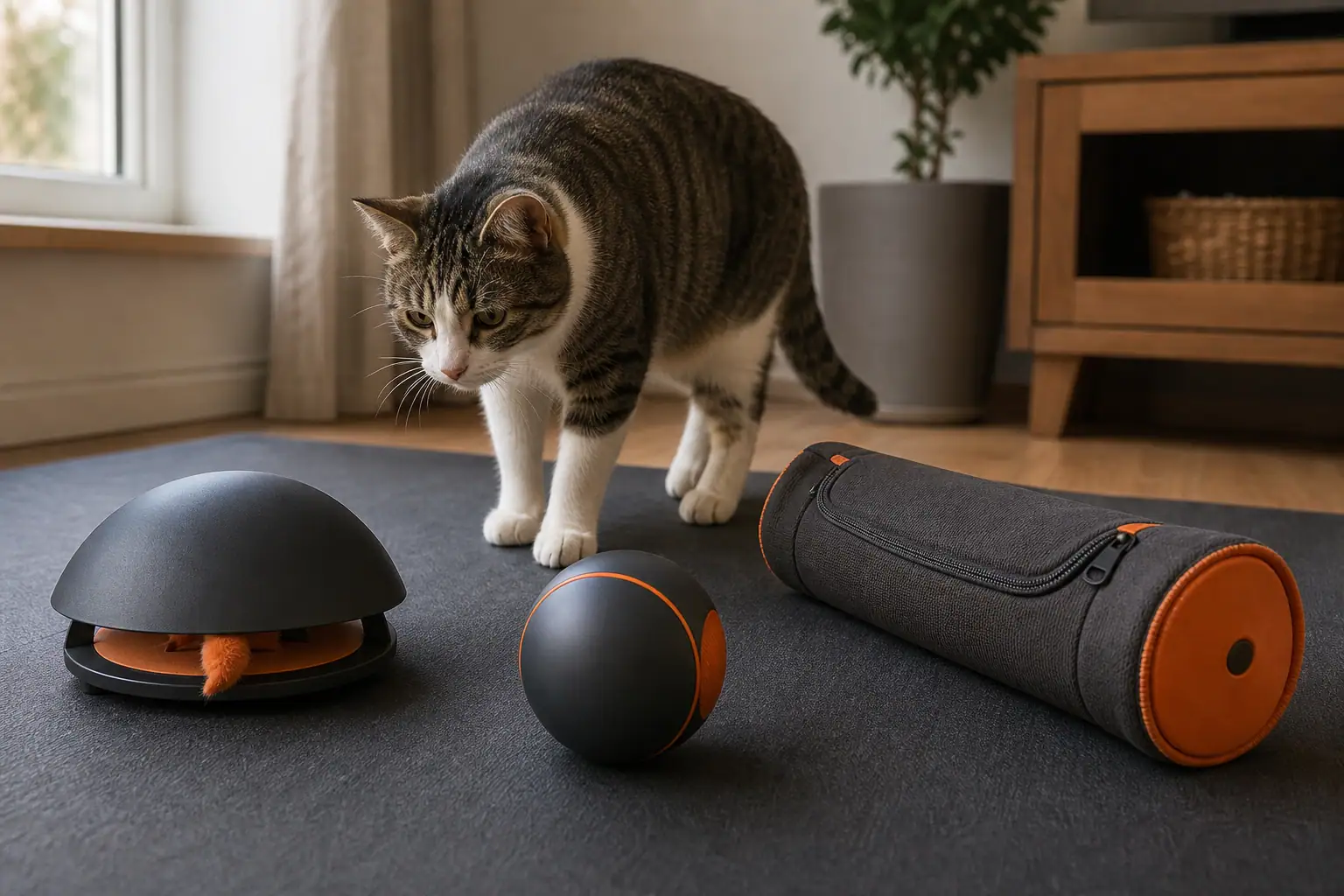
Cat comparing covered motion, rolling ball, and rechargeable kicker toys
Covered motion, rolling, and wrestle-style electronic toys create different games—and different risks.

Are electronic cat toys good for cats?

They can be. The benefit comes from what the toy allows the cat to do: locate, stalk, chase, pounce, catch, and manipulate a prey-like target. The Feline Veterinary Medical Association’s environmental-needs guidance recommends opportunities for play and predatory behavior, says cats should be allowed to capture the “prey” intermittently, and advises toy rotation to reduce boredom.

An electronic toy can create irregular movement when you are making dinner or joining a call. It cannot notice a subtle stress signal as well as you can, change the game with the same flexibility as a wand in your hand, or provide the social contact of playing together. Think of it as one instrument in the enrichment kit.

Signs of a useful session include watching with a loose body, stalking, short chases, pouncing, carrying an appropriate attachment, and choosing to re-engage after a pause. More speed is not always better. A kitten may chase quick direction changes; an older cat may prefer slow movement that disappears and returns. A cautious cat may need several sessions with the switched-off toy before the motor sound feels ordinary.

End the session if your cat repeatedly retreats, crouches tightly without advancing, flattens the ears, lashes the tail, attacks another animal, or becomes fixated on biting the housing rather than playing with the target. Turn the toy off, give space, and try a quieter or simpler game later.

Match the motion to your cat’s hunting style

For the watcher: covered and peekaboo movement

A fabric tail or small target that appears from beneath a cover can reward patience. Look for a broad base that stays flat when struck and openings that do not let a paw reach gears or a rotating shaft. The lure should be replaceable without exposing the drive system. If your cat hooks the entire attachment out in the first session, the toy is not a leave-out option.

For the sprinter: rolling toys

Choose a rolling toy larger than your cat can swallow, with a smooth intact casing and no detachable tail, cap, bell, or decorative ears. Test it in one closed room away from stairs, water bowls, breakable objects, floor vents, and gaps beneath appliances. Watch whether it stops when pinned or keeps driving against the cat’s body. A collision sensor is helpful only if it works on your actual flooring.

For the wrestler: electronic kickers

A flopping plush can give a cat something physical to grab, but its cover becomes the first line of defense around a hard internal module. Inspect the zipper or hook-and-loop flap, the seams over the motor, and every fin, tail, or glued decoration. Remove the module before washing if the instructions allow it, and never return it to the cover while either part is damp.

For the social hunter: remote-control toys

Remote control can be more useful than a fixed automatic pattern because you can make the toy flee, pause, hide, and finally be caught. Keep the charging cable stored. If the device has a camera, microphone, cloud account, or app, review its permissions, update policy, and privacy settings before placing it in your home. A “smart” toy should still work as a safe physical object when the app is closed.

For the light chaser: lasers need stricter rules

Never aim a laser at a cat, person, or reflective surface. The FDA’s laser-toy guidance warns that direct beams and reflections can injure eyes and recommends looking for an IEC Class 1 label on laser toys. Avoid products with missing power or classification information.

A light dot also cannot be caught. If you use one, keep the beam on the floor away from eyes and mirrors, run a short chase, then guide the dot to a real kicker, fabric lure, or small food reward and switch it off. For a deeper laser-specific decision guide, read are laser toys bad for cats?
Free Checklist

Free checklist: 30 ways to enrich your indoor cat's life.

Practical, printable, no fluff. Get the complete Indoor Cat Enrichment Checklist delivered to your inbox.

The electronic-toy safety inspection

Inspect a new electronic toy before charging it or adding batteries, again after the first session, and before every session with a rough player. Cornell’s cat-toy guidance advises avoiding small parts, feathers, string, and accessible electrical cords that can be separated and swallowed or chewed.

A 60-second pre-play check

  1. Switch off: inspect the toy while it cannot start unexpectedly.
  2. Try the battery door: it should not slide, flex open, or release when clawed. Tighten its screw with the correct tool; do not rely on tape as the primary closure.
  3. Press the casing: stop if plastic is cracked, whitened from stress, separated at a seam, unusually hot, swollen, or giving off an odd odor.
  4. Probe the moving area: use your fingers—not your cat’s paw—to identify exposed gears, sharp edges, wire ends, wheel gaps, or pinch points.
  5. Pull the attachment: apply light pressure to fabric tabs, feathers, elastic, tails, and connector pieces. If one loosens by hand, remove or retire it before play.
  6. Check the size: the complete toy and any part that could detach must be too large for your cat to swallow.
  7. Clear the route: remove cords, drinks, fragile items, and obstacles that could fall. Block stairs and appliance gaps.
  8. Watch one cycle: confirm the timer, collision response, speed control, and off switch work before your cat joins.

Pay special attention to coin or button batteries in a toy or remote. The U.S. Consumer Product Safety Commission advises checking for a secure closure that requires a tool, and replacing or disposing of products with damaged battery compartments. Keep loose and spent batteries completely inaccessible. If a battery is missing or you think your cat bit or swallowed one, stop searching the internet for home remedies and contact a veterinarian or emergency veterinary service immediately.

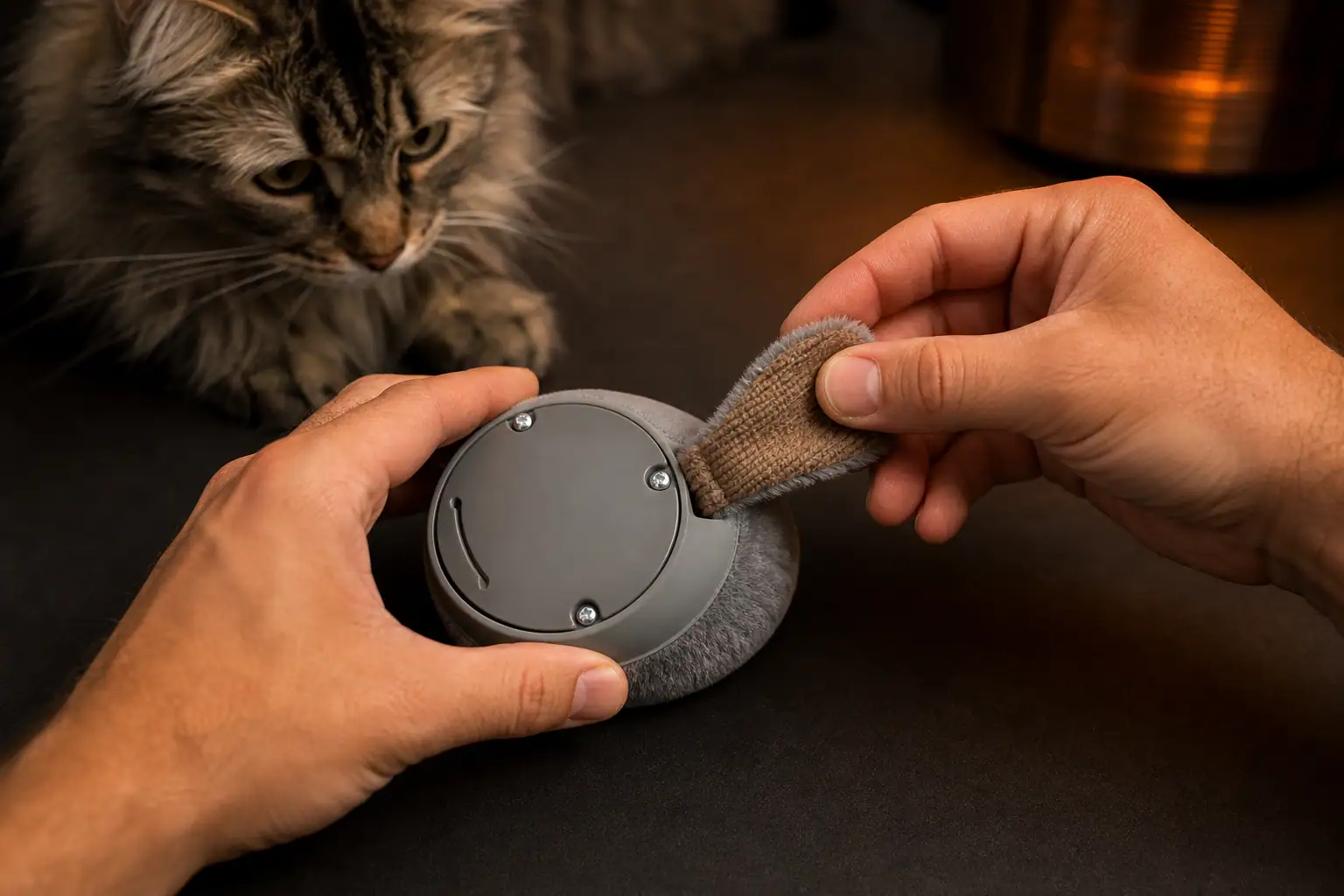
Hands checking an electronic cat toy battery door, casing, and fabric attachment
A secure battery door and intact housing matter more than a long feature list.

Durability rules for cats that destroy ordinary toys

No electronic cat toy is indestructible. Electronics add seams, switches, charging ports, wheels, access panels, and moving joints—the exact features a determined cat may pry, crush, or chew. Durability is a continuing match between one toy and one cat, not a permanent promise printed on a package.

Identify your cat’s failure pattern before you shop:

  • Plush skinner: choose a removable, washable cover with simple contours, reinforced seams, and no glued face or thin tail. Supervise every session.
  • Plastic gnawer: avoid thin shells and raised switches. Look for a smooth housing, recessed control, and no accessible charging port during play.
  • Attachment puller: skip feathers, elastic, exposed string, and snap-on tails. A covered target or replaceable wide fabric lure may last longer.
  • Crusher and kicker: choose a low stable base or a large capture toy. Retire any unit that rattles differently after a hard tackle.
  • Carrier and hider: use a toy too large to wedge behind appliances, carry up stairs, or drop into water. Do not leave remote-controlled devices where they can disappear under furniture while running.

For material, seam, and sizing checks beyond electronics, use our durable cat toys guide. If the motorized toy provides the chase but cannot safely take the final bite, pair it with a rugged fabric kicker that can serve as the catch.

A better 15-minute electronic play routine

Continuous access makes many toys predictable. A planned session preserves novelty and lets you see how the toy and cat affect each other.

  1. Set the room (2 minutes): close the door if needed, block hazards, inspect the toy, and put a physical catch toy nearby.
  2. Let the cat investigate (2 minutes): present the electronic toy switched off. Reward calm sniffing or approach; never place it against the cat.
  3. Run a slow cycle (3 minutes): start at the lowest useful speed. Allow watching and stalking instead of trying to provoke an immediate sprint.
  4. Add pauses and catches (5 minutes): stop the motion after short bursts. Let a catchable lure stay pinned, or switch attention to the kicker. Restart only if the cat chooses to engage.
  5. Finish clearly (1 minute): slow or stop the electronic movement after a successful catch. Offer a small food reward if it fits the cat’s diet.
  6. Inspect and store (2 minutes): check for heat, moisture, cracks, loosened fabric, and a changed motor sound. Store the toy and charging lead separately from the cat.

Fifteen minutes is a framework, not a target every cat must meet. Some cats prefer three active minutes; others return for several short rounds. In multi-cat homes, run individual sessions if one cat blocks access or becomes over-aroused. Rotate electronic play with a supervised cat wand toy, boxes, tunnels, food puzzles, climbing, and quiet scent exploration.

Free Enrichment PDF

Want the full enrichment checklist?

30 things you can do this week to make your indoor cat's life better. Free PDF, straight to your inbox.

Can you leave an automatic cat toy on while away?

Sometimes—but only after supervised testing, and never simply because the package uses the word “automatic.” A timer limits run time; it does not make loose attachments, exposed batteries, collisions, cords, or a determined chewer safe.

All seven should be true before unattended access

  • Your cat has used this exact toy in multiple supervised sessions without chewing the housing, prying at the battery door, or pulling off parts.
  • The toy has no string, elastic, wire, feather, small lure, or removable cap accessible during play.
  • The battery compartment requires a tool and the charging cable is removed and stored.
  • The casing is cool, intact, dry, and too large to swallow or wedge in a dangerous gap.
  • The toy stops on a short timer and does not repeatedly drive into a pinned paw, wall, stair edge, or water source.
  • The play room has been cleared of stairs, unstable objects, cords, other pets that create conflict, and spaces the toy can enter but the cat cannot safely exit.
  • You would still be comfortable leaving this toy out if the motor never turned on; its physical form is safe for your cat’s known play style.

If any answer is no—or if your cat shreds, swallows, or dismantles toys—store the electronic toy when you leave. A sturdy track toy, large plain ball, cardboard box without handles or staples, or appropriately designed food puzzle may be a safer independent option after its own testing. Our guide to automatic cat toys for when you are away expands this room-by-room decision.

When to retire the toy or call your veterinarian

Stop using the toy when a seam opens, an attachment loosens, the battery door no longer closes firmly, the casing cracks, the motor pitch changes, wheels or gears bind, the unit becomes hot, a rechargeable cell appears swollen, liquid enters the housing, or the toy behaves unpredictably. Follow the manufacturer’s instructions for battery disposal and electronic recycling. Do not hand a damaged electronic toy to another pet household.

Count the pieces before and after a rough session. If a battery, string, feather, plastic shard, fabric tab, foam, or internal component is missing, separate your cat from the area and contact your veterinarian promptly. Seek urgent veterinary advice for suspected battery ingestion, repeated vomiting or retching, drooling, pawing at the mouth, trouble swallowing, refusal to eat, marked lethargy, abdominal pain, breathing difficulty, burns, or a sudden eye problem after laser exposure.

A sudden loss of interest in play can also be a health signal rather than boredom with the gadget. Ask your veterinarian about a clear change in activity, movement, appetite, or behavior, especially in a senior cat or a cat with known joint, heart, vision, or neurologic disease.

Electronic cat toys: quick buying checklist

  • The motion matches how your cat already stalks, chases, or wrestles.
  • Your cat can catch a physical target during or at the end of the game.
  • The motor, gears, wheels, and moving joints cannot be reached by a paw or tooth.
  • The battery door requires a tool and stays rigid when pressed.
  • The charging lead is removable and can be stored out of reach.
  • The toy has no detachable decorations, exposed string, thin elastic, or tiny caps.
  • The complete toy is appropriately sized for your cat and stable under impact.
  • The speed, sound, timer, collision behavior, and off switch work as expected.
  • The cover or casing can be cleaned without wetting the electronics.
  • The manufacturer provides clear instructions, contact information, and battery or laser specifications where relevant.
  • You have a specific inspection and storage plan.
  • You are willing to use it only under supervision if your cat plays rough.

Do electronic cat toys replace playing with your cat?

No. They add motion and variety, but owner-led play is more adaptable and can strengthen your routine together. Keep electronic toys in a rotation with interactive chase, physical catch toys, food puzzles, scratching, climbing, and rest.

How long should an electronic cat toy run?

Start with a few minutes at low speed and watch your cat. Short, varied sessions with pauses and successful catches are usually more useful than leaving the same pattern running continuously. Stop while the cat is still comfortable, then inspect and store the toy.

Are rechargeable electronic cat toys safer than battery-powered toys?

Not automatically. Rechargeable toys avoid loose disposable batteries during ordinary use, but they add a charging port, cable, and internal cell. The port must remain intact, the cable must be stored, and any heat, swelling, odor, or casing distortion means the toy should be switched off and retired.

What is the best electronic cat toy for a rough player?

Usually one with a low stable body, enclosed mechanism, secure battery door, few attachments, and a replaceable wide fabric target—used under supervision. For a cat that attacks housings or opens seams, use the electronic device only to create a chase and offer a separate durable kicker for grabbing and biting.

Editorial note: This article provides general toy-selection and enrichment guidance. It does not replace advice from a veterinarian who knows your cat or emergency care after a suspected ingestion, burn, eye injury, or other accident.

Source: Electronic Cat Toys: A Safety-First Guide to Smarter Play