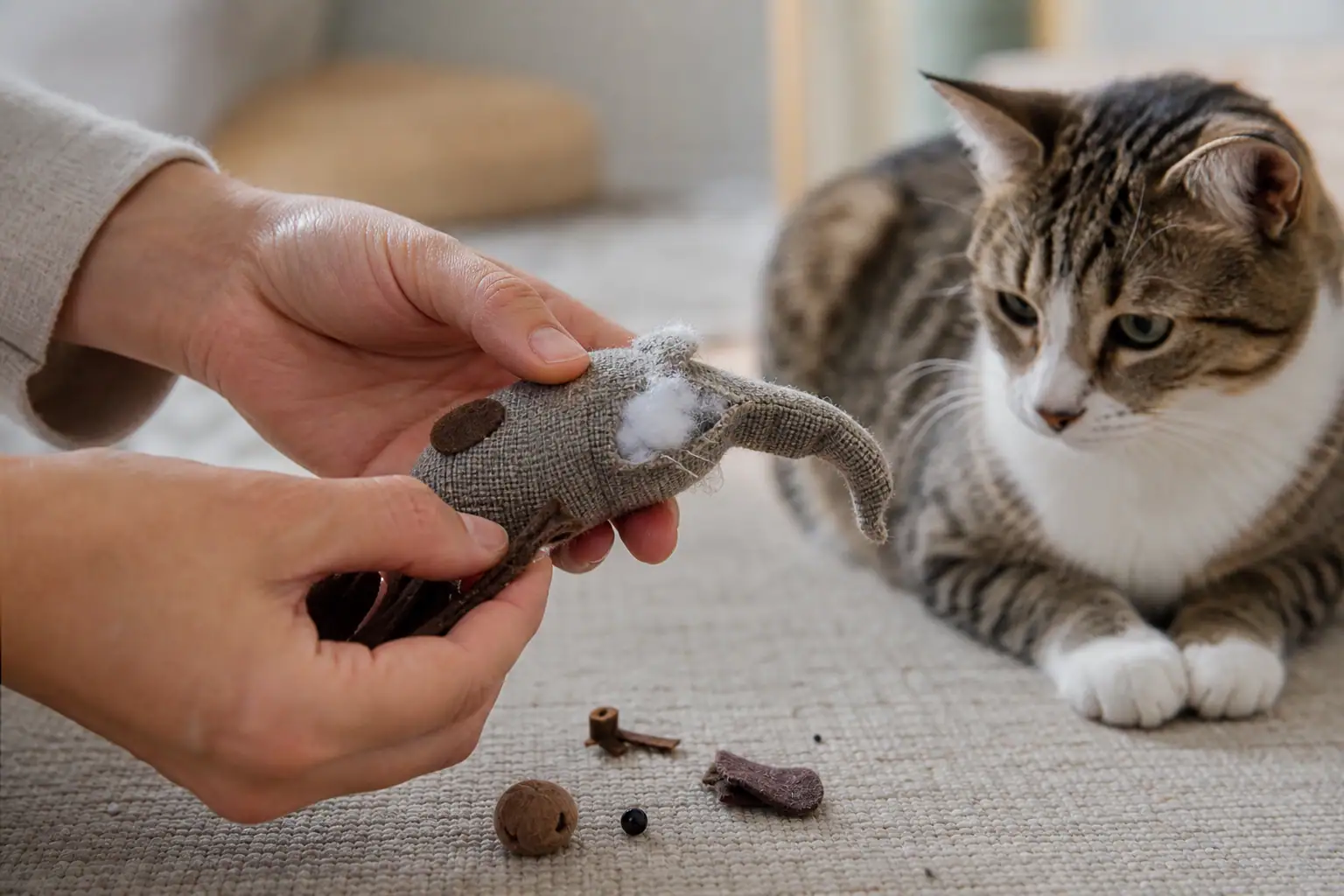
If your cat carries toys around and meows, the most likely explanation is that the toy has activated a prey-like play routine and your cat is vocalizing as part of the event. Your cat may be inviting you to notice or join, moving a valuable object to a preferred place, or repeating a routine that has earned attention before. In an otherwise relaxed, healthy cat, this is usually normal behavior.
There is no single translation for the meow, and the behavior does not prove that your cat thinks the toy is a kitten, is giving you a gift, or is trying to teach you to hunt. Those are appealing stories, but context is more reliable. Watch when the carrying happens, where the toy goes, what the cat does next, and whether anything else has changed.
Why Cats Carry Toys and Meow
Object play in adult cats closely resembles parts of predatory behavior. A cat may stalk a toy, pounce, bite, grab, kick, release it, and carry it to another location. Research on feline object play supports this connection: toy size, texture, novelty, and hunger can change how intensely cats interact with an object. Carrying is therefore not an odd extra step; it can fit naturally into a cat’s prey-handling sequence.
The meow is harder to interpret because cats can use vocalizations in different contexts. It may call your attention to the activity, express arousal during play, request another throw, or simply accompany a well-rehearsed trip through the house. Adult cats also use meows extensively in interactions with people, so your response can become part of the routine.
These explanations can overlap:
- Prey-like object play: your cat catches, carries, drops, and attacks the toy as if completing part of a hunt.
- A play invitation: the cat brings the toy to you, drops it nearby, watches you, or races after it when you toss it.
- Moving the catch: the cat takes the toy to a bed, hallway, food area, or other familiar spot before settling or resuming play.
- A learned attention routine: looking, talking, getting out of bed, or throwing the toy rewards the performance, so the cat repeats it.
- Self-directed excitement: some cats vocalize while aroused even when they do not appear to want help.
Sex alone does not explain it. Male and female cats, including neutered and spayed cats, can carry toys and vocalize. Parental-behavior theories are possible in some contexts, but they should not be treated as the default explanation when ordinary object play and learned interaction fit the evidence.
Use What Happens Next to Read the Behavior
Instead of trying to decode one sound, observe the full sequence. A short phone video can help you notice the destination, posture, and timing without interrupting.
- Drops the toy at your feet and waits: likely a social request. Try one short play session or toss the toy once and see whether the cat retrieves it.
- Carries it to a quiet room, then bites or kicks it: likely prey-like object play in a preferred play area.
- Brings it to bed at night: the activity may coincide with the cat’s normal evening energy and may also have become a reliable way to wake you.
- Places it near food or water: note the pattern, but do not assume the toy is being fed or cared for. The location may simply feel central or safe.
- Kneads beside or around the toy: the cat may be shifting from active play into a comfortable settling routine.
- Paces, hides, crouches tensely, or cannot settle: look beyond play and assess possible stress, pain, or environmental change.
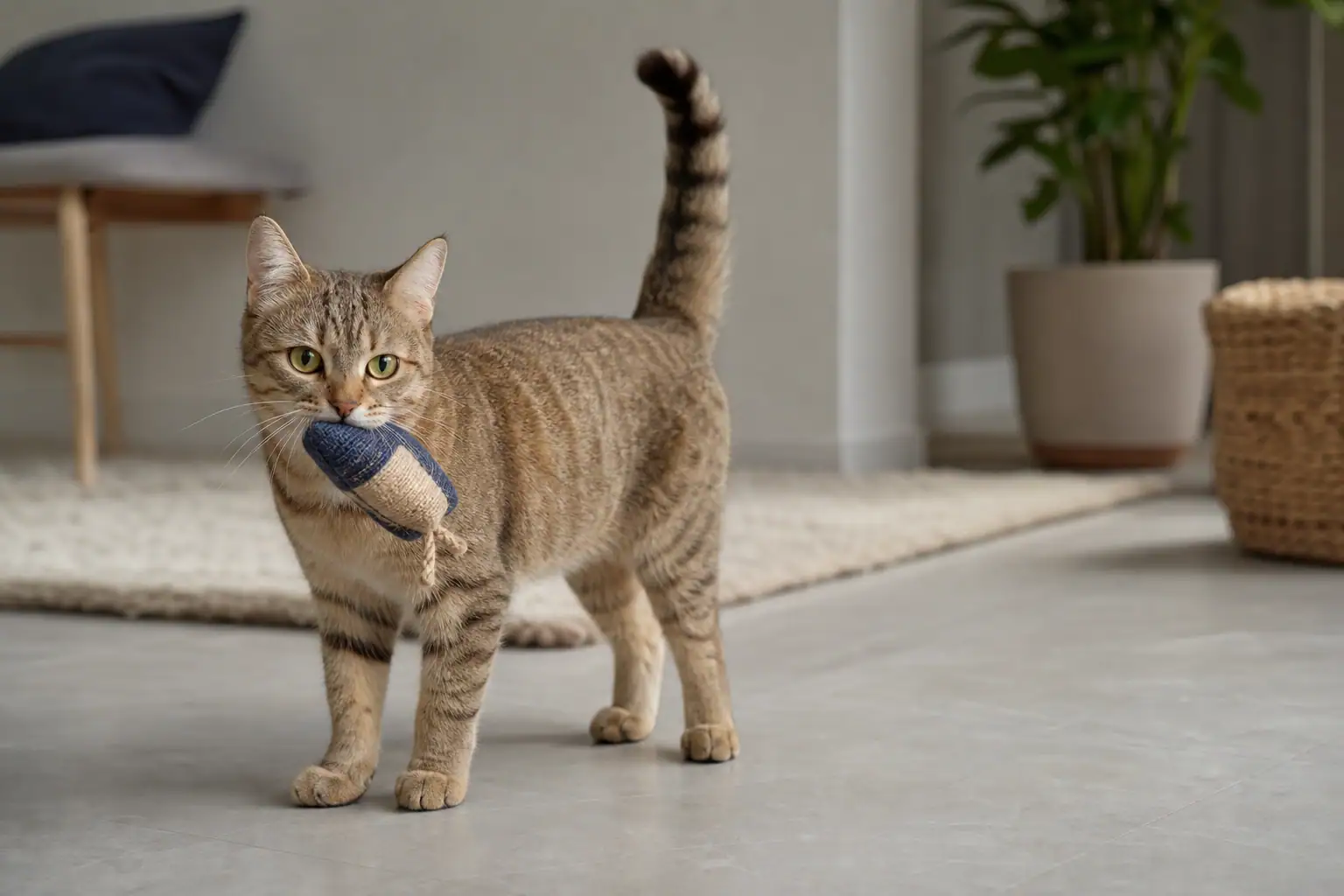
Body language matters. Loose movement, forward or neutral ears, an upright tail, normal appetite, and a quick return to play are reassuring. A hunched body, flattened ears, repeated hiding, disorientation, open-mouth breathing, or a distressed-sounding change from your cat’s usual voice deserves more attention.
Why It Often Happens at Night
Cats commonly become active around dawn and dusk, and a quiet house can make a toy-carrying performance seem dramatically louder. If your cat sleeps through much of the day, an evening burst of stalking and carrying may be the most interesting event available. Night meowing can also persist because it reliably makes a person speak, move, open a door, or throw the toy.
Try a predictable evening routine for one to two weeks:
- Schedule 10 to 15 minutes of interactive play before your bedtime.
- Move a wand or lure away from the cat with pauses for stalking.
- Let the cat make several real catches instead of ending with endless pursuit.
- Hand off to a sturdy carry or kicker toy for grabbing and biting.
- Finish with a small portion of the cat’s normal food, if that fits the feeding plan.
- Put string, ribbon, elastic, feather, and wand toys securely away.
For more ways to make that sequence satisfying, see Titan Claws’ guide to cat toys for hunting. If daytime boredom is fueling the midnight routine, build a broader plan with these cat enrichment activities.
Do not punish or frighten a cat for carrying a toy. If the behavior is harmless but wakes you, reward quiet play and daytime interaction rather than responding enthusiastically to every nighttime delivery. Make changes gradually, especially for a cat that depends on a stable routine.