
Indoor cat enrichment toys should do more than keep a cat busy for five minutes. The best choices let an indoor cat stalk, chase, pounce, grab, bite, kick, forage, climb, hide, or solve a small problem in a way that is safe for that cat’s body and play style. If your cat gets bored fast or destroys ordinary toys, the answer is usually not one expensive gadget. It is a small rotation of toys with clear jobs and clear safety rules.
For Titan Claws readers, the important distinction is simple: some toys are safe to leave out, some are for supervised play only, and some should be retired as soon as they show damage. This guide explains how to choose indoor cat enrichment toys for bored indoor cats, high-prey-drive cats, and rough players that chew, wrestle, or shred softer toys.
What Indoor Cat Enrichment Toys Are For
Enrichment means giving a cat appropriate ways to express natural behavior indoors. Cornell Feline Health Center describes toys as a way to encourage exercise and cognitive enrichment while letting cats stalk, pounce, and problem-solve. The AAFP and ISFM feline environmental needs guidelines go further: cats need opportunities for play and predatory behavior, including toys, owner interaction, and feeding practices that make the cat actively acquire food.
That does not mean every toy has to be complicated. A cardboard box, a ping pong ball, a food puzzle, a sturdy kicker, and a wand toy can all be enrichment tools when they are matched to the cat. The useful question is not “What is the best indoor cat toy?” It is “What behavior does this toy support, and is it safe for my cat’s level of intensity?”
The Main Types of Indoor Cat Enrichment Toys
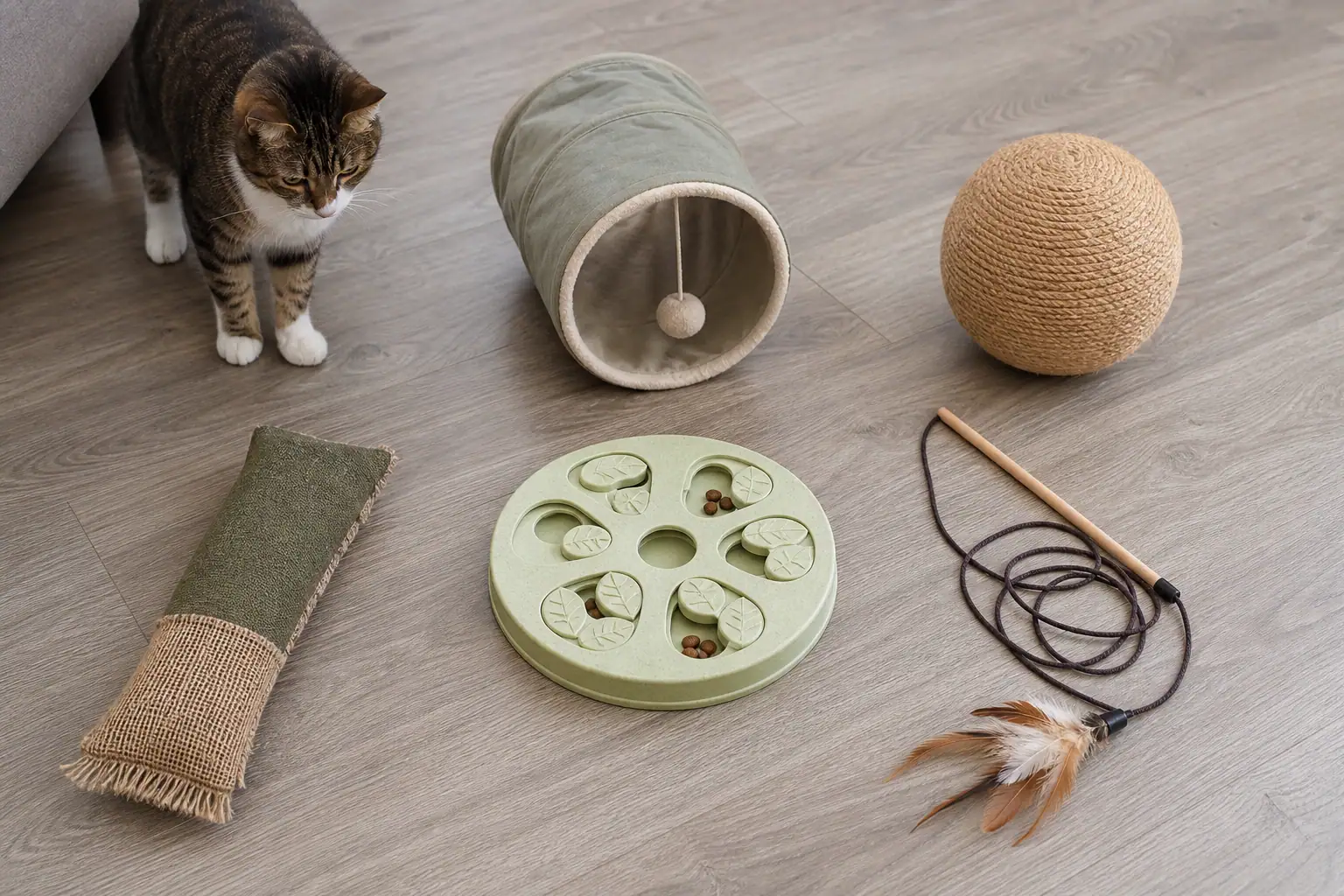
A balanced indoor setup usually includes toys from several categories. You do not need every option, but you do need enough variety that your cat can complete more of the hunting sequence instead of only staring at a toy that never gets caught.
Chase toys
Wands, teasers, skitter balls, springs, tunnels, and some automatic toys work because they move away from the cat. Move the target like prey: away, around a corner, behind a chair leg, under a tunnel edge, then pause. VCA recommends predatory games with toys the cat can eventually catch, which matters for intense cats that become frustrated by endless misses.
Most chase toys are supervised toys. Strings, elastic cords, feathers, clips, and ribbon tails should be put away after play. For a deeper comparison of this category, see Titan Claws’ guide to wand cat toys and the related guide to cat toys on sticks.
Catch and kick toys
Kicker toys give the cat something to grab with the front paws and rake with the back feet. They are especially useful for rough players, cats that redirect play onto hands, and cats that need a satisfying finish after a wand session. Choose a kicker long enough that your cat can hug it without your hand being in the bite zone.
For cats that destroy plush toys, skip tiny mice, glued eyes, thin tails, weak seams, and loose bells. Look for simple shapes, durable fabric, visible stitching, and enough size that the toy cannot be swallowed whole. Titan Claws’ cat kicker toy guide goes deeper on sizing and failure points.
Foraging and puzzle toys
Puzzle feeders, treat balls, snuffle-style mats, lick mats, scatter feeding, and hidden kibble trails turn part of a meal into work. Best Friends Animal Society notes that foraging toys can satisfy a cat’s instinct to search for food, and VCA describes puzzle feeders as enrichment and exercise for indoor cats.
Start easy. If a puzzle is too hard, the cat may walk away. Begin with a few pieces of kibble scattered on a rug, a towel fold, a toilet paper roll with safe openings, or a beginner puzzle with wide access points. Then increase difficulty only after your cat understands the game. Titan Claws’ puzzle cat toys article gives more detail on beginner, intermediate, and advanced options.
Solo batting toys
Large balls, track toys, plastic springs, crinkle balls, and sturdy rolling toys can help cats burn short bursts of energy without constant human input. The Ohio State Indoor Pet Initiative points out that cats are drawn to toys that squeak, chirp, jitter, swing, vibrate, roll, or otherwise act like moving prey.
For solo use, size and construction matter. Avoid brittle plastic, toys small enough to swallow, loose caps, exposed batteries, and anything your cat can chew into sharp pieces. If a toy is electronic, inspect the battery compartment and moving parts regularly.
Environmental toys
Boxes, tunnels, paper bags with handles removed, scratchers, perches, window views, and safe hiding spots make ordinary toys more interesting. A spring rolling past a tunnel opening is more engaging than the same spring sitting in the middle of the floor. Enrichment is often the relationship between the toy and the room, not just the object itself.
Match Toys to Your Cat’s Play Style
Before buying more indoor cat enrichment toys, watch two or three play sessions and write down what your cat actually does. The pattern will tell you what kind of enrichment is missing.
- The chaser runs after movement and may prefer wands, skitter toys, rolling balls, tunnels, and short hallway games.
- The ambusher hides, waits, and pounces. Add boxes, tunnels, rug edges, and toys that disappear behind furniture.
- The wrestler grabs and bunny-kicks. Use larger kickers and end chase games with a physical catch.
- The chewer attacks seams, tags, feathers, and stuffing. Choose simpler, tougher toys and inspect them after every session.
- The forager works for food. Use puzzle feeders, treat balls, scatter feeding, and hidden kibble searches.
- The watcher enjoys lower-impact enrichment. Try window perches, bird-safe window views, slow wand movement, gentle food puzzles, and scent novelty.
If your cat plays hard enough to ruin ordinary toys, pair this article with Titan Claws’ guides to durable cat toys, toys for cats that chew, and safe cat chew toys. The goal is durability plus inspection, not an impossible claim that any toy is indestructible.
