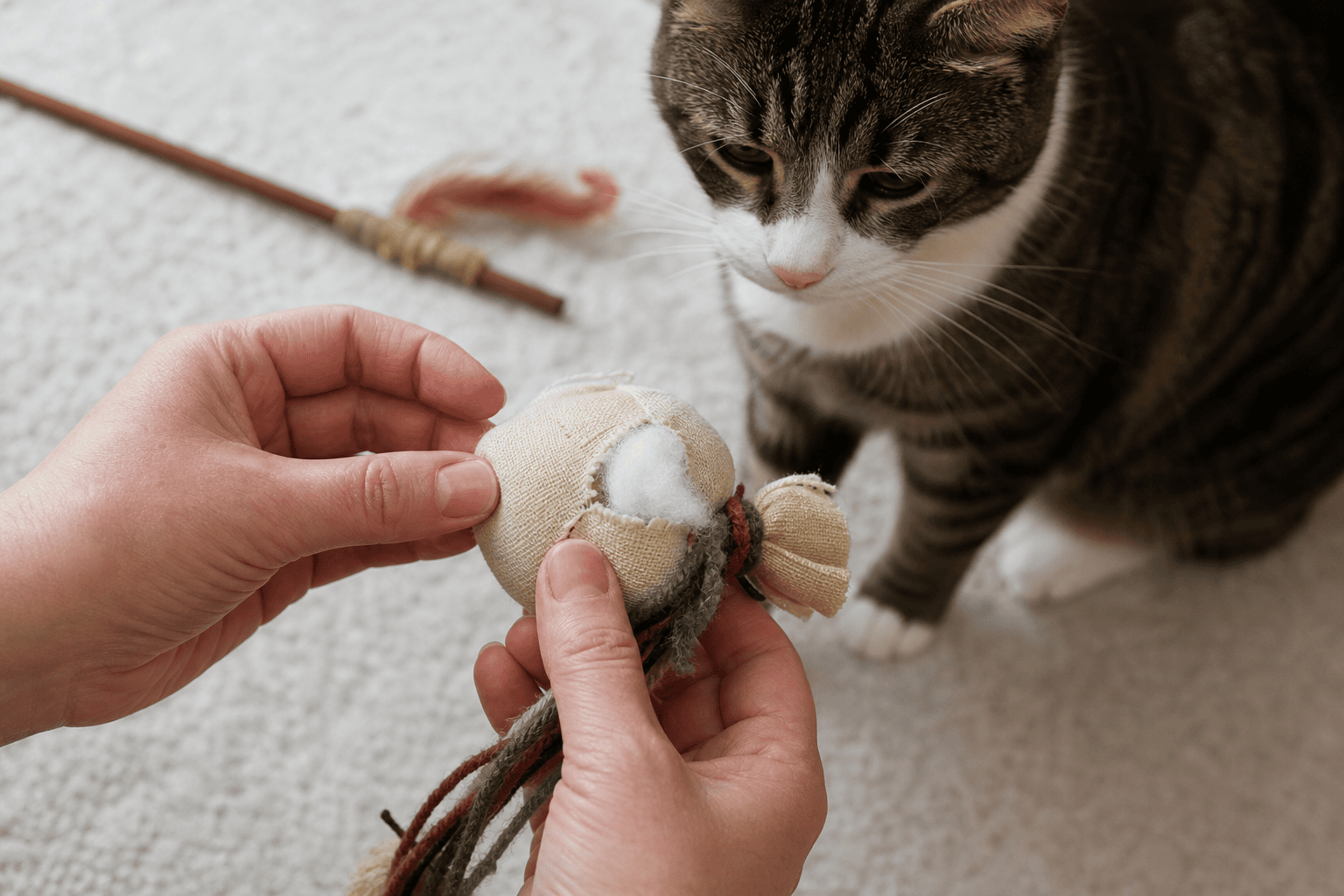
Homemade cat toys can be excellent for indoor cats when they are simple, supervised, and easy to inspect. The safest DIY options are usually cardboard puzzles, paper games, box mazes, fabric kickers, and wand-style games that you put away after play. The risky ones are toys with loose string, yarn, ribbon, rubber bands, beads, bells, glued eyes, staples, small plastic pieces, or stuffing your cat might eat.
If your cat plays rough, treat homemade toys as temporary enrichment rather than permanent equipment. Build them cheaply, use them intentionally, inspect them hard, and retire them early. A homemade toy does not need to survive forever. It needs to give your cat a safer outlet for stalking, chasing, pouncing, biting, kicking, and problem-solving without leaving swallowable parts behind.
What Homemade Cat Toys Are Best For
Homemade cat toys are best for variety. They let you test textures, sounds, hiding spots, food puzzles, and hunting games before buying a full toy setup. They are especially useful for cats that get bored with the same toy bin or ignore expensive gadgets but go wild for boxes, crinkly paper, and moving targets.
The strongest DIY toys usually solve one job at a time. A cardboard tube puzzle makes food harder to grab. A box tunnel creates ambush cover. A paper ball gives a lightweight chase target. A fabric kicker gives the back feet something to rake. A wand game lets you mimic prey movement. Trying to make one homemade toy do everything usually adds weak points.
The AAFP and ISFM feline environmental needs guidelines recommend giving cats opportunities for play and predatory behavior, including toys, owner-led play, and feeding devices that make the cat work for food. Homemade toys fit that well when they let the cat search, chase, catch, manipulate, and then settle down.
For a broader rotation, pair this guide with Titan Claws articles on DIY cat toys, best cat toys for bored indoor cats, and cat toys for enrichment.
The Safety Rule: Build for How Your Cat Breaks Things
Most homemade cat toy lists assume the cat will bat, chase, and walk away. Titan Claws readers often have a different cat: the one that bites seams, pulls feathers out, eats fuzz, shreds cardboard, or tries to carry the whole toy under the couch. For that cat, the right question is not, “Can I make this?” It is, “What happens when my cat damages it?”
- If your cat chews fabric: avoid loose stuffing, weak felt, thin yarn pom-poms, and glued decorations.
- If your cat eats string-like objects: skip yarn, ribbon, elastic, long tassels, dental floss, thread, and dangling cords.
- If your cat shreds cardboard: use cardboard only during supervised sessions and recycle it before pieces become snack-sized.
- If your cat cracks plastic: avoid plastic eggs, bottle caps, brittle containers, and small lids.
- If your cat carries toys away: make the toy larger than the cat can swallow and keep supervised-only toys in a closed drawer.
Cornell Feline Health Center warns that many household items can be hazardous to cats and advises prompt veterinary consultation when a cat may have ingested something toxic or dangerous. For homemade toys, use that same caution with non-food items. If you think your cat swallowed string, ribbon, stuffing, plastic, rubber, wire, a bell, or any toy part, call your veterinarian or an emergency clinic instead of waiting to see what happens.
Five Safer Homemade Cat Toys to Try
These ideas are intentionally plain. Plain is good. It means fewer tiny parts, fewer mystery materials, and fewer failure points.
1. Cardboard Tube Treat Puzzle
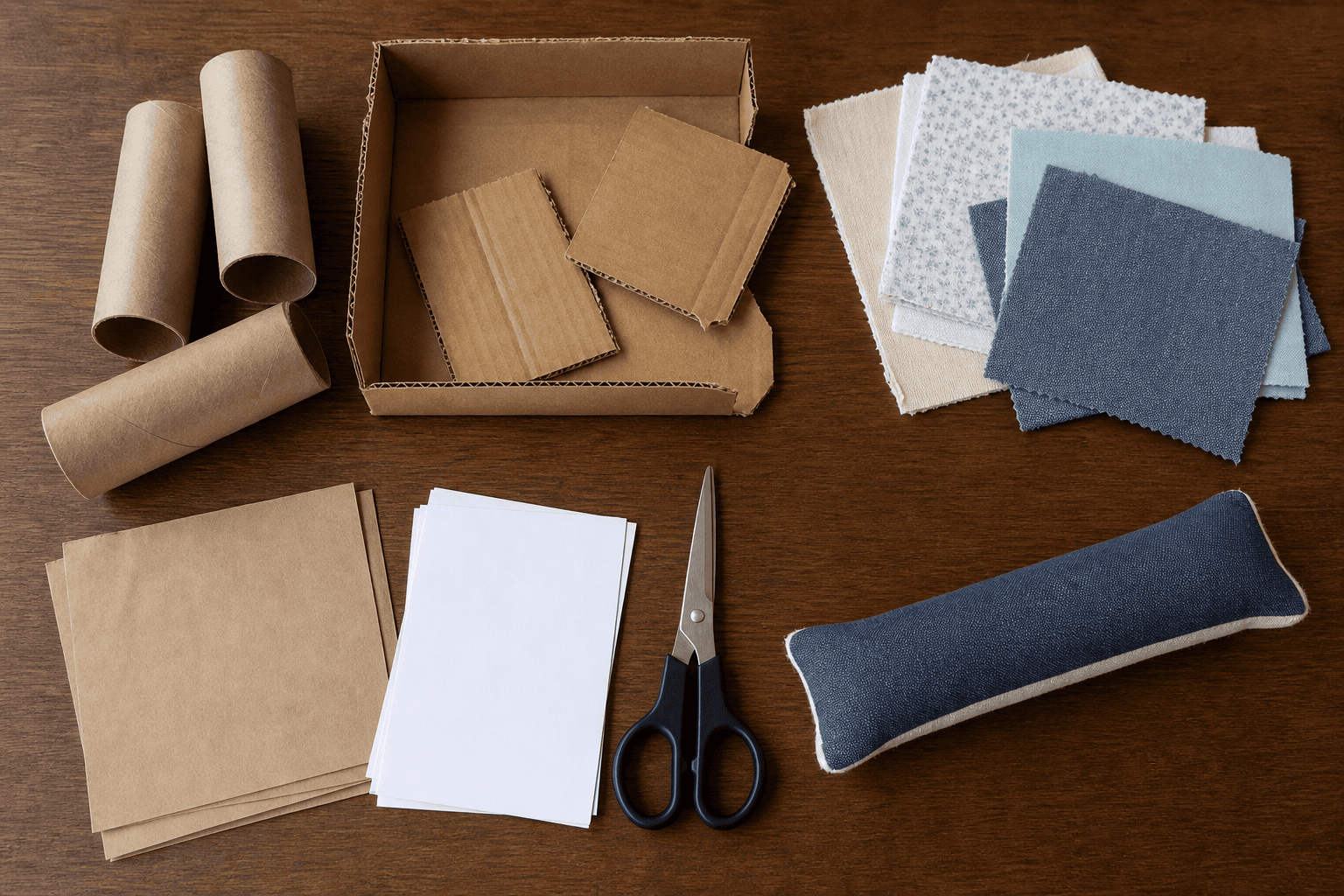
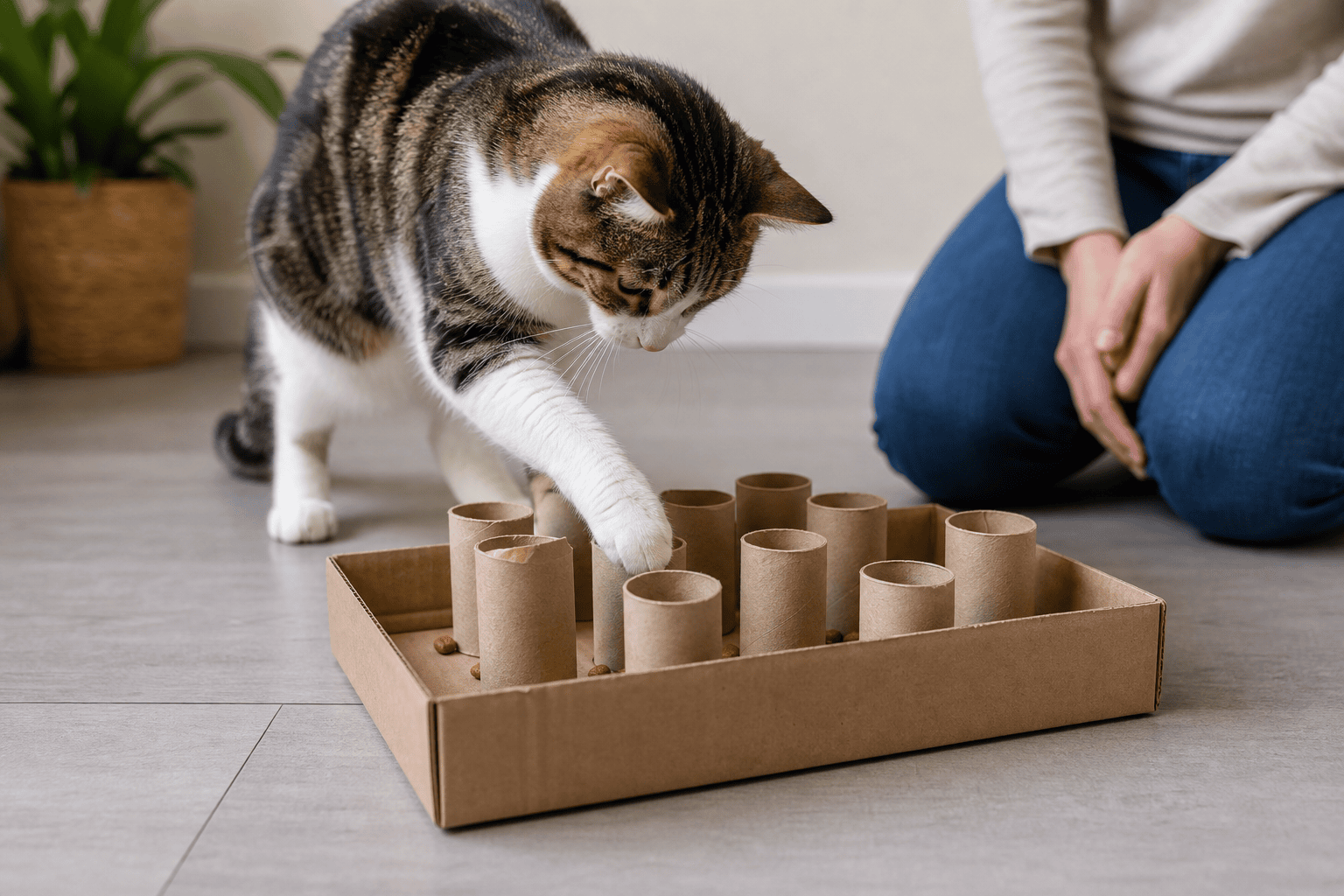
Set several empty toilet paper rolls upright inside a shallow cardboard box. Add a few pieces of kibble or treats into some of the tubes. Let your cat fish the food out with paws. Keep the puzzle shallow enough that the cat cannot get trapped, and remove tape, staples, plastic coating, and loose labels first.
This is a strong first homemade toy because it is cheap, easy to inspect, and close to the food-puzzle examples recommended by veterinary enrichment sources such as the ASPCA feline DIY enrichment guide and AAHA’s DIY enrichment toy guidance.
2. Paper Chase Ball
Crumple plain packing paper into a loose ball about golf-ball to tennis-ball size, depending on your cat. Toss it down a hallway or slide it behind a box so the cat can stalk and chase. Avoid foil, cellophane, gift ribbon, twist ties, and paper with heavy ink or glitter. Retire the ball when it gets wet, torn into small pieces, or chewed flat.
3. Box Ambush Tunnel
Cut two large doorways into a plain cardboard box so your cat can enter and exit without squeezing. Add a second box nearby or drape a towel over one edge to create a hiding spot. Use a wand toy outside the openings so the cat can pounce from cover. Do not use plastic bags, handled shopping bags, staples, or tight holes that could catch a collar or paw.
4. No-Frills Fabric Kicker
Roll clean, sturdy cotton fabric into a long shape and secure it with tight stitching if you sew, or with large, firm knots if you do not. Keep it long enough for your cat to hug and kick without reaching your hand. Skip buttons, beads, bells, glued eyes, loose yarn hair, and weak seams. If you add catnip or silvervine, seal it inside a durable inner layer and retire the toy when the closure loosens.
A homemade kicker is not automatically a durable toy. It is a test. If your cat opens seams quickly or eats fabric, move that cat to supervised-only play and read Titan Claws’ guides to cat kicker toys, toys for cats that chew, and safe cat chew toys.
5. Supervised Wand Game
You can make a simple wand game with a sturdy dowel and a short fabric strip, but this is supervised-only. Move the lure like prey: away from the cat, around corners, behind boxes, and across the floor. Let the cat catch it sometimes. When the session ends, put the entire wand away where the cat cannot chew the fabric or cord.
If your cat loves feather-style movement, Titan Claws has separate safety guidance on cat feather toys and the Da Bird cat toy, including why feather and string lures should not be left out for unsupervised chewing.